Generative AI Training in Hyderabad
with Real-Time Projects & Placement Assistance
Generative AI Masters offers live, instructor-led Generative AI training in Hyderabad, based at JNTU Metro Station, Kukatpally. The course covers LLMs, Prompt Engineering, RAG, LangChain, and Agentic AI over 3 months (60+ live class hours), taught by AI engineer Dinesh Tunguturi. Fees range from ₹35,000 (online) to ₹40,000 (offline classroom), with EMI options and placement assistance included. Batches run online, offline, and hybrid, with doubt support in English, Hindi, and Telugu.
⭐ 4.9/5 Google Rating · 👨🎓 400+ Students Trained · 🛠️ 15+ Real-World AI Projects
Last Updated: 27 Sep 2026 · Mr. Dinesh Tunguturi – Lead AI Trainer
📍 Training Center: JNTU, Hyderabad | Live Online & Classroom Batches Available
Book Your Free Demo Class
Attend a live demo session, explore the syllabus, and see how you'll build real-world AI projects.
✅ No spam. Free consultation included. By submitting, you agree that Generative AI Masters may call, WhatsApp or email you about this course. Read our Privacy Policy.
Batch DetailsCurriculumWhy ChooseModesTools CoveredSkills DevelopJobsPlacementTestimonialsFaqs
Generative AI Course in Hyderabad — Batch Details
Join our upcoming batch and learn how to build real-world Generative AI applications with guidance from an experienced AI engineer. Whether you choose online or classroom training, you’ll get the same trainer, same course content, and the same lifetime placement support.
Why Students Choose Generative AI Masters
✔ Classroom Training in Hyderabad✔ Online + Offline Batches✔ Real-Time AI Projects✔ Interview Preparation✔ Resume Building✔ Placement Assistance✔ Industry Expert Trainers✔ Course Completion Certification
Why Generative AI Masters is a Top Choice for Generative AI Training in Hyderabad
We focus only on Generative AI and provide in-depth training to help students build real-world skills. Unlike many institutes that include Generative AI as just one topic in a larger course, our entire program is dedicated to Generative AI. Here are 18 reasons why 400+ freshers, engineers, working professionals, and career changers have chosen our Generative AI Training in Hyderabad since 2024.
🎯Specialist focus, not a sub-moduleGenerative AI is the entire course, not lesson 17 of a general data-science syllabus. Every hour in class is GenAI — no padding with statistics revision, no detours into legacy ML algorithms you won’t use.
🧠Deep LLM curriculumWe cover the current GPT (GPT-6 Astra, GPT-5), Claude, Gemini and LLaMA models plus other open-weight models — including how they’re trained, how tokenisation works, context windows, hallucinations, system prompts and structured outputs.
🔗Production RAG, not toy demosYou’ll build retrieval-augmented generation pipelines using Pinecone, ChromaDB, Weaviate, FAISS and Qdrant — including hybrid search, re-ranking with Cohere, chunking strategies and evaluation with RAGAS.
⚙️Agentic AI & multi-agent systemsDedicated module on AI Agents using LangGraph, CrewAI, AutoGen and Microsoft Semantic Kernel. Tool calling, planner-executor patterns, multi-agent orchestration, and human-in-the-loop workflows.
🛠️Hands-on with the real stackOpenAI API, Anthropic API, LangChain, LlamaIndex, Hugging Face, Streamlit, Gradio, FastAPI, Docker, Pinecone, ChromaDB — all hands-on. Your laptop runs real code from week one.
🇮🇳Tri-lingual classroomDoubts cleared in English, Hindi or Telugu — whichever you’re fastest in. We’re one of the very few Generative AI institutes in Hyderabad that genuinely supports learners from non-English-medium backgrounds without compromising on technical depth.
👨🏫Trained by a practising AI engineerMr. Dinesh Tunguturi has worked in industry since 2016 — at Tata Motors, GA Digital and Virtusa, and now as Senior Data Scientist at Brolly Software Solutions building RAG and LLM applications — not just slides. You learn from someone whose week includes shipping real LLM apps, debugging RAG pipelines and tuning prompts for paying clients.
💻Project-led pedagogy15 hands-on projects across the course — including an AI chatbot, a document-QA RAG system, a multi-agent research assistant, a fine-tuned domain-specific LLM, and a deployed Streamlit app. Every project becomes portfolio evidence.
🎓No coding pre-requisiteModule 1 starts with Python from scratch for non-programmers. We’ve trained graduates from BCA, B.Sc, MBA, ECE, mechanical — not just computer science. If you can use a laptop and ask questions, you can finish.
📺Lifetime class recordings — Watch AnytimeEvery live session is recorded and added to your student portal — for life. Revise any module any time, even years after your course ends. No 90-day expiry tricks.
🔁Re-attend any batch freeIf you missed a module, want to refresh, or want to retake the entire course — re-attend any future batch at zero additional cost. This is one of our most-used features by working professionals.
💼Same trainer · same syllabus · online or offlineYour batch is taught live by Mr. Dinesh whether you attend on Zoom or in our classroom. No “junior trainer” downgrade for online students. Switch modes mid-course at no cost.
🤝1-on-1 mentor sessionsIndividual mentor calls for goal-setting, portfolio building, interview prep and salary negotiation. Not a group WhatsApp afterthought — a scheduled 30-minute call with the trainer.
🏛️2-minute walk from JNTU MetroJNTU campus at Pillar A689, JNTU Hyderabad Metro Station. Accessible from Ameerpet, HITEC City, Miyapur, Madhapur, Secunderabad — anywhere on the Miyapur–LB Nagar metro line. Free parking.
🌐Lifetime placement support✔ Resume Review
✔ LinkedIn Optimization
✔ HR Mock
✔ Technical Mock
✔ Referral Support
💰Honest pricing — ₹35K, no hidden upsells✔ EMI Available
✔ No Hidden Charges
✔ Lifetime Access
🚀Updated quarterly to current modelsOpenAI, Anthropic and Google ship major updates every quarter. We rebuild specific modules every 90 days so what you learn today is still relevant 12 months from now — not 2024 era ChatGPT screenshots.
💛Friendly, small-batch environmentMaximum 15 students per batch. Doubts cleared in class — never shamed. Students from non-CS and non-English-medium backgrounds thrive here. We’ve built a 400-strong community of working AI practitioners across Hyderabad.
What is Generative AI?
Generative AI is a branch of Artificial Intelligence that creates new content such as text, images, videos, audio, code, and documents. Unlike traditional AI, which mainly analyzes data or makes predictions, Generative AI generates original outputs using Large Language Models (LLMs) like ChatGPT, Claude, Gemini, and Llama. Today, it is widely used in healthcare, education, finance, software development, marketing, customer support, and many other industries.
Chat on WhatsApp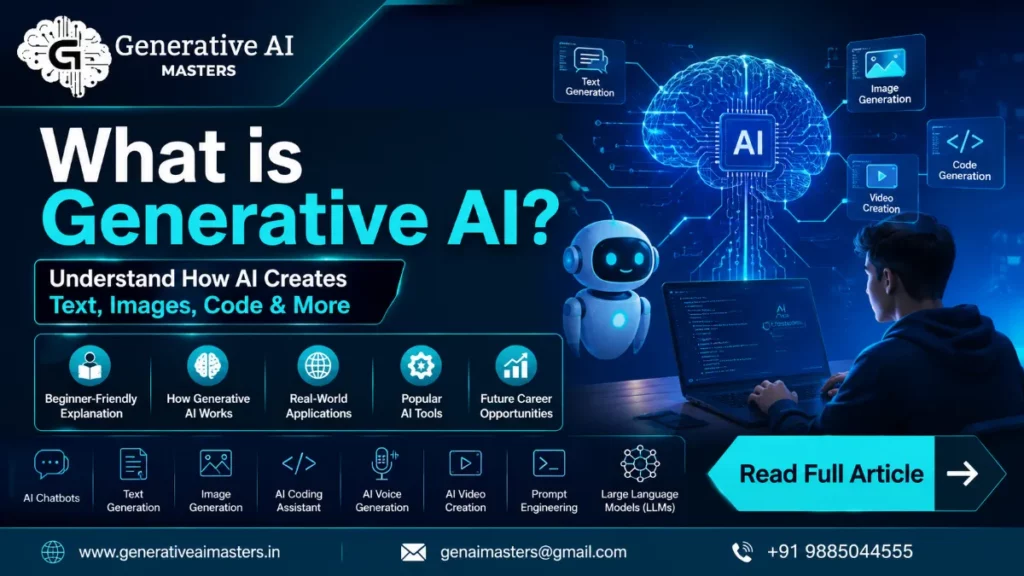
Where is Generative AI Used?
AI vs Generative AI vs Agentic AI — Comparison
PredictsTraditional AI / MLMachine-learning systems that predict or classify: spam filters, fraud detection, recommendation engines, demand forecasting. Trained on labelled or unlabelled data to produce a single numeric or categorical output.
• Output: a prediction
• Examples: Netflix recommendations, credit scoring
• Tech: scikit-learn, XGBoost, classical neural nets
• Typical role: Data Scientist, ML Engineer
GeneratesGenerative AI (what we teach)Systems that create new content — text, code, images, audio — by sampling from a learned probability distribution. Today’s GenAI is dominated by transformer-based LLMs and diffusion models.
• Output: novel content conditional on a prompt
• Examples: ChatGPT, Claude, Gemini, Stable Diffusion, Midjourney
• Tech: LLMs, LangChain, RAG, vector DBs, Hugging Face
• Typical role: GenAI Engineer, LLM Engineer, Prompt Engineer
ActsAgentic AI (advanced module)Generative AI systems that don’t just respond — they plan, use tools, take actions and chain steps autonomously. The 2026 frontier. We cover this in our Agentic AI module using LangGraph, CrewAI and AutoGen.
• Output: a completed multi-step task
• Examples: AutoGPT, Devin, Claude Computer Use, OpenAI Operator
• Tech: LangGraph, CrewAI, AutoGen, Semantic Kernel, MCP
• Typical role: AI Agent Engineer, Agentic Systems Architect
Sources: NASSCOM India Generative AI Startup Landscape 2025 · Stanford HAI AI Index 2026 · Wikipedia: Generative artificial intelligence
Generative AI Course Curriculum in Hyderabad
A practitioner-built Generative AI syllabus rebuilt every 90 days as OpenAI, Anthropic, Google and Hugging Face ship new models and APIs. Below is the full module-by-module breakdown — the same one we ship to every demo attendee in PDF form.
Phase 1 · Foundations of Python & AIModules 1–201 · Python for AI EngineersVariables, control flow, functions, OOP, list/dict comprehensions, generators, decorators, type hints, virtual environments, pip, Jupyter. We start from zero, no prior coding required. Numpy, Pandas and Matplotlib basics included.02 · AI, ML, Deep Learning & GenAI — the landscapeHow traditional ML differs from deep learning differs from Generative AI. Neural networks, backpropagation, gradient descent (intuitive, not just math). What a Transformer is and why it changed everything in 2017. Tokenisation, embeddings, attention.
Phase 2 · LLMs, Prompts & the OpenAI / Anthropic stackModules 3–403 · Large Language Models in depthGPT-6 Astra, GPT-5, Claude, Gemini, LLaMA, Mistral, DeepSeek and Qwen — the current version of each model family when your batch runs. Architectures, context windows (128K to 1M tokens), tool use, structured outputs, function calling, JSON mode, vision capabilities, model selection by task and cost.04 · Prompt Engineering — the marketable skillZero-shot, few-shot, chain-of-thought, ReAct, self-consistency, tree-of-thought. System prompts vs user prompts. Anthropic’s prompt caching. OpenAI’s prompting guide. Prompt templates with Jinja2. Evaluating prompts with Promptfoo. Real prompt engineering, not 10 ChatGPT tricks.
Phase 3 · RAG, Vector Databases & LangChainModules 5–705 · Retrieval-Augmented Generation (RAG)Why RAG beats fine-tuning for most enterprise use cases. Document loaders, text splitting strategies (recursive, semantic, agentic chunking), embeddings (OpenAI, Cohere, Voyage, BGE, E5), vector similarity search, hybrid search with BM25, re-ranking with Cohere or Jina, RAG evaluation with RAGAS & DeepEval.
• Build a RAG chatbot
• Use Pinecone & ChromaDB
• Create document search systems06 · Vector Databases & EmbeddingsHands-on with Pinecone, ChromaDB, Weaviate, Qdrant, FAISS, Milvus and pgvector. When to use which. Indexing strategies (HNSW, IVF, PQ), namespace design, metadata filtering, cost optimisation.07 · LangChain & LlamaIndexLCEL (LangChain Expression Language), Runnables, chains, retrievers, output parsers, callbacks, LangSmith for tracing. LlamaIndex for advanced indexing & data agents. When to use LangChain vs LlamaIndex vs raw SDK calls.
Phase 4 · Fine-tuning, Agents & Production DeploymentModules 8–908 · Fine-tuning & Open-Weight ModelsWhen to fine-tune vs prompt vs RAG. Hugging Face Transformers & PEFT. LoRA, QLoRA, full fine-tuning. Datasets, instruction tuning, DPO/ORPO basics. Running open models locally with Ollama and vLLM. Stable Diffusion & Midjourney for image generation.09 · AI Agents & Agentic AI WorkflowsLearn how AI agents can think, plan, make decisions, and perform tasks autonomously using Large Language Models (LLMs). This module covers AI agents, Agentic AI workflows, multi-agent systems, tool integration, memory, planning, and real-world automation projects using modern AI frameworks.
Want the full topic-by-topic syllabus?
Includes all 9 modules · 150+ topics · 15 project briefs · tool-by-tool curriculum mapping
View Full Curriculum →
Skills You'll Master Through Our Generative AI Training in Hyderabad
AI Tools Covered in This Generative AI Training in Hyderabad





Flexible Training Modes for Generative AI Classes in Hyderabad
Compare our online, classroom and hybrid options and Generative AI course fees in Hyderabad with certification, real-time projects, and placement support.
Who should join the Generative AI course in Hyderabad?
The course is structured to work for 8 distinct learner profiles. Mode, pace and depth adapt to where you are today.
💰Freshers & final-year studentsRecent graduates and final-year B.Tech/BCA/B.Sc/MCA/M.Sc students. Become a hireable Generative AI engineer in 3 months with a 15+ project portfolio.
💼Working software engineersAlready a developer? Add LLM, RAG and Agentic AI to your stack. Generative AI skills on your resume can strengthen your profile for higher-paying roles when you next switch jobs.
🔄Career switchers from non-AI rolesData analysts, QA engineers, support engineers, BAs — anyone with basic logical aptitude. We start with Python from zero in Module 1.
🚀Founders & business ownersWant to build AI products for your business or as a SaaS? You’ll learn to ship working LLM apps without an in-house ML team.
📚Data scientists & ML engineersAlready know classical ML? Move into the deepest, highest-paying part of the field. Skip the Python module if you’d like.
🏫Freelancers & consultantsAdd GenAI to your service menu. Prompt engineering, custom GPTs, RAG chatbots and AI agents are the highest-ticket freelance offerings in 2026.
🏫College students wanting a head-start2nd / 3rd year students join our Weekend Generative AI Class cohorts to graduate with portfolio evidence — and skip the “no experience” trap on campus interviews.
🏠Returning professionalsRestarting your career after a break? Our small-batch, doubt-friendly classroom and tri-lingual instruction make this the gentlest re-entry path into tech.
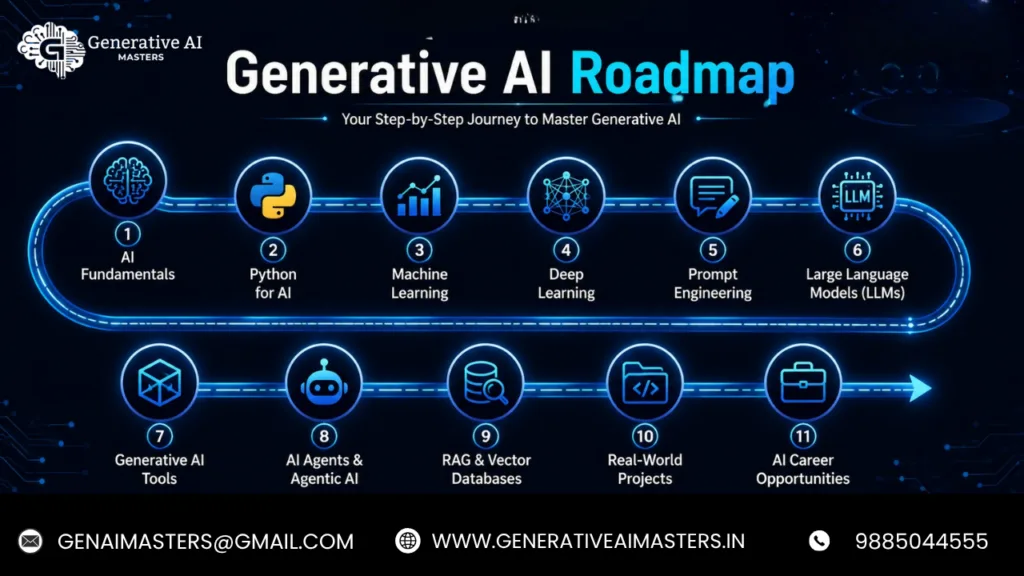
Step-by-Step Generative AI Training Roadmap
Our Generative AI Learning Path in Hyderabad is divided into 3 simple stages over 3 months. In each stage, you’ll learn new AI skills, explore powerful AI tools, and work on real-world projects. This practical approach helps you gain hands-on experience and become job-ready with confidence.
How to Choose the Best Generative AI Training in Hyderabad: 14-Point Checklist
Use this checklist to compare any Generative AI course in Hyderabad before you pay. Ask each institute to show evidence for every point — the syllabus, the trainer’s profile, sample student projects and placement records. The right-hand column lists what Generative AI Masters offers, so you can check it against other options.
Meet Your Generative AI Trainer – Mr. Dinesh Tunguturi
Learn directly from a practising data scientist who has worked in industry since 2016 and builds production LLM, RAG and agentic AI applications today.

Mr. Dinesh TunguturiLead AI Trainer, Generative AI Masters · Senior Data Scientist at Brolly Software Solutions (since 2024); previously Virtusa, GA Digital and Tata Motors. Studied at JNTUH College of Engineering Hyderabad.
Expertise
– Generative AI & Large Language Models (LLMs)
– Prompt Engineering & Advanced Prompt Design
– Retrieval-Augmented Generation (RAG)
– LangChain, LangGraph & LlamaIndex
– AI Agents, Agentic AI & Multi-Agent Systems
Courses Taught
– Generative AI Training in Hyderabad
– Prompt Engineering Course
– Agentic AI Course
Real-World Applications & Career Opportunities in Generative AI
Generative AI is transforming every industry. Here’s where your skills will be needed most — and what jobs await you.
🏥Healthcare & MedTechAI-assisted diagnosis, medical report summarization, drug discovery, patient communication chatbots, and clinical document analysis.
🏦Banking & Finance (BFSI)Fraud detection narratives, automated financial reports, AI-powered customer service, risk assessment, and compliance document generation.
🛒E-commerce & RetailProduct description generation, personalized recommendations, AI shopping assistants, visual search, and automated review analysis.
🎓EdTech & E-LearningPersonalized tutoring, automated quiz generation, course content creation, AI study assistants, and adaptive learning platforms.
🏗️IT & Software DevelopmentAI-assisted code generation (GitHub Copilot), automated testing, code review, documentation, and DevOps automation.
📢Marketing & AdvertisingAd copy generation, SEO content, social media automation, email personalization, creative ideation, and A/B testing at scale.
Placement Program for Generative AI Training in Hyderabad
60+Students Successfully Placed Since 2024
50+Active Hiring Partners in Hyderabad
₹3–7 LPA for FreshersTypical fresher salary range for Generative AI roles in Hyderabad (market estimate)
📋Resume & LinkedIn Profile OptimizationExpert review to get your profile shortlisted by AI systems and human recruiters at top companies.
🎤Technical & HR Mock InterviewsPractice rounds with real Generative AI interview questions and detailed feedback to improve quickly.
🤝Referral Support Through Our Hiring NetworkOur trainers refer job-ready learners to hiring contacts at AI and IT companies across Hyderabad.
💼Curated AI Job OpportunitiesDedicated job board with curated AI openings from Hyderabad and across India, updated daily
🥊1-on-1 Career MentoringPersonalized sessions to identify the right AI career path based on your background and goals.
💰Salary Negotiation GuidanceLearn exactly how to negotiate your AI salary offer to maximize your starting package.
Generative AI Jobs in Hyderabad
Typical Hyderabad salary ranges by role and experience (market estimates; actual offers depend on your skills, projects and the company).
AI Engineer₹3–7 LPA · Fresher
Prompt Engineer₹8–14 LPA · 1–3 yrs
LLM Developer₹14–22 LPA · 3–5 yrs
AI Product Manager₹25–45 LPA · 5+ yrs
ML Engineer₹20–32 LPA · 5–8 yrs
AI Solutions Architect₹35–60 LPA · 8+ yrs
NLP Engineer₹10–22 LPA
AI Researcher₹30–80 LPA · PhD/Senior
Generative AI Salary in Hyderabad for Freshers & Experienced Professionals
Hyderabad is rapidly becoming one of India’s leading hubs for AI innovation and technology careers. After completing this Generative AI course, you can explore high-demand AI job roles with competitive salary opportunities across top companies.
📍 Hyderabad AI Hub: HITEC City, Gachibowli, and the Financial District are rapidly growing as major AI hubs with top tech companies, global MNCs, and AI startups actively hiring Generative AI professionals across multiple domains.
🎓 Book Free Demo ClassTop Companies Hiring Generative AI Professionals
Top companies across India are hiring trained students from Generative AI Masters because of their strong practical skills and real-time project experience. Through our AI training in Hyderabad, we prepare students to become industry-ready professionals and confidently start their careers with trusted organizations.












Generative AI Placement Outcomes in Hyderabad
Since 2024, 60+ learners from our Generative AI Training in Hyderabad have been placed in AI and software roles, out of 400+ learners trained. Placement support includes resume and LinkedIn reviews, technical and HR mock interviews, and referrals to hiring companies. Outcomes depend on each learner's background, project work and interview performance, so placement assistance is not a job guarantee.
Job roles our Generative AI learners are trained for:
Generative AI Engineer
Builds LLM-powered applications with Python, LangChain and model APIs from OpenAI, Anthropic and Google.
LLM and RAG Developer
Connects language models to company data using embeddings and vector databases such as Pinecone and ChromaDB.
AI Agent Developer
Designs multi-step AI agents with LangGraph, CrewAI and AutoGen that use tools to complete real tasks.
Prompt Engineer
Designs, tests and evaluates prompts and guardrails so model output stays accurate, safe and consistent.
AI Application Developer
Adds AI features to web apps with FastAPI and Streamlit, and deploys them for real users.
MLOps and LLMOps Engineer
Fine-tunes models with LoRA and QLoRA, then deploys and monitors them in production.
Not sure which role fits your background? Call +91 98850 44555 (Mon–Sat, 9 AM–8 PM IST) or book a free demo class to plan your Generative AI career with the trainer.
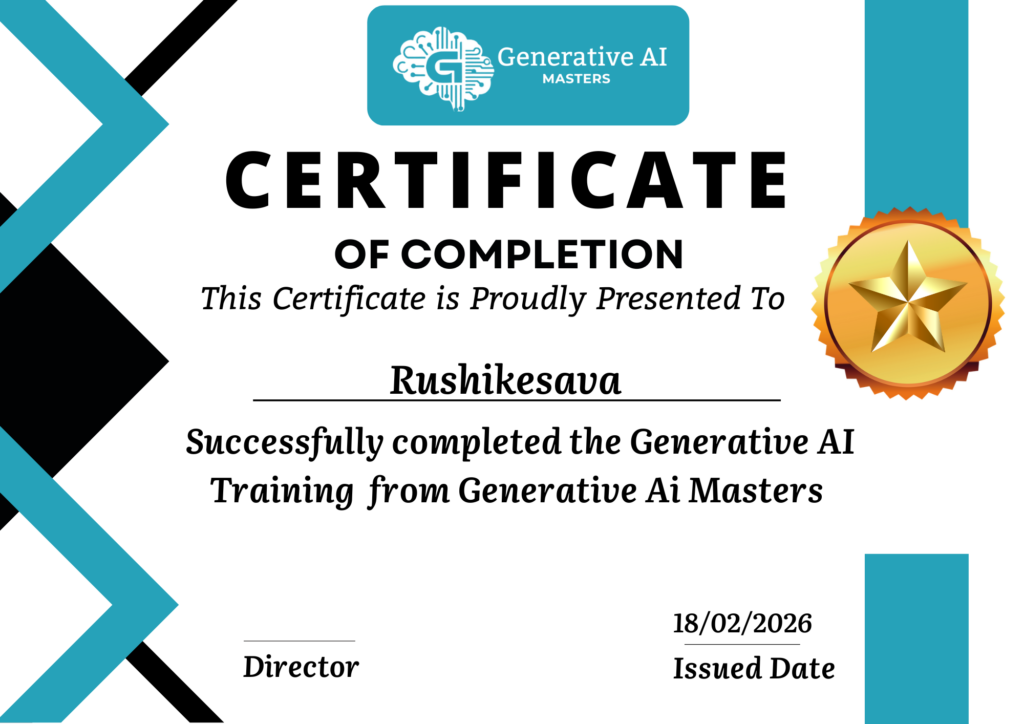
Generative AI Certification Training
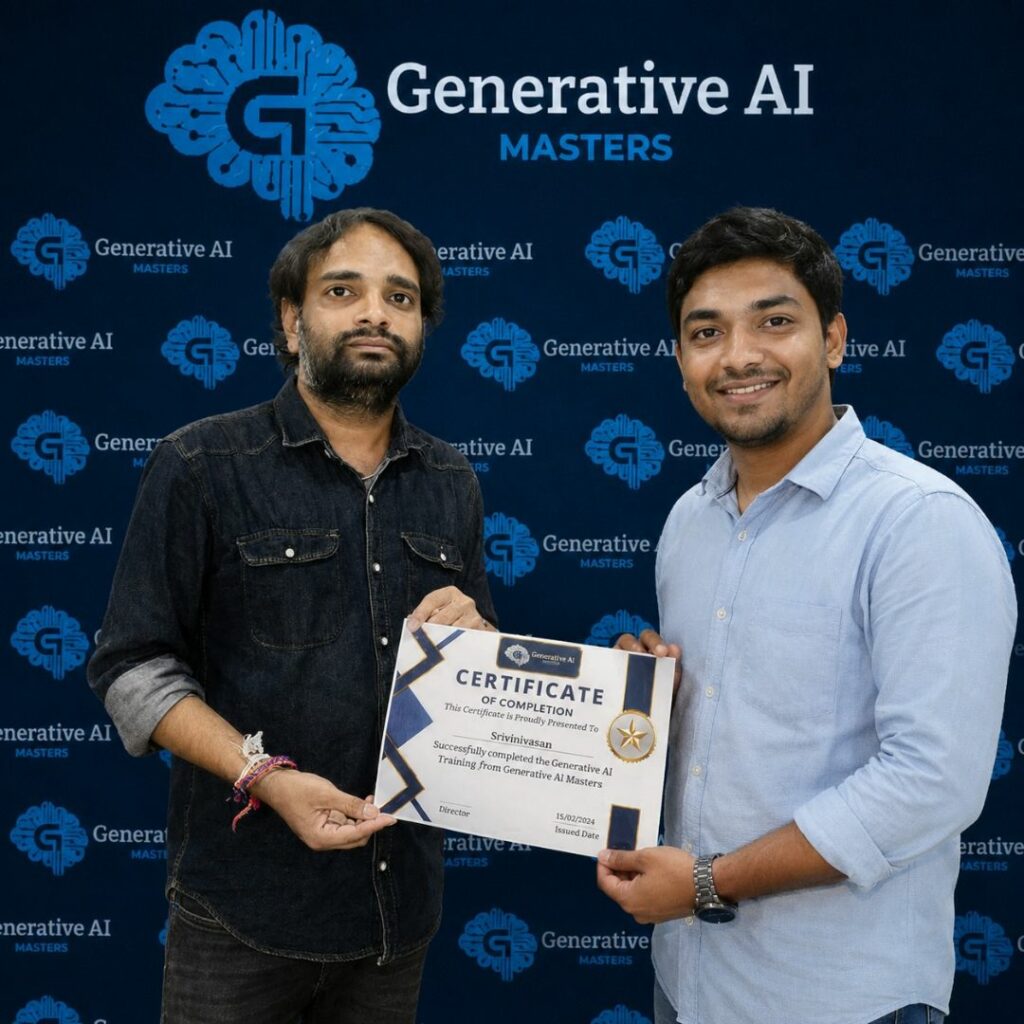
After completing your Generative AI Training in Hyderabad at Generative AI Masters, you will receive a Generative AI Certification that validates your skills in Generative AI, Large Language Models (LLMs), Prompt Engineering, and RAG systems. This certification strengthens your resume and improves your chances of getting shortlisted for AI and Data Science roles.
We also guide you step-by-step to achieve official global Generative AI certifications, ensuring you gain both practical knowledge and recognised credentials.
What You Will Get✔ Generative AI Masters course completion certificate
✔ Strong resume value for AI, LLM, and Generative AI roles
✔ Guidance for global AI certifications
✔ Help in selecting the right certification for beginners
✔ Step-by-step exam preparation and registration support
✔ Practice sessions and doubt clarification
✔ Career support until you become certified and job-ready
400+ Learners Trained60+ Learners Placed25+ Batches Completed
Generative AI Market Trends in Hyderabad (2026)
• India’s AI and GCC industry is rapidly expanding, with over 2,100 Global Capability Centers (GCCs) expected by FY2026, employing around 2.36 million professionals.
• Hyderabad is emerging as a major AI and innovation hub, attracting investments in cloud computing, Generative AI, automation, and enterprise AI transformation.
• Microsoft announced a $17.5 billion AI and cloud investment in India, including expansion of its Hyderabad hyperscale cloud infrastructure scheduled for 2026.
• Global companies including Microsoft, IBM, Cognizant, Deloitte, Accenture, and Amazon are increasing focus on AI-driven operations and AI talent hiring in India.
• Demand is increasing for professionals skilled in: Generative AI, Prompt Engineering, AI Agents, LLM Applications, AI Automation and AI Infrastructure.
• Hyderabad continues to attract AI startups, innovation centers, and enterprise technology hubs because of its strong IT ecosystem, digital infrastructure, and growing talent pool.
• Businesses across industries are investing in AI to improve productivity, automate workflows, and accelerate digital transformation, increasing the value of Generative AI skills for students and professionals.
Generative AI Video Course
🎥Recorded Videos — ₹8,000/- (One-Time Payment)✔ Lifetime access to the Generative AI class recordings.
✔ 70+ structured high-quality video lessons
✔ Complete Generative AI course, from basics to advanced topics.
✔ Prompt Engineering and Large Language Models (LLMs)
✔ RAG Architecture and Vector Database concepts
✔ Agentic AI and Automation Workflows
✔ Real-time Chatbot and AI application projects
✔ Step-by-step practical implementation
✔ Project source code and learning resources
✔ Beginner-friendly explanations for non-IT students
Industry-Level Generative AI Projects from Our Students
At Generative AI Masters, we guide freshers and beginners to build real-time Generative AI projects using prompt engineering, LLMs, chatbots, automation tools and AI applications during our practical training. For inspiration, browse our Generative AI project ideas for beginners.
Featured Student Case Studies
Learners in our Generative AI Training in Hyderabad build real products, not just classroom exercises. These three are live today, each built with Python, the OpenAI API and Streamlit.
AI-Powered Abacus Tutor
Charan · Batch 12, August 2024
Generates practice sums, explains every bead move and checks answers for children and abacus teachers.
AI Learning Activities for Kids
Gayatri · Batch 10, June 2024
Creates chess puzzles and language-learning activities for children on Brolly Juniors.
AI Kundali Generation and Matching
Mouli · Batch 26, January 2026
Generates birth charts and matches two kundalis for marriage compatibility for Anugraha Siddhi.
Student reviews – What our Generative AI students say
4.9 ★ across 51 Google reviews. Below are representative testimonials from recent cohorts. Read all verified reviews on our Generative AI reviews page.
★★★★★I recently completed my Generative AI training in Hyderabad, and it was an excellent learning experience. Dinesh Sir explained every Generative AI concept in a simple and practical way, making it easy to understand. The real-time projects gave me hands-on experience with AI applications, and the mock interviews helped improve my confidence for placements. Thank you, Dinesh Sir, for your valuable guidance and support throughout the training.— Mainampati Sai Krishna Reddy
★★★★★I recently completed the Generative AI Training in Hyderabad at Generative AI Masters and had a great experience. The training was practical, industry-focused, and easy to understand. The hands-on projects helped me gain real-world knowledge of Prompt Engineering, LLMs, AI Automation, and Agentic AI. The trainers were highly knowledgeable and supportive throughout the course. I highly recommend Generative AI Masters to anyone looking for quality Generative AI training in Hyderabad.— Lokesh Tudum
★★★★★I recently joined the Generative Ai Training in Hyderabad at Generative AI Masters and it has been an incredible experience so far! The sessions are well-structured and hands-on, making complex AI concepts easy to understand and apply.— Ramanjan Palkapati
★★★★★I recently completed a Generative AI training in Hyderabad program at Generative AI Masters, and the experience exceeded my expectations. The course is designed in a way that makes even complex AI concepts easy to understand and apply.— Kiran Putti
★★★★★Iam kethan took gen ai course
Very friendly faculty
Join generative masters for best python— kethan madderla
★★★★★I am Veda, and I had a great experience learning at GenAI Masters. It is one of the best institutes for offline AI training with excellent teaching standards, practical learning, and a friendly environment. The trainers and staff are very supportive and helpful throughout the course. I highly recommend this institute to anyone looking for quality Generative AI training in Hyderabad and professional software training programs.— Veda Ujwala Reddy
FAQs – Generative AI Training in Hyderabad
What is Generative AI and why should I learn it in 2026?
Generative AI is a modern branch of artificial intelligence that creates new content such as text, images, audio, videos, and code. Unlike traditional AI systems that mainly analyze data or make predictions, Generative AI can generate original and human-like outputs using large language models such as GPT, Claude and Gemini, and image models such as Stable Diffusion. In 2026, companies are building LLM, RAG and AI-agent applications, which makes these hands-on skills valuable for developers, freshers and career switchers.
How does Generative AI differ from conventional AI approaches?
Traditional AI is mainly used for analyzing data, making predictions, and automating decisions. Generative AI extends these capabilities by creating new content such as articles, images, code, videos, and marketing materials, making it more powerful, creative, and flexible for modern applications.
Which industries and fields are benefiting from Generative AI applications?
• AI Chatbots & Intelligent AI Agents
• Automated Content & Copy Generation
• AI-Based Image & Video Creation
• Smart Healthcare & Drug Research
• Financial Fraud & Risk Detection
• Personalized E-Commerce Experiences
• AI-Assisted Coding & Development Tools
What are the prerequisites for learning Generative AI?
None. Module 1 teaches Python from scratch, and concepts such as neural networks and gradient descent are explained intuitively, so you do not need prior coding, machine learning or advanced maths. Basic computer skills, logical thinking and regular practice are enough to get started.
Can freshers join Generative AI training in Hyderabad?
Yes. This course is beginner-friendly and suitable for both freshers and working professionals. It starts with the basics of coding and AI, then gradually moves into advanced Generative AI concepts including LLMs, prompt engineering, RAG, LangChain, fine-tuning and AI agents.
Are there specific tools taught in the Generative AI course?
Yes. You will work hands-on with Python, the OpenAI and Anthropic APIs, Hugging Face, LangChain, LlamaIndex, LangGraph, CrewAI, AutoGen, vector databases (Pinecone, ChromaDB, Weaviate, Qdrant, FAISS), LoRA and QLoRA fine-tuning, Ollama, FastAPI, Streamlit and Docker.
Is Generative AI useful for entrepreneurs?
Yes. Business owners can use Generative AI to automate customer support, create product content, generate marketing campaigns, and deliver personalized customer experiences. It helps startups and growing businesses improve efficiency while reducing marketing and operational costs.
What is Prompt Engineering in Generative AI?
Prompt engineering is the skill of writing clear instructions for AI tools like ChatGPT to generate accurate, relevant, and high-quality responses. It helps users get better results from Generative AI models.
What career opportunities are available after Generative AI training?
• AI & Machine Learning Engineer
• Generative AI Developer
• NLP & LLM Engineer
• MLOps Engineer
• Data Science Professional
• AI Solutions Consultant
• AI Product Manager
• Freelance AI Developer / AI Entrepreneur
What is the salary of Generative AI professionals in Hyderabad?
• Freshers (0–1 year): ₹3–7 LPA
• 1–3 years: ₹8–14 LPA
• 3–5 years: ₹14–22 LPA
• Senior roles (5+ years): ₹20 LPA and above
Hyderabad is rapidly growing as a major AI hub, creating strong demand and higher salary opportunities for skilled AI professionals.
Will I get placement support after this course?
Yes. The course offers complete placement support including resume building, mock interviews, and job referral assistance. Students are connected with top IT and AI companies in Hyderabad to help them secure strong career opportunities after completing the program.
Do I need coding experience to learn Generative AI?
No. Module 1 teaches Python from scratch, then the course moves into LLMs, prompt engineering, RAG, LangChain, AI agents and real-world projects. Freshers, non-CS graduates and working professionals all follow the same structured curriculum.
What is the fee for Generative AI Training in Hyderabad?
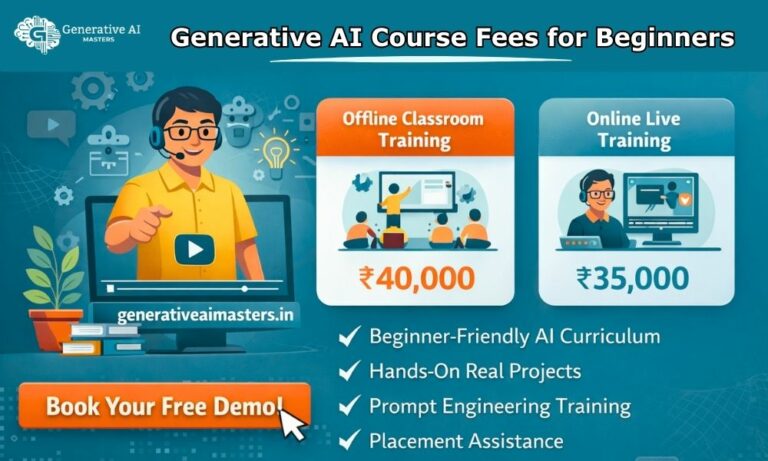
The fee for our Generative AI Training in Hyderabad depends on the learning mode you choose. Online training starts at ₹35,000, Hybrid training costs ₹37,500, and Offline Classroom training is ₹40,000. Flexible EMI options are also available. For the latest offers and personalized guidance, contact our admissions team.
Is there a free demo session?
Yes. We provide a free demo session that allows you to experience the training methodology, curriculum structure, project approach, and learning environment before enrolling. You can attend the demo and interact directly with the trainer to clarify your questions.
What is RAG in Generative AI?
RAG connects AI models with external documents to produce more accurate and context-based answers.
Other Relevant Courses
Our Latest Blog Posts
Visit our Generative AI Training in Hyderabad Office — or join online from anywhere
2-minute walk from JNTU Hyderabad Metro Station. Easily accessible from KPHB, Miyapur, Ameerpet, HITEC City, Madhapur, Gachibowli, Financial District, Kondapur, Manikonda, Secunderabad, Begumpet, LB Nagar, Dilsukhnagar and Uppal via the Miyapur–LB Nagar metro line.
Contact us
Address: Metro Pillar No: A689, JNTU Metro Station, Ground Floor, Dr Atmaram Estates, beside Sri Bhramaramba Theatre, Nizampet Cross Roads, Hyderabad, Telangana 500072.
Mobile Number: +91 9885044555
Email: genaimasters@gmail.com
Click Here for Directions →
Ready to become a Generative AI Engineer in Hyderabad?
Talk to a counsellor · download the syllabus · know batch dates. Free 30-minute counselling call — no obligation, no sales pressure. We’ll help you decide whether Generative AI Masters is the right fit even if the answer is “not yet.”
Online & Offline batches · Weekday and weekend options · English · Hindi · Telugu