Generative AI Syllabus
A Generative AI syllabus is a structured curriculum that teaches you to build AI systems that create content. It moves from AI foundations and Python to machine learning, deep learning, large language models, prompt engineering, LangChain, vector databases, RAG, and fine-tuning — ending with real-world projects. The path takes learners from beginner concepts to advanced, production-ready Generative AI skills.
Table of Contents
Generative AI Syllabus Introduction
If you have ever opened a Generative AI course page and felt lost in a wall of buzzwords, transformers, embeddings, RAG, fine-tuning, you are not alone. Most people want one clear thing before they enrol: what exactly will I learn, and in what order?
That is precisely what a Generative AI syllabus answers.
This guide walks through the complete Generative AI curriculum module by module, from your first line of Python to deploying a working AI application. Whether you are a student, a working professional switching into AI, or simply curious about how tools like ChatGPT and Gemini are built, this is the structured learning path you have been looking for.
Generative AI is the branch of artificial intelligence that creates new content — text, images, code, audio, and video — rather than simply analysing existing data. A traditional model might predict whether an email is spam. A generative model writes the email for you.
Learning this in a structured way matters more than people expect. Generative AI sits on top of several layers — programming, mathematics, machine learning, and deep learning — and skipping a layer leaves gaps that surface later when you try to build something real. A well-designed syllabus removes that risk by sequencing topics so each one builds naturally on the last.
Let’s break the entire curriculum down.
What is a Generative AI Syllabus?
A Generative AI syllabus is a structured outline of all the topics, modules, tools, and projects you study to learn how to design, build, and deploy generative AI systems. It defines the learning path from foundational concepts to advanced, production-level skills.
Think of it as the blueprint for your learning journey. Instead of randomly watching tutorials, a syllabus tells you what to learn first, what comes next, and how each topic connects to the bigger picture. A structured syllabus is the backbone of any serious Generative AI training program, which is why it’s worth understanding before you enrol.
A complete Generative AI course syllabus usually covers four broad layers:
- Foundations — what AI and generative AI are, plus the Python programming needed to work with them.
- Core machine intelligence — machine learning and deep learning concepts that power generative models.
- Generative AI specialisation — large language models, prompt engineering, LangChain, vector databases, RAG, and fine-tuning.
- Application — hands-on projects that turn theory into deployable products.
The best Generative AI training syllabus is practical. It does not stop at theory; it pushes you to build chatbots, document assistants, and AI agents you can actually show to others.
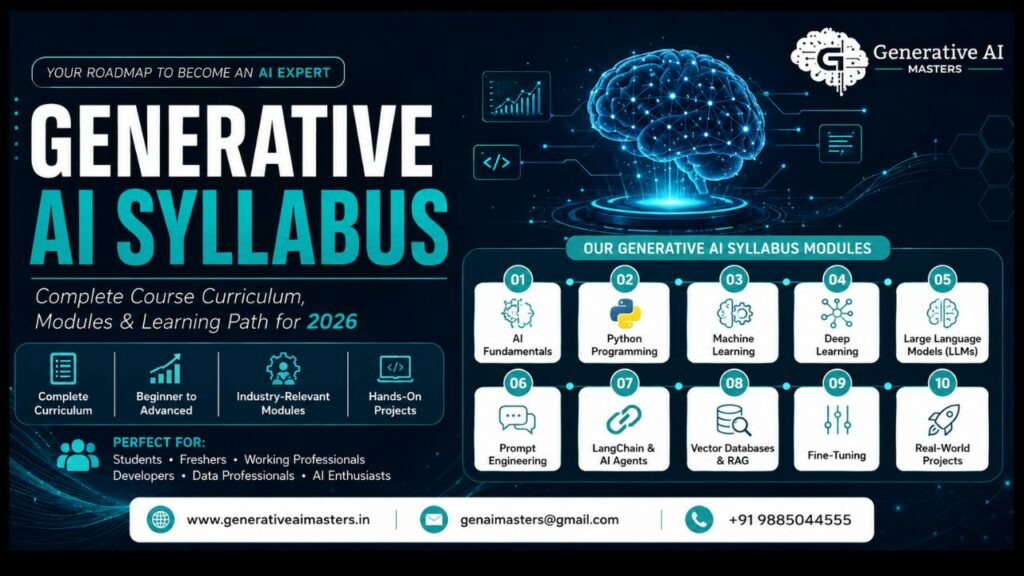
Complete Generative AI Syllabus Overview
Before we go module by module, here is the full Generative AI curriculum at a glance. This table maps every module to the topics it covers and what you should be able to do by the end of it.
Module | Topics Covered | Learning Outcome |
1. Introduction to AI & Generative AI | AI vs ML vs DL, types of AI, how generative models work, use cases | Understand where Generative AI fits and what it can create |
2. Python for Generative AI | Python basics, data structures, NumPy, Pandas, APIs, environments | Write clean Python code to work with AI models and data |
3. Machine Learning Fundamentals | Supervised/unsupervised learning, regression, classification, evaluation | Build and evaluate basic ML models confidently |
4. Deep Learning & Neural Networks | Neurons, layers, backpropagation, CNNs, RNNs, transformers | Understand the architecture that powers generative models |
5. Large Language Models (LLMs) | Tokenization, embeddings, attention, context windows, model families | Explain how LLMs like GPT and Claude generate text |
6. Prompt Engineering | Zero/few-shot, chain-of-thought, system prompts, prompt patterns | Design reliable prompts that produce consistent results |
7. AI Models & Platforms | ChatGPT, Claude, Gemini, Microsoft Copilot, OpenAI API | Choose and use the right model for each task |
8. LangChain & AI Agents | Chains, tools, memory, agent design, orchestration | Build multi-step AI agents that use tools |
9. Vector Databases & RAG | Embeddings, vector search, chunking, retrieval pipelines | Build AI that answers from your own documents |
10. Fine-Tuning & Custom Models | Transfer learning, LoRA, PEFT, dataset prep, evaluation | Customise models for specific domains and tasks |
11. Generative AI Tools & Platforms | Hugging Face, image/audio/video tools, deployment platforms | Work fluently across the modern GenAI tool stack |
12. Real-World Projects | Chatbots, RAG assistants, agents, content generators | Ship a portfolio of working Generative AI applications |
Now let’s unpack what actually happens inside each module.
Module 1: Introduction to Artificial Intelligence and Generative AI
Every good Generative AI syllabus starts with context. Before you write code, you need a clear mental map of the field.
This module explains the difference between Artificial Intelligence (the broad goal of machines performing intelligent tasks), Machine Learning (systems that learn from data), and Deep Learning (a powerful subset of ML using neural networks). Generative AI is a specialisation that sits inside deep learning.
You’ll learn:
- What “generative” actually means — creating new content versus classifying existing content.
- The main types of generative models, including large language models and diffusion models.
- Real use cases: text generation, image creation, code assistants, summarisation, and translation.
- The strengths and limits of generative systems, including hallucination and bias.
By the end, you can confidently explain what Generative AI is and why it works differently from older AI. To see how these capabilities show up in practice, explore these real-world Generative AI applications. This foundation makes every later module easier to absorb.
Module 2: Python Programming for Generative AI
Python is the language of Generative AI, so this module makes sure you are fluent in the parts that matter.
You don’t need to become a software engineer, but you do need to read and write Python comfortably. The syllabus focuses on the practical subset used in AI work.
Core topics include:
- Python fundamentals: variables, loops, functions, and conditionals.
- Data structures: lists, dictionaries, sets, and tuples.
- Working with libraries like NumPy for numerical data and Pandas for handling datasets.
- Reading and writing files, and working with JSON.
- Calling APIs — a critical skill, since you’ll connect to the OpenAI API and other model endpoints constantly.
- Setting up virtual environments and managing packages.
The learning outcome is simple but essential: you can write clean Python scripts to load data, call AI models, and process their responses. This is the practical bridge between theory and building.
Module 3: Machine Learning Fundamentals
Generative AI is built on machine learning, so understanding the basics is non-negotiable — even if you won’t build every model from scratch.
This module covers the core ideas that explain how machines learn from data.
You’ll study:
- Supervised learning — training models on labelled data (regression and classification).
- Unsupervised learning — finding patterns in unlabelled data (clustering).
- Key algorithms like linear regression, logistic regression, and decision trees.
- How to split data into training and testing sets.
- Model evaluation metrics: accuracy, precision, recall, and overfitting.
You don’t need a heavy maths background to start, but the syllabus introduces just enough statistics and probability to make the concepts click. The outcome: you understand the learning process that deep learning and generative models scale up dramatically.
Module 4: Deep Learning and Neural Networks
This is where the curriculum starts to feel like real Generative AI. Deep learning powers every modern generative model, and neural networks are the engine.
The module demystifies how neural networks actually work:
- Neurons and layers — the building blocks that pass and transform information.
- Activation functions and how networks introduce non-linearity.
- Backpropagation — how networks learn by adjusting weights from their mistakes.
- CNNs (Convolutional Neural Networks) for images and RNNs for sequences.
- Transformers the breakthrough architecture behind today’s large language models.
Transformers deserve special attention because they are the foundation of ChatGPT, Claude, and Gemini. You’ll learn the core idea of attention how a model decides which words matter most when generating the next one first introduced in the landmark paper “Attention Is All You Need”. Frameworks like TensorFlow and PyTorch are usually introduced here so you can build and train small networks hands-on.
By the end, you understand the architecture that makes generation possible which makes everything in the LLM modules far more intuitive.
Generative AI Training in Hyderabad
Learn LLMs, RAG, fine-tuning and AI agents with live classes, 15+ projects and placement support.
Next batch: 5 Oct 2026 · morning 10 AM & evening 7 PM IST
Module 5: Large Language Models (LLMs)
Large Language Models are the heart of modern Generative AI, and this module is often where learners get genuinely excited.
An LLM is a deep learning model trained on enormous amounts of text so it can predict and generate human-like language. The syllabus explains exactly how that works without drowning you in maths.
Key topics:
- Tokenization — how text is broken into pieces a model can process.
- Embeddings — turning words and meaning into numbers.
- The attention mechanism and how transformers use it.
- Context windows — how much text a model can “see” at once.
- Model families: the GPT series behind ChatGPT, Anthropic’s Claude, Google’s Gemini, and open models like Llama, Mistral, and Qwen.
- Capabilities and limits: reasoning, hallucination, and why prompts matter so much.
You’ll also explore multimodal models, which now handle text, images, audio, and video together — a baseline expectation in 2026 rather than a premium feature. The outcome: you can explain how an LLM generates a response and what influences its quality.
Module 6: Prompt Engineering
If LLMs are the engine, prompt engineering is how you steer them. This module teaches you to communicate with AI models so they produce reliable, useful output.
A surprisingly large part of working with Generative AI is knowing how to ask. Small changes in wording can dramatically change results, and this prompt engineering syllabus turns that into a repeatable skill.
You’ll learn:
- Zero-shot, one-shot, and few-shot prompting — giving the model zero, one, or several examples.
- Chain-of-thought prompting — guiding the model to reason step by step.
- System prompts and roles — setting behaviour and tone.
- Prompt patterns for summarisation, extraction, classification, and generation.
- Techniques to reduce hallucination and improve consistency.
- How to iterate and test prompts systematically.
This module is practical and immediately rewarding — you’ll see your results improve in real time. It is also the gateway skill to building agents and RAG systems in later modules.
Module 7: OpenAI, ChatGPT, Claude, Gemini, and AI Models
Knowing the theory is one thing; using the actual tools is another. This module gives you fluency across the major AI models and platforms you’ll use every day.
Here’s how the leading tools fit into the syllabus:
- ChatGPT (OpenAI) — the most widely used conversational assistant, great for general tasks, coding help, and content.
- Claude (Anthropic) — known for long-context understanding, careful reasoning, and document work.
- Gemini (Google) — strong multimodal capabilities and tight integration with Google’s ecosystem.
- Microsoft Copilot — AI embedded directly into productivity tools like Word, Excel, and Windows.
- OpenAI API — the programmatic way to build apps on top of GPT models, where you send prompts and receive responses in code.
You’ll learn to compare models, understand pricing and rate limits at a high level, and — most importantly — choose the right model for each job. A coding task, a long legal document, and an image-based query may each call for a different model. For a practical look at how these models are used day to day, browse these Generative AI examples. The outcome: you can build on top of these platforms instead of just chatting with them.
Module 8: LangChain and AI Agent Development
This is where you stop using single prompts and start building systems. LangChain is a popular framework for connecting LLMs to tools, data, and memory — and AI agents are programs that can plan and act on their own.
Agentic AI is one of the defining trends of 2026. Instead of only answering questions, modern AI agents plan tasks, call tools, route decisions, and complete multi-step jobs with limited supervision. Because agents are now a core skill, hands-on programs like the Generative AI training in Hyderabad build agent development directly into the curriculum. This module teaches you to build them.
Topics covered:
- Chains — linking multiple LLM calls and steps together.
- Tools — giving an AI the ability to search, run code, or call APIs.
- Memory — letting an application remember earlier parts of a conversation.
- Agent design — building systems that decide which tool to use and when.
- Orchestration — coordinating multiple models and steps into one workflow.
By the end, you can build an AI agent that, for example, reads a question, searches a database, calls an API, and returns a complete answer — all autonomously. This is one of the most in-demand skills in the entire Generative AI curriculum.
Module 9: Vector Databases and Retrieval-Augmented Generation (RAG)
LLMs are powerful but have two big limits: they don’t know your private data, and they can make things up. RAG solves both, and this module is one of the most practically valuable in the syllabus.
Retrieval-Augmented Generation combines an LLM with a search system. Instead of relying only on what the model memorised during training, RAG retrieves relevant information from your own documents and feeds it to the model before it answers.
To make that work, you need vector databases.
You’ll learn:
- Embeddings — converting text into numerical vectors that capture meaning.
- Vector databases like Pinecone, Chroma, and FAISS that store and search those vectors.
- Chunking — splitting documents into searchable pieces.
- Similarity search — finding the most relevant chunks for a query.
- Building a full RAG pipeline: ingest documents, embed, store, retrieve, and generate.
In 2026, RAG has matured into the standard way enterprises build trustworthy AI — with controlled sources and traceable, auditable answers. The outcome: you can build an AI assistant that answers accurately from your own company documents, manuals, or knowledge base.
Module 10: Fine-Tuning and Custom AI Models
Sometimes prompting and RAG aren’t enough, and you need a model that behaves a specific way by default. That’s where fine-tuning comes in.
Fine-tuning means taking a pre-trained model and training it further on your own data so it adapts to a particular domain, tone, or task. This module teaches you when fine-tuning is worth it — and when a good prompt or RAG setup is the smarter choice.
You’ll study:
- Transfer learning — building on a model’s existing knowledge.
- LoRA and PEFT (Parameter-Efficient Fine-Tuning) — modern, cost-effective techniques that fine-tune models without retraining everything.
- Dataset preparation — collecting and formatting high-quality training examples.
- Training and evaluation — running the fine-tune and measuring whether it actually improved.
- Open models you can fine-tune, often through Hugging Face.
The outcome is the ability to create custom AI models tailored to specialised use cases — medical, legal, customer support, or any domain with its own language and rules.
Module 11: Generative AI Tools and Platforms
A modern Generative AI syllabus isn’t limited to text. This module broadens your toolkit across the full generative landscape and the platforms that tie everything together.
You’ll get hands-on with:
- Hugging Face — the central hub for open models, datasets, and tools, often called the “GitHub of AI.”
- Image generation tools for creating visuals from text prompts.
- Audio and video generation tools, including voice synthesis.
- Code generation assistants that speed up development.
- Deployment platforms for turning your projects into accessible apps and APIs.
You’ll also explore orchestration and model-routing ideas — using fast, cheaper models for simple tasks and powerful reasoning models for complex ones, all within a single workflow. Deploying and maintaining models in production is a discipline of its own, often covered in dedicated MLOps training. The outcome: you can move fluently across the modern GenAI tool stack instead of being locked into one product.
Module 12: Real-World Generative AI Projects
Theory fades; projects stick. The final module of any strong Generative AI training syllabus is where you build things that prove your skills.
Projects pull together everything from the earlier modules. Typical builds include:
- A custom chatbot for a specific business or topic.
- A RAG-based document assistant that answers questions from uploaded PDFs.
- An AI agent that performs multi-step tasks using tools.
- A content generation tool for marketing, summaries, or reports.
- A multimodal application that handles text and images together.
These projects do double duty. They cement your understanding, and they become a portfolio you can show during interviews or to clients. The outcome of this module — and the syllabus as a whole — is a set of working applications that demonstrate real, job-ready Generative AI ability.
Advanced Topics Included in a Modern Generative AI Syllabus
Beyond the core twelve modules, an up-to-date 2026 curriculum layers in advanced topics that reflect where the field is heading.
These often appear in the later stages of a Generative AI learning path:
- Multi-agent systems — multiple AI agents collaborating to solve complex problems.
- AI orchestration and model routing — dynamically assigning tasks to the best-suited model.
- Advanced RAG — re-ranking, hybrid search, and evaluation frameworks for reliable outputs.
- AI evaluation and observability — measuring quality, monitoring behaviour, and catching errors.
- Responsible AI and governance — bias, safety, data privacy, and frameworks like the EU AI Act.
- On-device and edge AI — running smaller models locally for speed and privacy.
- Mixture-of-experts and efficient architectures — getting more capability at lower cost.
These topics separate a basic introduction from a genuinely modern, professional-grade Generative AI course content set.
Latest Trends Covered in Generative AI Training Programs
A syllabus written even a year ago can feel dated, because Generative AI moves quickly. A current 2026 program reflects several major shifts.
- Agentic AI is now central. The field has moved from chat-based assistants to goal-driven agents that plan tasks, call tools, and execute multi-step workflows under human oversight. Analysts expect a large share of enterprise applications to embed AI agents by the end of 2026.
- Multimodality is the baseline. Handling text, images, audio, and video together is now expected rather than special, so modern syllabi treat multimodal work as standard.
- AI orchestration and model routing. Instead of relying on one model, systems now route tasks dynamically — fast models for simple queries, deep reasoning models for hard ones.
- RAG as an enterprise truth system. Retrieval pipelines have evolved into governed, auditable systems with controlled sources, which is why RAG gets serious attention in current curricula.
- Domain-specific models. Narrow, industry-focused models often outperform general ones, so fine-tuning and customisation feature prominently.
- Governance and responsible AI. With regulations like the EU AI Act in force, topics like auditability, safety, and data privacy are now part of the syllabus, not an afterthought.
A program that includes these signals you’re learning the field as it exists today, not as it looked two versions ago.
Conclusion
A Generative AI syllabus is more than a list of topics—it is a structured roadmap that transforms beginners into capable AI builders.
Start by understanding the fundamentals of Generative AI and Python programming.
Build a strong foundation in Machine Learning and Deep Learning concepts.
Learn how neural networks and Transformer architectures power modern AI systems.
Master Large Language Models (LLMs) and Prompt Engineering techniques.
Explore advanced frameworks such as LangChain and AI Agents.
Understand Vector Databases and Retrieval-Augmented Generation (RAG).
Learn Fine-Tuning methods to customize AI models for specific use cases.
Apply your knowledge through real-world projects and industry scenarios.
Develop practical skills used by AI professionals and organizations today.
Follow a structured learning path where each module prepares you for the next stage.
By the end of the journey, you won’t just understand Generative AI—you’ll be able to build intelligent applications, automate workflows, and create AI-powered solutions with confidence.
A well-designed program like Generative AI Masters provides the complete learning sequence, helping you focus on gaining skills, building projects, and accelerating your AI career.
Frequently Asked Questions
1. What is included in a Generative AI syllabus?
A Generative AI syllabus includes AI and ML fundamentals, Python programming, deep learning and neural networks, large language models, prompt engineering, LangChain and AI agents, vector databases and RAG, fine-tuning, generative AI tools, and real-world projects. It takes you from foundations to building deployable applications.
2. Do I need coding experience to follow a Generative AI syllabus?
Not at the start. A good syllabus includes a Python module that teaches the programming you need from scratch. Basic logical thinking helps, but you can begin as a complete beginner and build up coding skills as you progress.
3. How long does it take to complete a Generative AI course syllabus?
It varies by depth and pace. A focused program covering all modules typically takes around three to six months with consistent study. Beginners spending a few hours a week may take longer, while those studying full-time can move faster.
4. What is the difference between a Generative AI syllabus and a machine learning syllabus?
A machine learning syllabus focuses broadly on algorithms that learn from data for prediction and classification. A Generative AI syllabus builds on ML and deep learning but specialises in models that create content — LLMs, prompt engineering, RAG, agents, and fine-tuning.
5. Is Python the only programming language in the Generative AI curriculum?
Python is the primary and most important language because nearly every AI library and framework supports it. Some programs touch on JavaScript for web integration, but Python remains the core requirement throughout the syllabus.
6. What are the most important modules in a Generative AI syllabus?
While every module matters, the modules on large language models, prompt engineering, LangChain and agents, and RAG with vector databases are the most practically valuable for building modern Generative AI applications.
7. Does a Generative AI syllabus cover ChatGPT, Claude, and Gemini?
Yes. A modern syllabus teaches you to use and compare leading models including ChatGPT, Claude, Gemini, and Microsoft Copilot, and to build on platforms like the OpenAI API. You learn to pick the right model for each task.
8. What is RAG in a Generative AI syllabus?
RAG stands for Retrieval-Augmented Generation. It combines a language model with a search system so the AI answers from your own documents instead of only its training data. It’s taught alongside embeddings and vector databases.
9. What projects are included in a Generative AI training syllabus?
Common projects include custom chatbots, RAG-based document assistants, AI agents that use tools, content generators, and multimodal applications. These projects build a portfolio that demonstrates your practical skills.
10. Is a Generative AI syllabus suitable for beginners?
Yes. A well-structured syllabus starts with foundational concepts and Python, then gradually advances to LLMs, agents, and fine-tuning. Beginners can follow the full learning path as long as the topics are sequenced from basic to advanced.

Mr. Dinesh Tunguturi Generative AI Trainer
GenAI Masters AI Experts | 60+ Articles Published on Generative AI, Prompt Engineering, LLMs & AI Careers
Mr. Dinesh is a Generative AI Trainer with expertise in Large Language Models (LLMs), Prompt Engineering, Agentic AI, RAG, and AI Automation. He helps students and professionals gain practical, job-ready AI skills through hands-on training, real-world projects, and industry-focused mentorship.
Turn this knowledge into a career: Generative AI Training in Hyderabad
Learn LLMs, RAG, fine-tuning and AI agents with live classes, 15+ projects and placement support.
₹35,000 online · ₹40,000 classroom · 60+ live hours · 3 months · ★ 4.9 from 51 Google reviews