Generative AI Roadmap
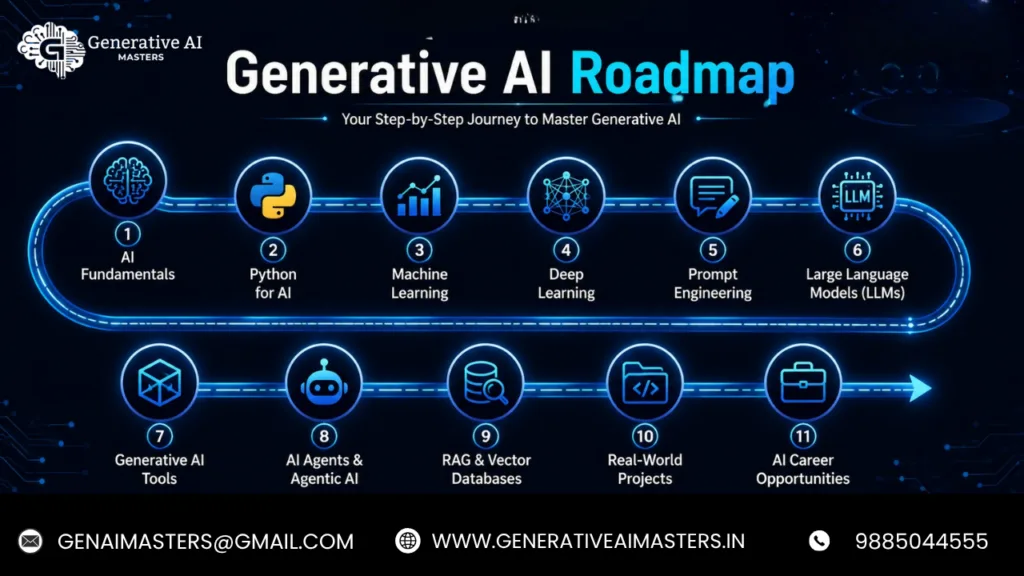
A Generative AI roadmap is a structured learning path that takes you from AI fundamentals to building production-grade AI applications. It progresses through Python, machine learning, deep learning, large language models, prompt engineering, LangChain, vector databases, RAG, and fine-tuning. Each step builds on the last, so learners master concepts in the right order instead of jumping randomly between topics.
Table of Contents
Generative AI Roadmap Introduction

Generative AI has moved from research labs into everyday tools in just a few years. Chatbots write code, design images, summarize documents, and answer customer questions — and the demand for people who actually understand how these systems work keeps growing. The challenge for most learners isn’t motivation. It’s knowing what to learn, in what order.
That’s exactly what a Generative AI roadmap solves.
This guide lays out a complete, step-by-step Generative AI learning path. Whether you’re a student, a fresher, a working developer, or a professional switching domains, you’ll find a clear progression — from the absolute basics all the way to building and fine-tuning your own AI applications. No skipping ahead, no gaps, no guesswork.
Let’s walk through it.
What is a Generative AI Roadmap?
A Generative AI roadmap is a structured, ordered plan that shows you which skills, tools, and concepts to learn — and in what sequence — to become proficient at building generative AI systems.
Think of it as a map for a long road trip. You could drive without one and eventually reach your destination, but you’d waste time backtracking and missing important stops. A roadmap keeps you moving in the right direction.
A good Generative AI learning roadmap usually covers four broad zones:
- Foundations — programming, math intuition, and how AI works
- Core machine learning — the models that power everything else
- Deep learning and LLMs — neural networks and large language models
- Applied generative AI — prompt engineering, RAG, agents, fine-tuning, and real projects
Each zone depends on the one before it. You can’t meaningfully understand large language models without first understanding deep learning, and deep learning makes far more sense once you’ve grasped basic machine learning. That dependency is the whole reason a roadmap matters.
Why You Need a Structured Generative AI Learning Path
Most people who try to learn generative AI on their own hit the same wall: information overload. There are thousands of tutorials, courses, and YouTube videos, and they all assume different starting points. One day you’re watching a transformer architecture deep-dive, the next you’re confused about basic Python loops.
A structured Generative AI learning path fixes this in a few concrete ways:
- It removes decision fatigue. You always know what to study next.
- It builds real understanding. Concepts stack logically, so each topic reinforces the last.
- It saves months of wasted effort. You stop re-learning the same things in the wrong order.
- It keeps you motivated. Visible milestones make progress feel real.
- It prepares you for actual work. A good roadmap ends with projects, not just theory.
In short, a Generative AI study plan turns a vague goal — “I want to learn AI” — into a series of achievable steps. That’s the difference between people who stall after a month and people who ship working AI applications. It’s also exactly what structured Generative AI training in Hyderabad is built around — a guided path instead of guesswork.
Complete Generative AI Roadmap Overview
Before we go deep into each stage, here’s the full roadmap at a glance. This table maps every step to the topics you’ll learn, the tools you’ll use, and the outcome you should expect.
Step | Topics to Learn | Recommended Tools | Outcome |
1. AI Fundamentals | What AI is, types of AI, how generative AI differs | Articles, free courses, ChatGPT for explanations | Clear mental model of the field |
2. Python Programming | Syntax, data structures, functions, OOP, libraries | Python, VS Code, Jupyter Notebook | Comfortable writing and reading code |
3. Machine Learning | Supervised/unsupervised learning, evaluation, key algorithms | scikit-learn, NumPy, pandas | Can train and test basic ML models |
4. Deep Learning | Neural networks, backpropagation, CNNs, RNNs | TensorFlow, PyTorch, Keras | Understand how modern AI learns |
5. Large Language Models | Transformers, attention, tokens, embeddings | Hugging Face, ChatGPT, Claude | Understand how LLMs generate text |
6. Prompt Engineering | Prompt patterns, context, few-shot, system prompts | ChatGPT, Claude, Gemini, Copilot | Get reliable results from any model |
7. AI Models & APIs | OpenAI API, model selection, parameters | OpenAI API, Anthropic, Google AI Studio | Call models programmatically |
8. AI Apps & Agents | Chains, memory, tools, agent loops | LangChain, LlamaIndex | Build multi-step AI applications |
9. Vector DBs & RAG | Embeddings, similarity search, retrieval pipelines | Pinecone, Chroma, FAISS, Weaviate | Build AI that answers from your data |
10. Fine-Tuning | Custom datasets, LoRA, evaluation | Hugging Face, OpenAI fine-tuning | Adapt models to specific tasks |
11. Tools & Platforms | Image, audio, video, and code generation tools | Midjourney, DALL·E, Copilot, others | Know the wider GenAI ecosystem |
12. Real-World Projects | End-to-end apps, deployment, evaluation | All of the above + cloud platforms | A portfolio of working projects |
Now let’s break each step down properly. (If you’d rather follow a ready-made version of this path, our Generative AI curriculum maps the same sequence into a structured course.)
Step 1: Learn Artificial Intelligence Fundamentals
Every Generative AI roadmap starts here, and for good reason. Before you write a single line of code, you need a clear picture of what AI actually is and where generative AI fits in.
At this stage, focus on understanding rather than building. You want to be able to answer questions like:
- What is artificial intelligence, and how is it different from regular software?
- What are the main types of AI — narrow AI, machine learning, deep learning, generative AI?
- What makes generative AI special? (Hint: it creates new content — text, images, code, audio — rather than just classifying or predicting.)
- Where is generative AI used in the real world?
You don’t need math or programming yet. Read accessible explainers, watch a few overview videos, and use a chatbot like ChatGPT to explain concepts back to you in plain language. The goal is a solid mental map of the territory before you start the climb.
Spend a week or two here. It’s tempting to rush, but a strong foundation makes everything that follows easier.
Step 2: Master Python Programming
Python is the language of AI. Almost every machine learning library, deep learning framework, and AI tool is built with Python in mind, which makes it non-negotiable on any AI engineer roadmap.
The good news: you don’t need to become a software engineer. You need practical Python for data and AI work. Focus on:
- Basics — variables, data types, loops, conditionals
- Data structures — lists, dictionaries, sets, tuples
- Functions and modules — writing reusable code
- Object-oriented programming — classes and objects (enough to read library code)
- Core libraries — NumPy for numerical work and pandas for handling data
Use VS Code or Jupyter Notebook as your workspace. Jupyter is especially friendly for AI work because you can run code in small chunks and see results instantly.
A practical tip: write small programs daily. Build a calculator, scrape a web page, clean a messy spreadsheet. Hands-on practice cements the language far better than passive watching. By the end of this step, reading other people’s AI code should feel manageable.
Step 3: Understand Machine Learning Concepts
With Python in hand, you can start on machine learning — the engine room of modern AI. Generative AI is built on top of machine learning principles, so this step is essential even though you won’t build LLMs directly here.
Concentrate on the core ideas:
- Supervised learning — training models on labeled data (e.g., predicting house prices)
- Unsupervised learning — finding patterns in unlabeled data (e.g., grouping customers)
- The training process — features, labels, training/test splits, overfitting
- Evaluation — accuracy, precision, recall, and why they matter
- Common algorithms — linear regression, decision trees, clustering
Use scikit-learn, the most beginner-friendly machine learning library, along with pandas and NumPy. Build a few small models: predict survival on a classic dataset, classify emails, cluster data points. You’ll learn how models actually learn from data — a concept that carries directly into deep learning and LLMs.
You don’t need heavy math here. A working intuition for how models improve through data is enough to move forward.
Step 4: Learn Deep Learning and Neural Networks
Deep learning is where generative AI truly comes alive. This step explains how machines learn complex patterns, and it’s the bridge between traditional machine learning and the large language models you’ll study next.
Key concepts to master:
- Neural networks — layers of connected “neurons” that process information
- How networks learn — forward passes, loss functions, and backpropagation
- Activation functions — the non-linear pieces that let networks model complexity
- CNNs (Convolutional Neural Networks) — used heavily in image tasks
- RNNs and sequence models — early approaches to handling text and sequences
Pick a framework — PyTorch is the most popular in research and increasingly in industry, while TensorFlow and Keras remain widely used. Build a simple neural network that recognizes handwritten digits. Watching a network improve over training epochs is one of those “aha” moments that makes the whole field click.
By the end of this step you’ll understand the foundation that transformers — and therefore every modern LLM — are built on.
Generative AI Training in Hyderabad
Learn LLMs, RAG, fine-tuning and AI agents with live classes, 15+ projects and placement support.
Next batch: 5 Oct 2026 · morning 10 AM & evening 7 PM IST
Step 5: Study Large Language Models (LLMs)
Now you reach the heart of generative AI. Large language models like GPT, Claude, and Gemini are what power today’s most impressive AI tools, and understanding them is central to any LLM roadmap. If you want a plain-language primer first, see our guide on how large language models work.
You don’t have to build an LLM from scratch — almost no one does. But you should understand how they work:
- Transformers — the architecture behind modern LLMs, introduced in 2017, that replaced older sequence models
- Attention mechanism — how models decide which words matter most in context
- Tokens — how text is broken into chunks the model processes
- Embeddings — how words and concepts are represented as numbers
- Pre-training and context windows — how models learn and how much they can “see” at once
Explore the Hugging Face platform, which hosts thousands of open models you can experiment with directly. Read a plain-language explanation of the transformer architecture, then play with models hands-on. Once you understand attention and embeddings, the rest of the roadmap becomes far more intuitive.
Step 6: Master Prompt Engineering
Prompt engineering is the skill of communicating clearly with AI models to get reliable, high-quality results. It’s one of the highest-leverage skills on the entire prompt engineering roadmap because it applies whether you’re using a chatbot casually or building a production application.
Core techniques to learn:
- Clear instructions — being specific about what you want and the format you want it in
- Context — giving the model the background it needs
- Few-shot prompting — showing examples so the model follows a pattern
- System prompts — setting the model’s role and behavior
- Chain-of-thought — asking the model to reason step by step for complex tasks
Practice across multiple models — ChatGPT, Claude, Gemini, and Microsoft Copilot — because each responds slightly differently. You’ll quickly learn that the same prompt can produce very different results depending on how it’s phrased. Good prompt engineering is part technical skill and part clear thinking, and it pays off in every later step. Once you’re comfortable, test yourself against these prompt engineering interview questions.
Step 7: Learn OpenAI, ChatGPT, Claude, Gemini, and AI Models
Using AI through a chat window is one thing. Calling it from your own code is where real applications begin. This step moves you from user to builder.
Get familiar with the major models and their APIs:
- ChatGPT / OpenAI API — OpenAI’s models, accessed through the OpenAI API for programmatic use
- Claude — Anthropic’s models, known for strong reasoning and large context windows
- Gemini — Google’s family of models, accessible through Google AI Studio
- Microsoft Copilot — AI woven into Microsoft’s products and developer tools
Learn the practical mechanics: how to authenticate with an API key, send a prompt, and handle the response. Understand key parameters like temperature (creativity vs. consistency) and max tokens (response length). Try sending the same request to two different models and comparing the results.
Knowing how to call models programmatically — and how to choose the right model for a task — is a defining skill on the Generative AI career roadmap.
Step 8: Build Applications with LangChain and AI Agents
Single prompts are powerful, but real applications often need multiple steps: fetch data, reason about it, call a tool, then respond. Frameworks like LangChain (and alternatives like LlamaIndex) make this orchestration manageable, which is why they sit at the center of the AI agent development roadmap.
Here you’ll learn to:
- Build chains — connect multiple model calls and steps into a workflow
- Add memory — let an application remember earlier parts of a conversation
- Give models tools — let an AI search the web, run code, or query a database
- Create AI agents — systems that decide which actions to take to reach a goal
AI agents are one of the most exciting frontiers in generative AI. Instead of answering a single question, an agent can break a task into steps, use tools, and work toward an objective with limited human input. Building even a simple agent — say, a research assistant that searches and summarizes — teaches you how modern AI applications are actually assembled.
Step 9: Learn Vector Databases and Retrieval-Augmented Generation (RAG)
LLMs are powerful, but they don’t know about your documents, your company data, or anything published after their training cutoff. Retrieval-Augmented Generation (RAG) solves this, and it’s one of the most in-demand skills in applied generative AI.
The idea is simple but powerful: instead of relying only on what the model memorized, you retrieve relevant information from your own data and feed it to the model at question time.
To do this, you’ll learn:
- Embeddings — turning text into numerical vectors that capture meaning
- Vector databases — specialized databases like Pinecone, Chroma, FAISS, and Weaviate that store and search these vectors
- Similarity search — finding the most relevant chunks of information for a query
- The RAG pipeline — retrieve relevant context, then generate an answer grounded in it
RAG is the backbone of most real-world AI assistants — internal company chatbots, document search tools, customer support systems. Building a RAG application that answers questions from a set of PDFs is one of the most valuable projects you can complete on this roadmap.
Step 10: Fine-Tuning and Custom AI Models
Sometimes prompting and RAG aren’t enough. When you need a model to consistently follow a specific style, format, or domain expertise, fine-tuning lets you train an existing model further on your own examples.
This is a more advanced step, so don’t rush it. Focus on:
- When to fine-tune — and when prompting or RAG is the better, cheaper choice
- Preparing datasets — collecting and formatting high-quality training examples
- Efficient methods — techniques like LoRA that fine-tune models without huge compute
- Evaluation — measuring whether the fine-tuned model actually performs better
Use the Hugging Face ecosystem for open models, or managed fine-tuning options from providers like OpenAI. A practical lesson here: fine-tuning is often the last tool to reach for, not the first. Many problems are solved more cheaply with better prompts or RAG. Knowing when to fine-tune is as important as knowing how.
Step 11: Explore Generative AI Tools and Platforms
Generative AI isn’t only about text. To be well-rounded, spend time exploring the broader ecosystem of tools so you understand what’s possible across modalities.
Areas worth exploring:
- Text and chat — ChatGPT, Claude, Gemini, Microsoft Copilot
- Image generation — tools that create images from text descriptions
- Audio and voice — speech synthesis, transcription, and music generation
- Video generation — emerging tools that create or edit video
- Code generation — AI coding assistants that speed up development
- Open-source models — the thousands of models available on Hugging Face
You don’t need to master every tool. The goal is awareness — knowing which tool fits which job. This breadth makes you more versatile and helps you pick the right building blocks when you start designing your own generative AI projects.
Step 12: Build Real-World Generative AI Projects
Theory only takes you so far. The final step on any serious Generative AI roadmap is building real, end-to-end projects. Projects prove your skills, deepen your understanding, and become the portfolio that demonstrates what you can do.
Strong project ideas that combine multiple steps:
- A document Q&A assistant — upload PDFs and ask questions (RAG + vector database)
- A customer support chatbot — answers from a company knowledge base
- A research agent — searches, reads, and summarizes information (agents + tools)
- A content generator — produces drafts, summaries, or structured outputs
- A custom-tuned assistant — a model adapted to a specific tone or domain
For each project, go beyond just making it work. Deploy it so others can use it, add error handling, and think about evaluation — how do you know the output is good? Real-world thinking like this is exactly what separates someone who learned about generative AI from someone who can build with it.
Skills Required to Follow a Generative AI Roadmap
Success on this path depends on a mix of technical and non-technical skills:
Technical skills
- Python programming
- A working understanding of machine learning and deep learning
- Familiarity with LLMs, prompt engineering, and APIs
- Comfort with frameworks like LangChain and vector databases
- Basic understanding of data handling and cloud deployment
Foundational knowledge
- Logical and analytical thinking
- Basic math intuition (you don’t need to be a mathematician, but comfort with the ideas helps)
- Reading documentation and debugging
Soft skills
- Curiosity and willingness to experiment
- Patience — this field rewards consistent practice over cramming
- The ability to learn independently, since tools change fast
The encouraging part: most of these skills are built through the roadmap itself. You don’t need them all on day one.
Generative AI Roadmap for Beginners vs Advanced Learners
The roadmap looks different depending on where you’re starting. Beginners need to build foundations carefully; advanced learners can skip ahead and focus on applied skills. Here’s how the two paths compare.
Beginner Generative AI Roadmap | Advanced Generative AI Roadmap |
Start with AI fundamentals and concepts | Start with LLMs and applied generative AI |
Spend significant time on Python basics | Already fluent in Python; focus on AI libraries |
Learn machine learning before deep learning | Move quickly into transformers and embeddings |
Practice prompt engineering on chatbots | Master advanced prompting and system design |
Build small, guided projects | Build complex, multi-component applications |
Focus on understanding how things work | Focus on optimization, scaling, and deployment |
Timeline: several months at a steady pace | Timeline: faster, focused on specialization |
Goal: solid foundation and first projects | Goal: production-grade apps and fine-tuned models |
Common Mistakes to Avoid When Learning Generative AI
Even with a roadmap, learners stumble in predictable ways. Avoid these and you’ll progress far faster:
- Skipping the fundamentals. Jumping straight to LLMs without understanding machine learning leaves you with shallow, fragile knowledge.
- Tutorial hell. Endlessly watching videos without building anything. You learn by doing, not just watching.
- Trying to learn everything at once. The roadmap is sequential for a reason. Respect the order.
- Ignoring projects. Theory without practice doesn’t stick, and it doesn’t prove anything.
- Chasing every new tool. The field moves fast, but fundamentals don’t change. Master the basics before chasing the latest release.
- Fine-tuning too early. Many beginners reach for fine-tuning when a better prompt or RAG would solve the problem more cheaply.
- Not understanding why something works. Copy-pasting code without understanding it limits how far you can go.
A steady, project-driven approach beats a frantic, scattered one every time.
Conclusion
A Generative AI roadmap turns an overwhelming field into a clear, achievable journey. You begin by understanding what AI is, then build the programming foundation with Python. From there, machine learning and deep learning give you the how behind intelligent systems, leading naturally into large language models — the engines of generative AI.
Once you understand the models, you learn to communicate with them through prompt engineering, then to build with them using APIs, LangChain, and AI agents. Vector databases and RAG let your applications work with real data, and fine-tuning lets you adapt models to specific needs. Finally, real-world projects tie everything together and prove what you can do.
The progression is consistent: foundations → core machine learning → deep learning and LLMs → applied generative AI → real projects. Beginners move through it carefully, building understanding step by step. Advanced learners move faster and specialize. Both arrive at the same destination — the ability to design and build generative AI systems that actually work.
The most important advice is simple: follow the order, build as you learn, and stay consistent. Generative AI rewards steady, hands-on practice more than raw speed. Start at step one, keep moving — and if you’d prefer guided, hands-on learning, Generative AI Masters can shortcut the journey. You’ll be surprised how far this roadmap can take you.
Frequently Asked Questions Generative AI Roadmap
1. How long does it take to complete a Generative AI roadmap?
For most beginners, reaching a solid working level takes roughly six to twelve months of consistent study and practice. If you already know Python and machine learning, you can move much faster — often in a few months. The exact timeline depends on your starting point and how many hours you can commit each week. Consistency matters far more than speed.
2. Do I need a strong math background to learn generative AI?
No, you don’t need to be a mathematician. A basic intuition for concepts like probability, statistics, and how models improve through data is helpful, but you can learn most of generative AI through practical, code-first study. Many successful AI builders learn the math gradually, as they go, rather than mastering it upfront.
3. Should I learn machine learning before generative AI?
Yes — at least the core concepts. Generative AI is built on machine learning and deep learning principles. Understanding how models learn from data makes everything that follows, including large language models, far easier to grasp. You don’t need to become a machine learning expert, but skipping it entirely leads to shallow understanding.
4. Is Python necessary for a Generative AI roadmap?
Almost always, yes. Python is the dominant language across AI tools, libraries, and frameworks. While you can use some AI tools without coding, building real generative AI applications — with APIs, LangChain, RAG, and fine-tuning — practically requires Python. It’s one of the earliest and most important steps on the path.
5. What is the difference between prompt engineering and fine-tuning?
Prompt engineering means crafting better instructions to get good results from an existing model — no training involved. Fine-tuning means training a model further on your own examples to change its behavior. Prompt engineering is faster and cheaper and should usually be tried first. Fine-tuning is more powerful but more involved, and it’s only worth it for specific, repeated tasks.
6. What is RAG, and why is it important in the roadmap?
RAG (Retrieval-Augmented Generation) is a technique where an AI retrieves relevant information from your own data and uses it to generate accurate, grounded answers. It’s important because LLMs don’t know about your private documents or recent information. RAG is the backbone of most real-world AI assistants, which makes it a high-value skill on any applied generative AI path.
7. Can a complete beginner follow a Generative AI roadmap?
Absolutely. The roadmap is designed to start from the basics — what AI is, then Python, then core concepts — before reaching advanced topics. Beginners simply move through it more slowly, spending extra time on foundations. The key is following the steps in order rather than jumping ahead to topics that depend on earlier knowledge.
8. What tools should I learn on a Generative AI roadmap?
Start with Python and its core libraries, then move to machine learning tools like scikit-learn and deep learning frameworks like PyTorch. For applied work, learn to use ChatGPT, Claude, and Gemini, the OpenAI API, LangChain for building applications, Hugging Face for models, and a vector database like Pinecone or Chroma for RAG. Add specialized tools as projects require them.
9. Do I need to build an LLM from scratch?
No. Building a large language model from scratch requires enormous data and computing resources, and almost no one does it outside major labs. Instead, you learn how LLMs work conceptually, then build on top of existing models through prompting, APIs, RAG, and fine-tuning. Understanding the architecture matters; rebuilding it does not.
10. What should I build to practice generative AI?
Start small and build progressively: a chatbot using an API, then a document Q&A tool using RAG, then a simple AI agent that uses tools, and eventually a complete deployed application. Projects that combine several skills — like a customer support assistant grounded in real documents — teach the most and make the strongest portfolio.

Mr. Dinesh Tunguturi Generative AI Trainer
GenAI Masters AI Experts | 60+ Articles Published on Generative AI, Prompt Engineering, LLMs & AI Careers
Mr. Dinesh is a Generative AI Trainer with expertise in Large Language Models (LLMs), Prompt Engineering, Agentic AI, RAG, and AI Automation. He helps students and professionals gain practical, job-ready AI skills through hands-on training, real-world projects, and industry-focused mentorship.
Turn this knowledge into a career: Generative AI Training in Hyderabad
Learn LLMs, RAG, fine-tuning and AI agents with live classes, 15+ projects and placement support.
₹35,000 online · ₹40,000 classroom · 60+ live hours · 3 months · ★ 4.9 from 51 Google reviews