Application of AI in Banking
The application of AI in banking covers fraud detection, AI chatbots, credit scoring, anti-money laundering, algorithmic trading, robo-advisors, and generative and agentic AI for operations. In 2026, banks are moving from pilot projects to full-scale, embedded AI systems that improve efficiency, security, and personalized customer experiences across every banking function.
Table of Contents
Introduction to Application of AI in Banking
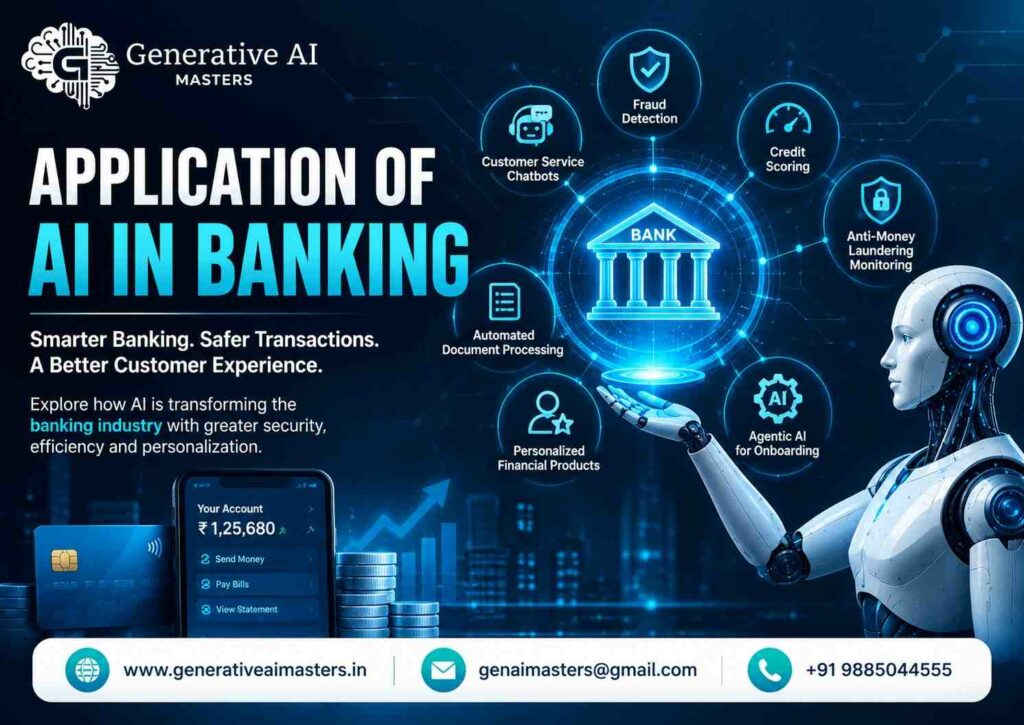
Artificial intelligence is no longer an experiment sitting inside a bank’s innovation lab. It now sits inside everyday banking the fraud alert on your card, the chatbot that answers your loan question at midnight, the algorithm that decides your credit limit, and the system that flags suspicious transactions before money ever leaves your account.
If you have ever wondered how banks actually use AI, and not just the buzzwords, this guide breaks it down in plain language. You will learn what AI does in banking, why it matters, how it works behind the scenes, and what is changing in 2026 as banks shift from small pilot projects to AI running at the core of their operations.
This guide is written for students, finance professionals, developers, business owners, and anyone curious about how banks really use AI today. If you want to go beyond reading about AI in banking and actually build with it, our Generative AI Roadmap is a good next stop.
What is AI in Banking?
- AI in banking means using technologies like machine learning, natural language processing, computer vision, and generative AI to automate, predict, and improve banking decisions and services. It touches front, middle, and back-office functions alike from the teller counter to the compliance desk.
- Instead of a human manually reviewing every transaction or loan application, AI systems analyze massive amounts of data in seconds and flag what needs human attention. This does not replace bankers it removes repetitive work so people can focus on judgment calls, relationships, and exceptions.
- Banking has always relied on data. What AI changes is the speed and depth at which that data gets used. A single AI model can review millions of transactions overnight, something that would take a human team weeks to complete.
Why AI Matters in the Banking Industry
- Banks handle enormous volumes of transactions, documents, and customer interactions every single day. Doing this manually is slow, expensive, and prone to human error. AI matters because it solves three problems at once: speed, accuracy, and scale.
- A fraud detection system, for example, does not get tired after reviewing ten thousand transactions. It applies the same level of scrutiny to the millionth transaction as it did to the first. That consistency is something manual review simply cannot match.
- There is also a competitive angle. Research on the banking sector suggests that institutions actively using AI are capturing a noticeably larger share of the market than those still relying on legacy processes, largely because AI-driven banks can approve loans faster, catch fraud earlier, and respond to customers instantly.
- Generative AI adds another layer. McKinsey estimates that generative AI alone could add somewhere between $200 billion and $340 billion in value annually across global banking, largely through faster document processing, smarter risk modeling, and improved customer communication.
How AI Is Used in Banking
Before going deep into each application, here is a snapshot of where AI shows up across a typical bank’s operations.
Banking Function | How AI Is Applied | Common Tools/Technologies | Business Outcome |
Fraud Detection | Real-time anomaly detection on transactions | Machine learning models, anomaly detection engines | Fewer false declines, faster fraud catches |
Customer Service | AI chatbots and virtual assistants | NLP, LLMs, conversational AI platforms | 24/7 support, lower call center load |
Credit Scoring | Predicting creditworthiness beyond credit history | ML classification models, alternative data | Faster, fairer loan approvals |
AML/KYC/KYB | Detecting money laundering patterns and verifying identities | Graph analytics, ML, document AI | Regulatory compliance, reduced risk |
Trading | Executing trades based on real-time market signals | Algorithmic trading models, reinforcement learning | Faster execution, reduced slippage |
Wealth Management | Automated portfolio suggestions | Robo-advisors, predictive analytics | Personalized investing at scale |
Personalization | Tailoring offers and products to individuals | Behavioral analytics, recommendation engines | Higher engagement, less generic marketing |
Document Processing | Reading and summarizing contracts, statements | Generative AI, OCR, RAG systems | Faster underwriting and reporting |
Operations | Autonomous multi-step workflows | Agentic AI, multi-agent orchestration | Lower operating costs, faster turnaround |
Fraud Detection and Prevention
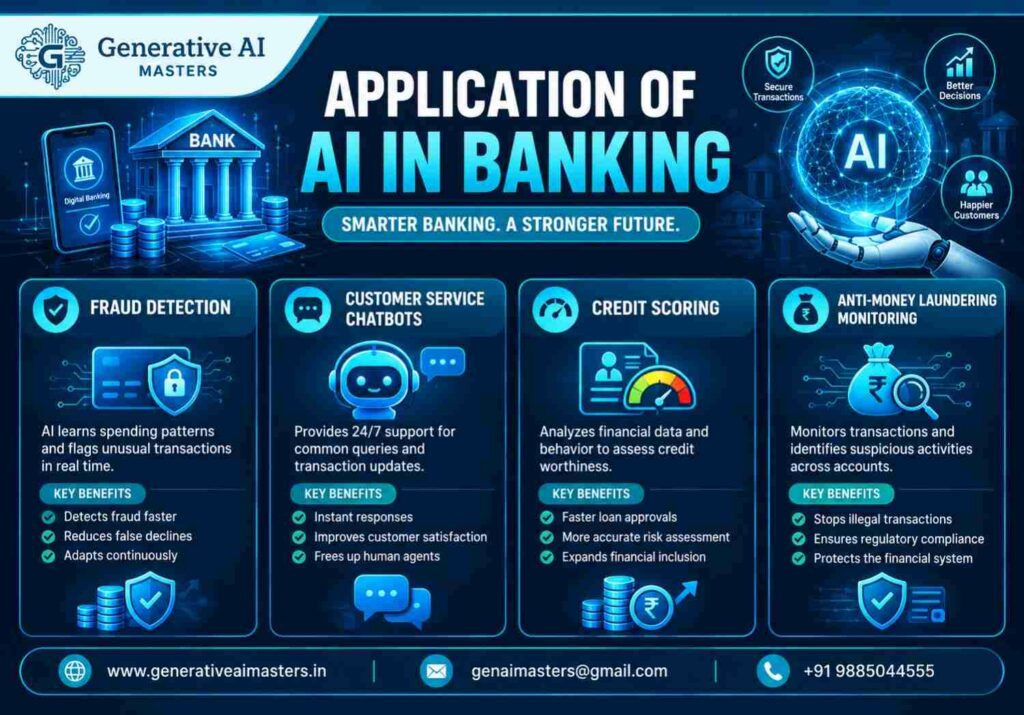
- Traditional fraud systems relied on fixed rules for example, blocking any transaction over a certain amount from a new location. These rules caught obvious fraud but also blocked a lot of legitimate purchases, frustrating customers.
- Modern AI fraud systems learn each customer’s typical behavior. If you usually shop locally and suddenly a transaction appears from another country at 3 AM, the system flags it instantly by comparing it against your personal spending pattern, not just a generic rule.
- Banks are increasingly embedding this intelligence directly into onboarding, KYC, and KYB systems, moving from basic automation toward adaptive, real-time risk scoring that improves as more data flows through it. Platforms like NVIDIA’s AI for Fraud Detection use graph neural networks to spot connections between accounts that a rules-based system would miss entirely.
AI-Powered Chatbots and Virtual Assistants
- Money launderers often spread transactions across many small amounts to avoid detection. Rule-based systems struggle to catch these patterns because each individual transaction looks harmless. AI models built on graph analytics can map relationships between accounts and spot networks of suspicious activity that a human analyst would miss.
- In 2026, AML and KYC/KYB systems are shifting from periodic batch checks to continuous, real-time monitoring, which lets banks flag risk during onboarding rather than discovering it months later during an audit.
Credit Scoring and Loan Underwriting
- Traditional credit scoring relies heavily on credit bureau data, which can unfairly exclude people with thin credit files, students, gig workers, or people new to the formal banking system. AI-based underwriting can incorporate additional signals, giving a fuller picture of someone’s ability to repay.
- This does not mean AI approves of everyone. It means the decision is based on a richer dataset, which can lead to both faster approvals for good borrowers and more accurate rejections for genuinely high-risk applicants.
Generative AI in Banking
- Large language models used to draft documents, summarize reports, answer complex customer questions, and support advisory work.
- Generative AI has become one of the fastest-growing applications in banking because it directly attacks a huge cost center: paperwork. Loan documents, compliance reports, and customer correspondence used to require significant manual effort. Generative AI models can now draft, summarize, and cross-check these documents in a fraction of the time.
- Many banks pair generative AI with Retrieval-Augmented Generation, or RAG, which grounds the model’s answers in the bank’s actual policy documents and data instead of relying purely on the model’s general training. This significantly reduces the risk of the AI confidently stating something incorrect, a known issue with generative models.
- Banks are also increasingly using smaller, domain-specific language models instead of massive general-purpose ones for certain tasks, since a smaller model trained specifically on banking data tends to be more predictable and easier to govern than a general-purpose model.
Agentic AI in Banking Operations
This is the biggest shift happening in banking AI in 2026 — the move from generative to agentic AI. Instead of a chatbot that only answers questions, an agentic AI system can open a case, gather the required documents, check them against policy, and route the file to a human only if something needs judgment.
Industry analysts describe this as the emergence of a “10x bank” model, where a single employee, supported by a team of AI agents, can manage the workload that previously required an entire department. Multi-agent systems, where several specialized AI agents coordinate on a single task, are projected to independently handle a meaningful share of routine day-to-day banking decisions within the next couple of years.
This does not mean full automation without oversight. Regulated decisions — loan denials, account closures, compliance flags — still require human accountability, and responsible banks build clear checkpoints where a person reviews the agent’s work before anything final happens.
Cybersecurity and AI-Driven Threat Detection
Banks are prime targets for cyberattacks, and AI-driven security platforms analyze network behavior to catch intrusions that traditional signature-based antivirus tools would miss. These systems can also use privacy-compliant synthetic data to train fraud and security models without exposing real customer information.
Given how much of banking now runs through AI and agentic systems, security platforms are becoming a core investment priority, since a breach in an AI-connected system can cascade across multiple banking functions at once. The Bank for International Settlements has flagged this exact risk, noting that AI can both strengthen and expose the financial system depending on how it’s governed.
Real-World Examples of AI in Banking
Bank/Institution | AI Application | Result |
Trust Bank (Singapore) | Generative AI chatbot for customer service | Reduced support workload and customer complaints significantly |
Wells Fargo | Enterprise data science platform for AI development | Standardized AI tools across the organization |
BNY | Internal AI platform (Eliza) for employee productivity | Broader adoption of generative AI across teams |
Major global banks | RAG-based compliance and document review | Faster underwriting and reporting cycles |
Traditional AI vs Agentic AI in Banking
Traditional AI in Banking | Agentic AI in Banking |
Answers a single question or completes one task | Completes multi-step workflows independently |
Reacts to a transaction after it happens | Monitors and adjusts actions in real time |
Requires a human to trigger each step | Initiates and manages its own next steps |
Works within a single system | Coordinates across multiple systems and data sources |
Limited to pattern recognition | Combines reasoning, tool use, and decision-making |
Latest Trends in AI Banking for 2026
Banking in 2026 is defined by a shift from AI pilots to AI embedded permanently into core operations. Accenture’s 2026 banking research points to a handful of trends worth watching closely:
Agentic AI moving into production: Instead of experimental chatbots, banks are deploying AI agents that run real workflows like onboarding and liquidity management with measurable efficiency gains.
Domain-specific language models: Banks are moving away from massive general-purpose models toward smaller models trained specifically on banking and financial data, since these are easier to govern, more predictable, and less prone to hallucination.
Hyper-personalization through behavioral analytics: Generic cross-selling is being replaced by AI systems that understand individual customer context well enough to suggest genuinely relevant products.
Autonomous, real-time compliance: Compliance is shifting from scheduled audits to continuous, always-on monitoring powered by AI.
AI-native architecture: Rather than bolting AI onto old systems, newer banking platforms are being built with AI as a core layer from the start, which tends to scale more reliably than legacy integrations.
Rising trust with a desire for control: Surveys show a majority of customers are now open to using an AI financial assistant, but they still want clear ways to reach a human and understand how decisions are made.
Benefits of AI in Banking
- Faster fraud detection with fewer false declines
- 24/7 customer support without long wait times
- More accurate, data-driven credit decisions
- Reduced operational costs from automated document processing
- Real-time compliance monitoring instead of periodic audits
- Personalized product recommendations instead of generic offers
- Faster trade execution and market analysis
Challenges and Risks of AI in Banking
- Bias in models: If historical data reflects past discrimination, AI can unintentionally repeat it in lending decisions.
- Explainability: Regulators increasingly require banks to explain why an AI system made a specific decision, which is harder with complex models.
- Data privacy: AI systems need large amounts of customer data, raising real concerns about how that data is stored and used.
- Over-automation: Removing humans entirely from sensitive decisions like loan denials can create compliance and trust problems.
- Legacy system integration: Many banks still run on decades-old core systems that are difficult to connect with modern AI tools.
- Model drift: An AI model that worked well a year ago can become less accurate as customer behavior and market conditions change, requiring ongoing monitoring.
Key Takeaways
- AI in banking spans fraud detection, chatbots, credit scoring, AML, trading, robo-advisors, and compliance.
- Generative AI is now widely used for document drafting, summarization, and advisory support, often paired with RAG for accuracy.
- Agentic AI is the biggest 2026 shift, enabling AI to complete multi-step workflows instead of just answering questions.
- AI improves speed and consistency but introduces real challenges around bias, explainability, and data privacy.
- Human oversight remains essential for sensitive, regulated decisions even as automation expands.
- Domain-specific, smaller AI models are becoming preferred over general-purpose models for banking-specific tasks.
Conclusion
The application of AI in banking has moved well past simple automation. It now touches nearly every function inside a bank — from the moment a customer opens an account to the moment a fraud alert stops a suspicious transaction in real time.
In 2026, the clearest shift is from AI as an isolated tool to AI as an embedded layer running across onboarding, compliance, customer service, and operations. Agentic AI, generative AI, and hyper-personalization are no longer experimental ideas; they are becoming standard infrastructure.
What matters most going forward is not just how much AI a bank uses, but how responsibly it is used — with clear human oversight, explainable decisions, and strong data protection. Banks that get this balance right are the ones most likely to earn lasting customer trust while capturing the efficiency gains AI makes possible.
If this roadmap has you thinking about building these skills yourself, our Generative AI Training in Hyderabad program covers LLMs, RAG, and agentic AI with hands-on, real-world projects.
Frequently Asked Questions
1. What is the main application of AI in banking?
The main applications are fraud detection, customer service chatbots, credit scoring, and anti-money laundering monitoring. These high-volume, repetitive tasks are where most banks start before expanding into generative and agentic AI.
2. How does AI help detect fraud in banking?
AI learns each customer’s normal spending pattern and flags transactions that deviate from it in real time. This adapts continuously, catching more fraud while reducing false declines compared to fixed rule-based systems.
3. Is AI replacing bank employees?
No — AI automates repetitive tasks like data entry and basic queries, not entire roles. Staff are redeployed to relationship-driven work like financial advising and resolving escalated disputes.
4. What is agentic AI in banking?
Agentic AI completes multi-step tasks independently, such as gathering documents and finishing onboarding, instead of just answering a question. It’s considered the biggest shift in banking AI for 2026.
5. How is generative AI used in banking?
Generative AI drafts documents, summarizes reports, and powers conversational assistants. It’s typically paired with Retrieval-Augmented Generation (RAG) to ground answers in the bank’s actual policies and data.
6. Is AI safe to use in banking?
Yes, when paired with strong governance, human oversight, and explainability requirements. Bias and data privacy remain real risks, which is why sensitive decisions still get human review.
7. How does AI improve customer experience in banking?
AI offers 24/7 chatbot support, faster loan decisions, and product recommendations matched to actual spending behavior. This replaces generic mass-marketing offers with genuinely relevant ones.
8. What is the difference between a chatbot and agentic AI in banking?
A chatbot answers a single question and stops, needing a human for any follow-up action. Agentic AI actually completes the task itself — like freezing a card — without a human triggering each step.
9. How much value can AI add to the banking industry?
Generative AI alone could add $200–340 billion in annual value across global banking. Most of this comes from faster document processing, sharper risk modeling, and reduced operational costs.
10. What skills are needed to work with AI in banking?
You need finance domain knowledge plus technical skills like data analysis, ML basics, and prompt engineering. The exact mix depends on the role — a compliance officer’s needs differ from a developer’s.

Mr. Dinesh Tunguturi Generative AI Trainer
GenAI Masters AI Experts | 60+ Articles Published on Generative AI, Prompt Engineering, LLMs & AI Careers
Mr. Dinesh is a Generative AI Trainer with expertise in Large Language Models (LLMs), Prompt Engineering, Agentic AI, RAG, and AI Automation. He helps students and professionals gain practical, job-ready AI skills through hands-on training, real-world projects, and industry-focused mentorship.