Foundation Models in Generative AI
Foundation models are large AI models trained on broad datasets that can be adapted to perform many different tasks — such as text generation, image creation, translation, and coding. They are the base layer that powers most modern generative AI tools, including ChatGPT, Gemini, and Claude. In simple terms: Generative AI is the field, foundation models are the base, and LLMs are the text-focused type of foundation model.
- Dinesh Tunguturi
Table of Contents
Foundation Models in Generative AI Introduction
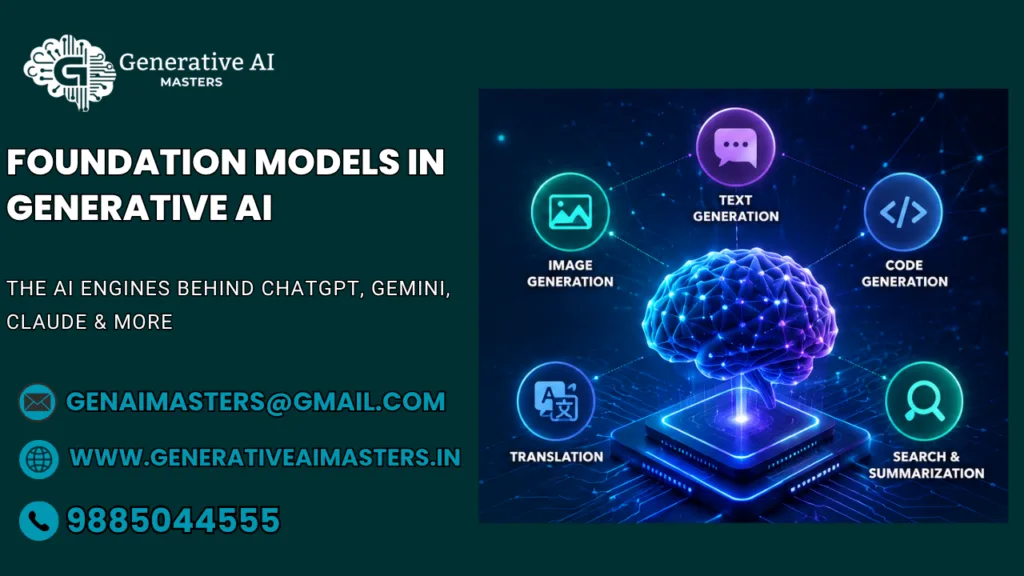
Every time you type a question into ChatGPT, ask Gemini to summarise a report, or watch an AI turn a sentence into an image, one thing is doing the heavy lifting behind the scenes: a foundation model. It’s the single most important idea in modern AI, and yet most people using these tools every day have never heard the term.
Here’s why that matters. A few years ago, if a company wanted an AI to do a new task, it had to train a brand-new model from scratch — slow, expensive, and repetitive. Foundation models flipped that completely. Now you train one powerful “base” model once, and then reshape it for hundreds of different jobs. That single shift is what took AI from research labs into apps you use daily, and it’s why “foundation model” has become the vocabulary word that unlocks everything else in generative AI.
If you’ve ever felt lost in the alphabet soup of AI — GPT, LLM, RAG, transformers — this is the concept that ties it all together. Understand foundation models, and the rest of the field stops feeling like jargon and starts making sense.
In this guide we’ll break down what foundation models are, why they’re called that, how they actually work, the difference between foundation models and LLMs, real-world examples and case studies, and why they matter for your AI career — all in plain English, no maths degree required. If you’re mapping out where this fits in your learning journey, our generative AI learning roadmap is a good companion to keep open alongside this article.
What Are Foundation Models?
A foundation model is a general-purpose AI model trained on massive amounts of data — text, images, code, or a mix — so that it learns broad patterns it can later apply to many specific tasks.
Think of it like a medical student. During years of general training, they learn anatomy, biology, chemistry, and how the whole body works. That broad “foundation” is what lets them later specialise as a cardiologist, a surgeon, or a paediatrician without starting from scratch. Foundation models work the same way: broad training first, specialisation second.
Foundation model in one line
If you had to explain it to a friend in a sentence: a foundation model is one big AI brain, trained once on a lot of data, that many different apps can build on.
The key idea: trained broadly, adapted narrowly
The magic isn’t just the size. It’s the flexibility. A single foundation model can be adapted to:
- Answer customer questions
- Summarise long documents
- Write and debug code
- Generate marketing copy
- Power a search engine
One model, dozens of jobs. That reusability is exactly why foundation models changed everything.
Why Are They Called "Foundation" Models?
The name isn’t marketing — it comes from research. In 2021, a group of researchers at Stanford’s Center for Research on Foundation Models (CRFM) published a widely-cited report that introduced the term. Their argument was simple: these models act as a foundation — a base layer — that countless applications are built on top of, the same way a building’s foundation supports everything above it. You can read Stanford’s own reflections on the foundation models term if you want the origin story straight from the source.
The name stuck because it captures the shift perfectly. Before foundation models, teams trained narrow, single-purpose models. After them, the industry moved to one shared, adaptable base — a genuine change in how AI gets built.
Foundation models vs task-specific models
Task-specific model | Foundation model | |
Training data | Narrow, one job | Broad, many domains |
Reusability | Built for a single task | Adapted to many tasks |
Cost to add a task | Train a whole new model | Fine-tune or prompt the same base |
Example | A spam-only email filter | A model that can filter spam and write emails and translate them |
How Do Foundation Models Work?
You don’t need to understand the maths, but understanding the flow will make everything else click. Here’s the four-stage journey, from raw model to real product.
Step 1 — Pre-training
The model is fed enormous amounts of data and learns to predict what comes next — the next word, the next pixel, the next token. Nobody hand-labels this data; the model teaches itself by spotting patterns. This is called self-supervised learning, and it’s what lets these models learn from the entire internet’s worth of text without an army of humans tagging every sentence.
Step 2 — Adaptation (transfer learning)
Once the base model understands language (or images), that knowledge can be transferred to new tasks. This is transfer learning — reusing what the model already knows instead of relearning it. It’s why you can take one base model and point it at legal documents, medical notes, or customer chats.
Step 3 — Fine-tuning and alignment
Here the model is polished for a specific purpose or made safer and more helpful. A common technique is RLHF (Reinforcement Learning from Human Feedback), where human ratings teach the model which answers are actually useful and which to avoid. This is the step that turns a raw text-predictor into a well-behaved assistant.
Step 4 — Deployment and inference
Finally, the model goes live. When you type a prompt and get an answer, that’s inference — the model applying everything it learned to your specific request in real time.
In short: pre-train broadly → adapt the knowledge → fine-tune for behaviour → deploy for real use. Get that sequence and you understand 90% of how modern AI is built.
Practical tip: You’ll hear “pre-training” and “fine-tuning” used constantly in AI courses and job interviews. Pre-training builds general knowledge (expensive, done once, by big labs). Fine-tuning specialises that knowledge (cheaper, done often, by teams like the one you might join). Knowing the difference cold makes you sound like you’ve actually worked with these systems.
Foundation Models vs LLMs vs Generative AI (The Hierarchy)
This is where most beginners get tangled, because the terms get thrown around as if they mean the same thing. They don’t. Here’s the clean hierarchy.
Concept | What it is | How it relates |
Generative AI | The broad field of AI that creates new content — text, images, audio, code | The umbrella term |
Foundation model | A large, broadly-trained model that can be adapted to many tasks | The engine underneath most generative AI |
Large Language Model (LLM) | A foundation model that specialises in text and language | A type of foundation model |
The simplest way to remember it: Generative AI is the field. Foundation models are the base. LLMs are the text-focused subset of foundation models.
Are all LLMs foundation models?
Yes — an LLM is a foundation model that happens to focus on language. If you want the deeper breakdown, our guide on generative AI vs LLM unpacks exactly where the lines sit.
Are all foundation models generative?
Not necessarily. Some foundation models are built for understanding rather than generating — for example, models that classify text or power search. But the most famous ones (the ones behind ChatGPT, Gemini, and Claude) are generative. To go deeper on the text side specifically, see how large language models work.
Generative AI Training in Hyderabad
Learn LLMs, RAG, fine-tuning and AI agents with live classes, 15+ projects and placement support.
Next batch: 5 Oct 2026 · morning 10 AM & evening 7 PM IST
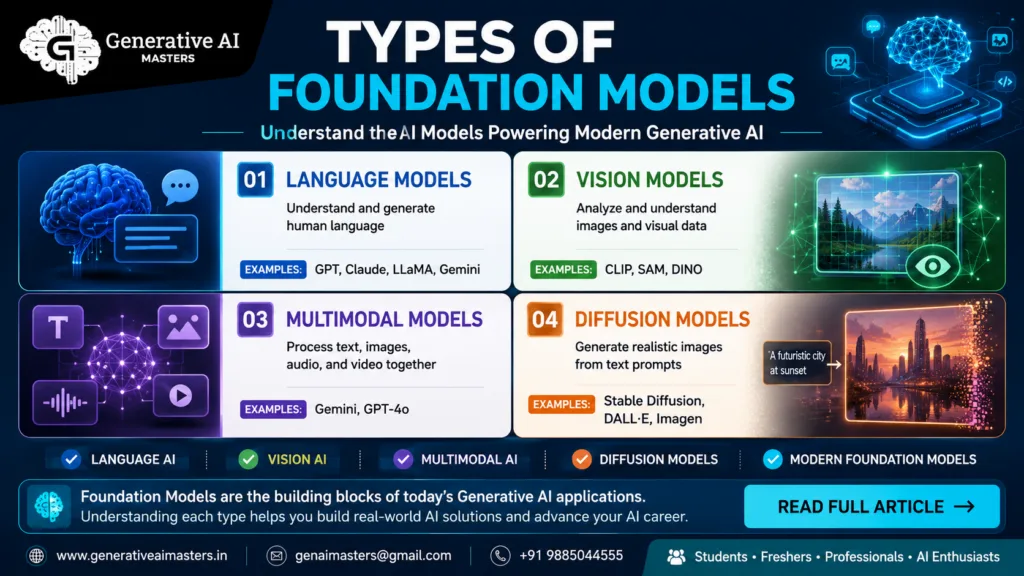
Types of Foundation Models
Foundation models aren’t all the same. They’re usually grouped by the kind of data they were trained on.
Type | Trained on | Good at | Example use |
Language models | Text and code | Writing, reasoning, translation, coding | Chatbots, coding assistants |
Vision models | Images | Recognising and describing images | Image search, medical imaging |
Multimodal models | Text + images (+ audio/video) | Understanding several formats at once | “Describe this photo” features |
Diffusion models | Image–text pairs | Generating images from text | AI art, design tools |
Language models
These are the text specialists — the LLMs we just covered. Underneath, most use a design called the transformer architecture, which relies on an attention mechanism to figure out which words in a sentence matter most to each other. Within language models you’ll hear about encoder-only models (great at understanding), decoder-only models (great at generating), and encoder-decoder models (great at tasks like translation).
Vision and multimodal models
Vision models “see.” Multimodal models combine senses — text and images and sometimes audio — which is why you can now show an AI a picture and ask it a question about it in the same breath.
Diffusion models
These power the AI image boom. A diffusion model learns to start from random noise and gradually “denoise” it into a coherent image that matches your prompt. It’s the technology behind tools like Stable Diffusion and DALL·E.
Examples of Popular Foundation Models (2026)
Let’s put names to the concepts. Here are some of the best-known foundation models and what they’re typically used for. (We’re keeping version numbers out on purpose — these update constantly, but the models themselves stay recognisable.)
Model | Built by | Type | Commonly used for |
GPT | OpenAI | Language (generative) | ChatGPT, writing, coding, chatbots |
Gemini | Multimodal | Text, image and reasoning tasks | |
Claude | Anthropic | Language (generative) | Long-form reasoning, safe assistants |
LLaMA | Meta | Language (open) | Custom and self-hosted AI apps |
BERT | Language (understanding) | Search, text classification | |
Stable Diffusion | Stability AI | Diffusion | Text-to-image generation |
A few of these are worth exploring at the source: Anthropic explains its approach on the official Claude page, and if you ever want to actually load and experiment with open models, the Hugging Face Transformers documentation is the standard starting point. Google’s own explainer on what foundation models are is another clean, vendor-neutral reference.
Key Concepts Behind Foundation Models
A handful of ideas come up again and again. Get comfortable with these and the rest of the AI world becomes much easier to read.
Pre-training vs fine-tuning
Pre-training is the big, expensive, general phase. Fine-tuning is the smaller, targeted phase where the model is shaped for a specific job or tone. Big labs do the pre-training; companies and developers do most of the fine-tuning.
Prompt engineering
Sometimes you don’t retrain the model at all — you just get better at asking. Prompt engineering is the skill of writing instructions that get the best results from a foundation model, and it’s one of the most in-demand practical skills in the field right now. Our prompt engineering for generative AI guide goes deep on this.
Retrieval-Augmented Generation (RAG)
Foundation models don’t know everything, and they don’t know your private data. RAG solves this by letting the model look up relevant information from your own documents before answering — dramatically reducing wrong answers and letting the model work with up-to-date, company-specific knowledge. Here’s a full breakdown of what RAG is in generative AI.
Tokens, parameters and context windows
Three words you’ll see everywhere: tokens are the small chunks of text a model reads and writes; parameters are the internal settings the model learned during training (more parameters usually means more capability); and the context window is how much text the model can consider at once. That’s the vocabulary — you now speak the language.
Want the full, structured version of all this? Take a look at the complete Generative AI Masters syllabus to see how these concepts stack into a job-ready curriculum.
Foundation Models in the Real World (Case Studies)
Theory is fine, but the point of foundation models is what they do. Here are four grounded examples.
Case Study 1 — Text generation (ChatGPT)
ChatGPT is built on a GPT foundation model. The base model learned language from vast text data; fine-tuning and RLHF turned it into the conversational assistant millions use daily. It’s the clearest example of the “one base, many uses” idea — the same underlying model can draft an email, explain a concept, or write code.
Case Study 2 — Search understanding (BERT)
When Google rolled out BERT into Search, it helped the engine understand the intent behind queries rather than just matching keywords — especially for longer, conversational searches. This is a foundation model working invisibly: you never “use BERT,” but it quietly improves results for billions of searches.
Case Study 3 — Image generation (Stable Diffusion & DALL·E)
These diffusion-based foundation models turned text prompts into original images, unlocking a wave of AI design tools. Type “a watercolour fox in a misty forest” and the model generates it — a task that was science fiction a few years ago.
These diffusion-based foundation models turned text prompts into original images, unlocking a wave of AI design tools. Type “a watercolour fox in a misty forest” and the model generates it — a task that was science fiction a few years ago.
Case Study 4 — Enterprise RAG assistants
Companies increasingly wrap a foundation model in a RAG system so it can answer questions using their own internal documents — think a support bot that actually knows your product’s return policy because it’s reading the real policy document, not guessing. This pattern is now one of the most common ways businesses deploy AI. NVIDIA’s generative AI glossary is a useful reference for how these enterprise pieces fit together, and IBM’s overview of foundation models covers the business angle well.
Industry insight: McKinsey’s research on AI adoption has reported that a large and growing share of organisations now use generative AI in at least one business function — and RAG-style assistants are one of the fastest-spreading use cases. In other words, the “foundation model + your data” pattern isn’t a lab experiment; it’s becoming standard business tooling.
Best Practices, Common Mistakes & Practical Tips
If you’re moving from knowing about foundation models to working with them, here’s what actually helps.
Best practices
- Start with prompting before you reach for fine-tuning — you’ll solve more problems than you’d expect without touching the model.
- Use RAG when answers need to be accurate, current, or based on private data.
- Always evaluate outputs; foundation models are confident even when they’re wrong.
Common mistakes to avoid
- Assuming bigger is always better. A smaller, well-fine-tuned model often beats a giant general one for a specific task.
- Confusing “it sounds right” with “it is right.” Foundation models can hallucinate — produce fluent but false information. Verification matters.
- Skipping the fundamentals. Jumping straight to fancy tools without understanding pre-training, tokens, and prompting leaves gaps that show up fast in interviews and real projects.
Practical tips for learners
- Build one small project end-to-end (a chatbot or a document summariser) rather than reading endlessly.
- Learn prompt engineering early — it’s the highest-leverage, lowest-barrier skill.
- Get hands-on with an open model through a platform like Hugging Face so the concepts stop being abstract.
Why Foundation Models Matter for Your AI Career
Here’s the part that turns theory into opportunity. Nearly every generative AI job today is, in some form, a job built on foundation models.
Job roles built on foundation models
- Generative AI Engineer — builds applications on top of foundation models
- Prompt Engineer — designs the instructions that get the best model outputs
- LLM Engineer — works specifically with large language models, fine-tuning and integration
- AI Application Developer — ships real products powered by these models
Skills employers expect
Python, an understanding of LLMs, prompt engineering, RAG, and the ability to fine-tune and deploy models. Notice that every one of those maps directly back to the concepts in this article.
Industry insight — the money side: Salaries for these roles in India vary widely by experience and city, but commonly-reported ranges on platforms like Glassdoor and AmbitionBox put entry-level generative AI and AI engineering roles in the region of a few lakhs per annum, rising sharply into the double digits (and well beyond for senior, specialised roles). Treat these as ranges, not promises, and always check current listings — but the direction is unmistakably up. For a fuller picture, see our breakdown of generative AI salaries in India.
Hyderabad specifically has become a genuine AI hub, with product companies and service giants alike hiring for these roles across HITEC City, Gachibowli, and the KPHB–JNTU corridor — which makes it one of the better places in India to train and launch an AI career.
How to Learn Foundation Models the Right Way
You can absolutely start on your own — read, watch, and experiment with free tools. Self-study builds real intuition, and you should do plenty of it.
But there’s a ceiling to self-study. A good structured programme gives you three things it’s hard to get alone: a sequence (so you learn concepts in the order that builds on itself), real projects (so you have a portfolio, not just notes), and feedback (so your mistakes get corrected before an interviewer finds them).
A strong curriculum should move you from Python and machine learning basics, through LLMs and the transformer idea, into prompt engineering, RAG, and finally building and deploying real AI applications — mirroring the exact pipeline foundation models themselves follow. If you want to see how that path is structured, revisit the generative AI learning roadmap.
If you’re serious about turning this knowledge into a career, structured, hands-on generative ai training in hyderabad with real projects and placement support is the fastest way to go from understanding foundation models to building with them professionally. That’s exactly what we do at Generative AI Masters — take you from “I finally get what a foundation model is” to “I built one into a working application.”
Conclusion
Foundation models are the quiet engine behind the entire generative AI wave. Once you understand that a single, broadly-trained model can be reshaped for countless jobs, the rest of the field stops feeling like a pile of buzzwords and starts making sense. You now know what they are, why they’re called “foundation” models, how they’re trained, how they differ from LLMs, and where they show up in real products you use every day.
The takeaways to hold onto:
- A foundation model is one large, broadly-trained model that can be adapted to many tasks — the base layer under most generative AI.
- The hierarchy is simple: Generative AI (the field) → Foundation models (the base) → LLMs (the text-focused subset).
- They work in four stages: pre-train → adapt → fine-tune → deploy.
- Real tools like ChatGPT, Google Search, and AI image generators are all foundation models in action.
- Understanding them — plus prompt engineering and RAG — is the foundation of a generative AI career.
The concepts are the easy part. The real advantage comes from building with them — writing prompts that work, wiring up RAG, and shipping a project you can show an employer. That’s the jump self-study rarely makes on its own, and it’s exactly where structured, hands-on training pays for itself.
Ready to stop reading about foundation models and start building with them? Explore our hands-on programme and take the next step toward a real AI career with Generative AI Masters.
Frequently Asked Questions
1.What are foundation models in generative AI?
Foundation models are large AI models trained on broad datasets that can be adapted to many different tasks, such as text generation, image creation, translation, and coding. They act as the base layer for most modern generative AI tools.
2. What is the difference between a foundation model and an LLM?
A foundation model is any large, broadly-trained model that can be adapted to many tasks. A large language model (LLM) is a type of foundation model that specialises in text and language. So every LLM is a foundation model, but not every foundation model is an LLM.
3.Why are they called foundation models?
The term was introduced by Stanford’s Center for Research on Foundation Models in 2021. They’re called “foundation” models because they act as a base that countless applications are built on top of, similar to how a building’s foundation supports everything above it.
4. What are some examples of foundation models?
Popular examples include GPT (which powers ChatGPT), Gemini, Claude, LLaMA, BERT, and Stable Diffusion. Each is trained on large datasets and adapted for tasks like chatting, search, or image generation.
5. How are foundation models trained?
They’re trained in stages: first pre-training on huge datasets using self-supervised learning, then adaptation through transfer learning, followed by fine-tuning and alignment (often with human feedback), and finally deployment for real-world use.
6.Are foundation models the same as ChatGPT?
No. ChatGPT is an application built on top of a GPT foundation model. The foundation model is the underlying engine; ChatGPT is one product that uses it.
7. Do I need to learn foundation models to get a generative AI job?
Yes, at least conceptually. Nearly every generative AI role builds on foundation models, so understanding how they work, along with prompt engineering and RAG, is essential for roles like Generative AI Engineer or Prompt Engineer.
8. Are foundation models covered in generative AI training in Hyderabad?
Yes. A good generative AI course in Hyderabad covers foundation models, LLMs, prompt engineering, RAG, and hands-on projects, taking you from core concepts to building and deploying real AI applications.

Mr. Dinesh Tunguturi Generative AI Trainer
GenAI Masters AI Experts | 60+ Articles Published on Generative AI, Prompt Engineering, LLMs & AI Careers
Mr. Dinesh is a Generative AI Trainer with expertise in Large Language Models (LLMs), Prompt Engineering, Agentic AI, RAG, and AI Automation. He helps students and professionals gain practical, job-ready AI skills through hands-on training, real-world projects, and industry-focused mentorship.
Turn this knowledge into a career: Generative AI Training in Hyderabad
Learn LLMs, RAG, fine-tuning and AI agents with live classes, 15+ projects and placement support.
₹35,000 online · ₹40,000 classroom · 60+ live hours · 3 months · ★ 4.9 from 51 Google reviews