What Is Large Language Models in AI?

- Dinesh Tunguturi
- May 7, 2026
- 6:19 pm
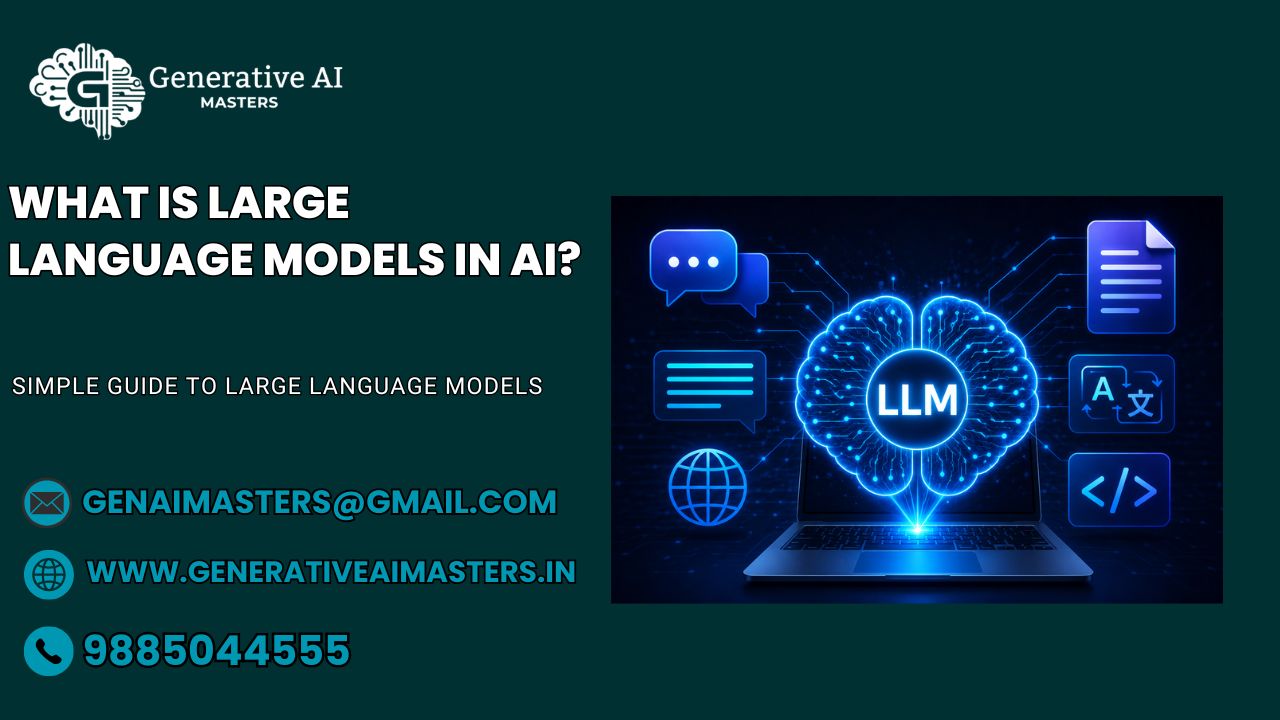
Table of Contents
What Is Large Language Models in AI?
What Are Large Language Models in AI? Large Language Models (LLMs) are advanced AI systems that can understand, generate, and respond to human language like a real person. These models are trained on huge amounts of text data, which helps them answer questions, write content, translate languages, summarize information, and even generate code. Tools like ChatGPT use LLM technology to interact with users naturally. Today, Large Language Models are widely used in education, business, healthcare, customer support, and software development because they make communication and automation faster and smarter.
Overview of What Is Large Language Models in AI?
Topic | Simple Explanation |
What Are Large Language Models in AI? | Large Language Models (LLMs) are advanced AI systems that can understand and generate human language. In simple words, if we ask a question, these AI models can give answers like humans. |
Why Are They Called “Large”? | These models are trained using billions of words and massive datasets. Since they use a very large amount of data, they are called “Large” Language Models. |
What Do LLMs Do? | LLMs can answer questions, write blogs, create emails, help with coding, translate languages, and generate summaries. |
How Do LLMs Work? | LLMs learn language patterns by reading huge amounts of text data from the internet, books, articles, and code. Then they predict suitable responses based on user questions. |
Real Example | AI tools like ChatGPT, Gemini, and Claude all use LLM technology. |
Technologies Used in LLMs | LLMs use technologies like Machine Learning, Deep Learning, Natural Language Processing (NLP), and Transformer Models. |
Where Are LLMs Used? | LLMs are used in Education, Healthcare, Banking, Customer Support, Software Development, Digital Marketing, Content Writing, and AI Chatbots. |
Benefits of LLMs | LLMs provide fast responses, automation, higher productivity, time savings, multilingual support, and smart communication. |
Limitations of LLMs | Sometimes LLMs may provide incorrect information or outdated answers because they depend on training data from the internet. |
Difference Between Normal Chatbots and LLMs | Traditional chatbots can only provide fixed answers. LLMs can understand context and generate dynamic human-like responses. |
Why Are LLMs Important? | As companies move toward AI automation, LLMs are becoming very important for future technology and jobs. |
Career Opportunities | There is growing demand for roles like Prompt Engineer, AI Engineer, NLP Engineer, Machine Learning Engineer, and AI Content Specialist. |
Skills Needed to Learn LLMs | Learning Python basics, AI fundamentals, Prompt Engineering, NLP concepts, and API usage can help beginners start learning LLMs easily. |
Future of LLMs | In the future, AI assistants, smart search engines, AI agents, voice assistants, and automation tools will become even more advanced. |
Simple Final Understanding | In simple words, LLMs are smart AI brains that can understand human language and generate human-like responses. |
What Are Large Language Models in AI?
Large Language Models (LLMs) are advanced AI systems that can understand and generate human language like a real person. In simple words, they can answer questions, write content, create summaries, and even help with coding. These models are trained on huge amounts of data from books, websites, articles, and code, which helps them learn language patterns quickly. Tools like ChatGPT and Gemini use Large Language Model technology to interact with users naturally. Today, LLMs are playing an important role in industries like education, business, healthcare, and software development because they make work faster, smarter, and more efficient.
Generative AI Training in Hyderabad
Learn LLMs, RAG, fine-tuning and AI agents with live classes, 15+ projects and placement support.
Next batch: 5 Oct 2026 · morning 10 AM & evening 7 PM IST
How Do Large Language Models Work?
Large Language Models (LLMs) are AI systems trained on huge amounts of text data like books, websites, and articles. They learn language patterns and use them to generate human-like responses.
These models work by predicting the next word in a sentence based on previous words. This is how AI tools can answer questions, write content, and hold conversations naturally.
In 2026, LLMs are widely used in India for education, customer support, coding, and content creation.
How ChatGPT Gives Answers
The process starts when a user enters a question or prompt. The AI reads the input and understands the topic.
AI analyzes patterns
The model checks patterns learned during training, including:
- Word relationships
- Sentence structure
- User intent
This helps the AI understand what type of response is needed.
Generates human-like responses
The AI predicts words one by one to create natural responses. This makes conversations feel smooth and human-like.
Modern AI tools in 2026 can generate blogs, emails, summaries, and even code within seconds.
Data Training and Machine Learning
Internet data and text datasets
LLMs are trained using large datasets collected from:
- Websites
- Books
- Blogs
- Research articles
This training helps the model understand different topics and writing styles.
Learning patterns from examples
Machine learning helps AI learn from examples instead of fixed rules. The model learns:
- Grammar
- Context
- Sentence flow
- Common responses
The more data it sees, the better it performs.
Continuous improvement through training
AI models improve through regular updates and human feedback. In 2026, LLMs are becoming faster, smarter, and more accurate.
Role of Neural Networks in LLMs
Basic overview of neural networks
Neural networks are systems that help AI process information and identify language patterns. They are the core technology behind LLMs.
Human brain comparison
Neural networks are inspired by the human brain. Just like humans learn through experience, AI learns through data and examples.
Understanding context and meaning
Neural networks help AI understand the meaning of words based on context.
Real-Life Examples of Large Language Models
Large Language Models are already being used in many AI tools that people use daily for learning, productivity, content creation, coding, and customer support.
In 2026, AI-powered tools are becoming common in schools, companies, startups, and online businesses across India.
ChatGPT
ChatGPT is one of the most popular Large Language Model applications used worldwide.
Content writing
ChatGPT helps users create:
- Blog articles
- Social media captions
- Emails
- Product descriptions
Many digital marketers and students in India use it to save time and improve productivity.
Answer generation
Users can ask questions on different topics and receive quick explanations in simple language. This makes it useful for learning and research.
Coding help
Developers use ChatGPT for:
- Writing code
- Fixing errors
- Learning programming concepts
- Creating scripts
This helps improve developer productivity.
Gemini
Google Gemini is Google’s AI-powered assistant designed to improve search and productivity tasks.
Google AI assistant features
Gemini can help users:
- Summarize information
- Generate content
- Answer questions
- Assist with daily tasks
It integrates with Google services and AI tools.
Search and productivity support
Many users rely on Gemini for:
- Smart search results
- Document assistance
- Email drafting
- Productivity support
In 2026, AI assistants are becoming an important part of workplace productivity.
AI Chatbots
AI chatbots are widely used by businesses to communicate with customers automatically.
Customer support bots
Many companies use AI chatbots to answer:
- Customer queries
- Order updates
- Service requests
- Frequently asked questions
This improves response speed and customer experience.
Website assistants
Website AI assistants help visitors by:
- Providing information
- Guiding users
- Recommending products
- Offering instant support
Many ecommerce and education websites in India now use AI chatbots.
Coding AI Tools
AI-powered coding tools help developers write and manage code more efficiently.
AI code generation
Coding AI tools can generate:
- Code snippets
- Functions
- Scripts
- Website components
This helps developers complete tasks faster.
Debugging assistance
AI tools can identify coding errors and suggest fixes. This reduces debugging time and improves accuracy.
Developer productivity tools
In 2026, developers use AI tools to:
- Automate repetitive coding tasks
- Improve code quality
- Learn new programming languages
- Increase development speed
These tools are becoming essential in modern software development.
Applications of Large Language Models
Large Language Models are being used across many industries to automate tasks, improve productivity, and provide better user experiences.
In 2026, businesses in India are rapidly adopting AI-powered solutions for education, healthcare, marketing, customer support, and software development.
LLMs in Education
Large Language Models are transforming the education sector by making learning more personalized and accessible.
AI tutors
AI-powered tutors help students understand concepts, answer questions, and provide instant explanations anytime.
Personalized learning
LLMs can create customized learning experiences based on student performance and learning speed.
Assignment support
Students use AI tools for:
- Research assistance
- Content summaries
- Idea generation
- Practice questions
This helps improve learning efficiency.
LLMs in Healthcare
Healthcare organizations are using LLMs to improve medical workflows and patient communication.
Medical documentation
AI tools help doctors create:
- Medical reports
- Patient notes
- Clinical documentation
This reduces manual paperwork.
Patient support systems
AI chatbots assist patients by answering basic healthcare questions and appointment-related queries.
Research assistance
Researchers use AI to summarize medical studies and analyze healthcare information faster.
LLMs in Marketing
Marketing teams use Large Language Models to create content and improve digital campaigns.
Content creation
AI tools help generate:
- Blog articles
- Product descriptions
- Email content
This saves time for marketers and businesses.
SEO writing
LLMs assist with:
- Keyword-based content
- Meta descriptions
- SEO-friendly blog writing
Many digital marketing agencies in India use AI for content optimization in 2026.
Social media captions
AI tools can quickly create engaging captions, hashtags, and promotional content for social media platforms.
LLMs in Customer Support
Many businesses use AI-powered support systems to improve customer service.
24/7 chatbot support
AI chatbots can respond to customer questions anytime without human intervention.
Faster responses
LLMs help companies provide quick and accurate replies, improving customer satisfaction.
Automated ticket handling
AI systems can:
- Categorize support tickets
- Route customer issues
- Generate basic responses
This reduces workload for support teams.
LLMs in Software Development
Software companies use LLMs to speed up development and improve coding efficiency.
Code generation
AI tools can generate code snippets and basic program structures based on user instructions.
Bug fixing
Developers use AI to identify coding errors and receive debugging suggestions quickly.
Documentation writing
LLMs help create:
- Technical documentation
- Code explanations
- User guides
This improves communication and project management within development teams.
Benefits of Large Language Models
Large Language Models are helping businesses and individuals complete tasks faster and more efficiently. In 2026, many companies in India are adopting LLMs to improve productivity, automate work, and enhance customer experience.
Faster Task Completion
LLMs can generate responses and complete tasks within seconds, helping users save time.
Saves time
AI tools reduce the time required for:
- Writing content
- Answering questions
- Research tasks
- Customer support
This allows businesses to work more efficiently.
Quick response generation
LLMs can instantly generate:
- Emails
- Blog content
- Summaries
- Chat replies
This improves speed and workflow productivity.
Automation of Repetitive Work
Large Language Models help automate routine and repetitive tasks.
Reduces manual effort
AI systems can handle repetitive activities like:
- Data entry
- Content drafting
- Basic customer support
- Report generation
This reduces human workload.
Improves workflow efficiency
Automation helps businesses:
- Save operational time
- Improve task management
- Increase overall efficiency
Many companies in India are using AI automation tools in 2026 to streamline daily operations.
Improved Productivity
LLMs help individuals and teams complete more work in less time.
Helps teams work faster
AI tools assist employees with:
- Content creation
- Coding
- Documentation
- Research support
This increases team productivity.
Supports multiple tasks simultaneously
LLMs can handle different tasks at the same time, such as:
- Writing
- Answering queries
- Generating ideas
- Analyzing information
This makes workflows faster and more organized.
Better User Experience
Large Language Models improve interactions between businesses and users.
Human-like conversations
AI chatbots and assistants can communicate naturally, making conversations feel more engaging and user-friendly.
Personalized interactions
LLMs can provide customized responses based on user needs and preferences. This improves customer satisfaction and overall user experience.
Conclusion - Is Generative AI a Good Career in 2026?
Large Language Models (LLMs) are transforming the way people interact with technology. These AI systems can understand language, generate human-like responses, create content, assist with coding, and automate many daily tasks.
In this article, we explored:
- How Large Language Models work
- Real-life examples of LLMs
- Applications across industries
- Benefits of AI-powered systems
- Frequently asked questions about LLMs
In 2026, AI is becoming an essential part of industries like education, healthcare, marketing, customer support, and software development. Businesses across India are actively adopting AI tools to improve productivity and efficiency.
Learning about Large Language Models today can open new career opportunities in:
- Generative AI
- Machine Learning
- Prompt Engineering
- AI-powered content creation
- Software development
As AI technology continues growing, professionals with practical AI skills will be in high demand.
If you want to build a career in AI, now is the right time to start learning Generative AI and Large Language Models.
At Generative AI Masters, you can learn:
- Generative AI fundamentals
- Prompt engineering
- AI tools and applications
- Real-world projects
- Practical industry skills
Start your AI career journey today and prepare for the future of technology with hands-on Generative AI training.
FAQ’s Skills Required for an AI Engineer (2026)
A Large Language Model (LLM) is an AI system that understands and generates human language. It learns from huge amounts of text data and can answer questions, write content, and have conversations.
Yes, ChatGPT is powered by a Large Language Model. It uses AI technology to understand user questions and generate human-like responses.
LLMs learn by analyzing large datasets such as books, websites, articles, and online text. They identify language patterns, sentence structures, and relationships between words through machine learning.
Some popular examples of Large Language Models include:
- ChatGPT
- Google Gemini
- Claude
- Llama
These AI tools are widely used in 2026 for productivity and automation.
Yes, LLMs are a major part of Generative AI. They can generate text, answer questions, create content, and support conversational AI applications.
Many industries use LLMs, including:
- Education
- Healthcare
- Marketing
- Customer support
- Software development
- Finance
Businesses in India are increasingly adopting AI solutions across these sectors.
LLMs can automate some repetitive tasks, but they are mainly designed to assist humans rather than fully replace them. Human creativity, decision-making, and critical thinking are still important in many industries.
LLMs can provide highly useful responses, but they are not always 100% accurate. Their accuracy depends on:
- Training data quality
- User prompts
- Context understanding
Users should verify important information, especially in technical or medical topics.
The future of LLMs looks very strong in 2026 and beyond. AI models are becoming:
- Smarter
- Faster
- More personalized
- Better at understanding context
Large Language Models are expected to play a major role in business automation, education, healthcare, and digital transformation worldwide.
Turn this knowledge into a career: Generative AI Training in Hyderabad
Learn LLMs, RAG, fine-tuning and AI agents with live classes, 15+ projects and placement support.
₹35,000 online · ₹40,000 classroom · 60+ live hours · 3 months · ★ 4.9 from 51 Google reviews