AI Data Science Jobs in India
AI data science jobs in India include roles such as data analyst, data scientist, machine learning engineer, AI engineer, and generative AI developer. Most roles require Python, SQL, statistics, machine learning, and a strong project portfolio. Hiring spans IT services, product companies, startups, banks, and healthcare. The best path is to learn core skills, build real projects, and apply for entry-level roles in cities like Hyderabad, Bengaluru, Pune, and Delhi NCR.
Table of Contents
Introduction to AI Data Science Jobs in India
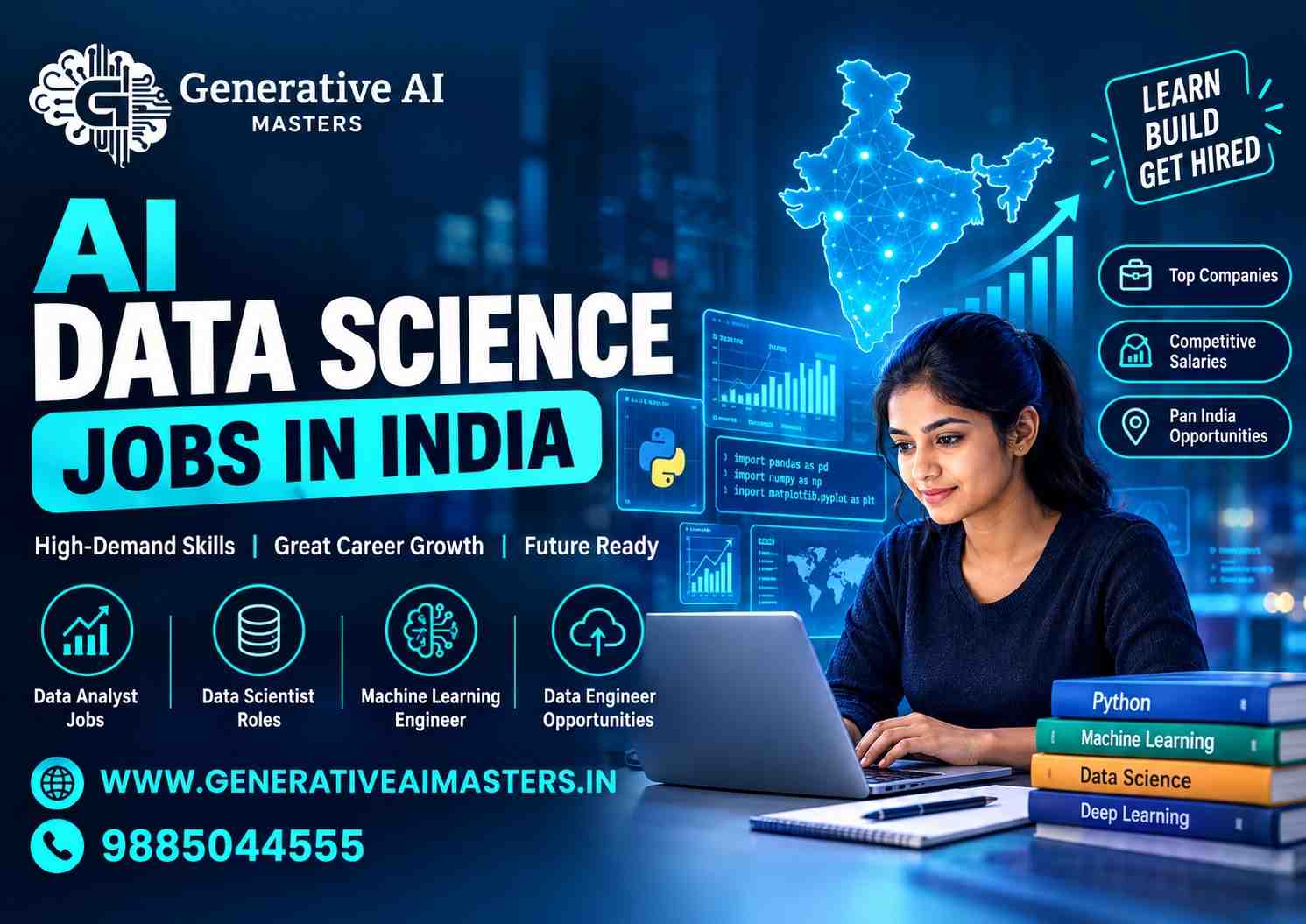
Every year, thousands of Indian students and professionals search for AI data science jobs. Most of them ask the same thing: where do I start, and what do employers actually want?
Data science is the practice of using data, statistics, and code to find patterns and make decisions. Artificial intelligence (AI) is the broader field of building systems that do tasks that normally need human intelligence, such as understanding language or recognising images. Today the two overlap heavily. A modern data scientist often builds machine learning models. An AI engineer often works with data pipelines. Many job titles blur together.
This guide is a career map for the Indian market, with a closer look at Hyderabad. It explains which roles exist, what each one needs, what to learn first, which projects to build, and how to prepare for interviews. It is written by the team at Generative AI Masters, a Hyderabad-based Generative AI training institute.
What Are AI Data Science Jobs?
AI data science jobs are roles where you collect, clean, analyse, and model data, then use machine learning or AI to solve business problems. The output might be a sales forecast, a fraud alert, a recommendation engine, or a chatbot that answers customer questions.
Think of a data team like a restaurant kitchen. Data engineers bring in the ingredients. Analysts taste and describe them. Data scientists create new recipes. Machine learning engineers make sure the recipe can be cooked for ten thousand customers every day. AI engineers add smart new equipment, such as language models.
The common thread is simple: turn raw data into useful decisions.
Why AI Data Science Careers Are Growing in India
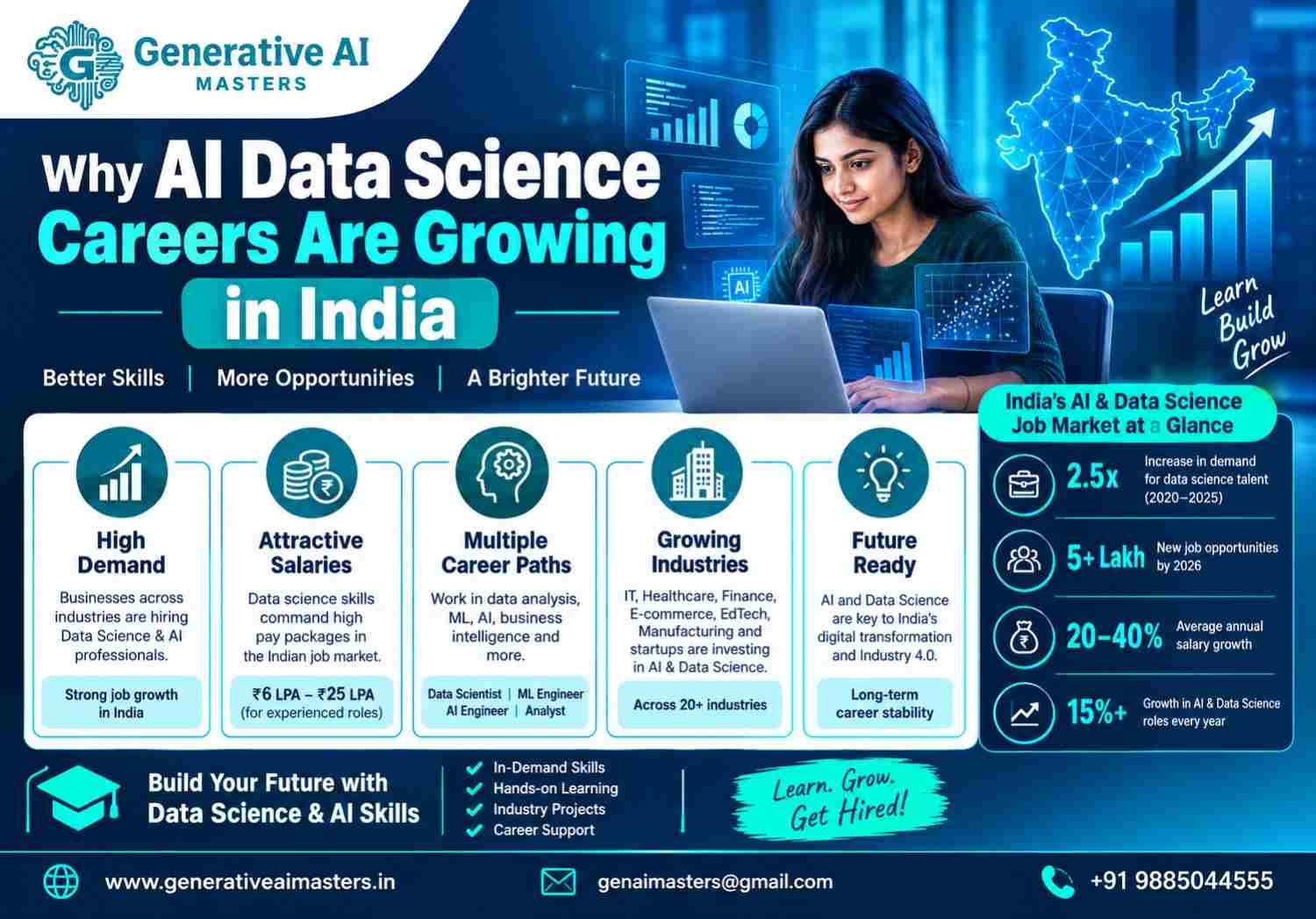
Indian organisations are adopting AI because they hold large amounts of data and need faster, cheaper, and smarter decisions. Several forces push this along:
- Digital payments and fintech produce huge transaction data, which feeds fraud detection and credit scoring.
- E-commerce and delivery apps depend on recommendations, demand forecasting, and route optimisation.
- Global capability centres (GCCs) set up by international firms in India run advanced analytics and AI work.
- Healthcare, agriculture, and public services are using AI for diagnosis support, crop advisory, and planning.
- Generative AI has opened a new category of roles. You can see the range in these generative AI applications, from chatbots to document search.
Industry bodies are tracking this shift too. NASSCOM’s report on India’s generative AI startup landscape maps how fast new companies are forming around the technology.
Frameworks and tools from companies like Google, Microsoft, Meta, and OpenAI, along with open-source libraries, have also lowered the cost of getting started. You can learn and practise with a laptop and an internet connection.
Complete Career Overview: Roles, Skills, and Learning Steps
Before we go deep, here is the full path in one view. Use it as your checklist.
Step-by-Step Learning Path
Step | Topics to Learn | Recommended Tools | Expected Outcome |
1 | Maths, statistics, probability | Khan Academy, NumPy | Understand how data behaves |
2 | Python programming | Python, Jupyter Notebook | Write clean scripts for data tasks |
3 | SQL and databases | MySQL, PostgreSQL, BigQuery | Pull and join data from tables |
4 | Data analysis and visualisation | Pandas, Matplotlib, Power BI, Tableau | Turn data into clear insights |
5 | Machine learning | Scikit-learn, XGBoost | Build and evaluate predictive models |
6 | Deep learning | PyTorch, TensorFlow | Work with images, text, and sequences |
7 | Generative AI and LLMs | OpenAI API, Anthropic API, Hugging Face, LangChain | Build AI-powered applications |
8 | Deployment and MLOps basics | Git, Docker, FastAPI, cloud platforms | Put models into real use |
Top AI Data Science Job Roles in India
Job titles vary between companies, so focus on the work rather than the label.
Data Analyst
A data analyst answers business questions using data, dashboards, and reports. This is often the best entry point. You work with SQL, Excel, and visualisation tools, and you learn how the business thinks.
Data Scientist
A data scientist builds statistical and machine learning models to predict outcomes or find patterns. You need strong statistics, Python, and the ability to explain results to non-technical people.
Machine Learning Engineer
An ML engineer takes models from notebooks to production. You write cleaner code, build pipelines, monitor models, and work closely with software teams.
AI Engineer / Generative AI Engineer
An AI engineer builds applications using pretrained models, especially large language models. Typical work includes retrieval-augmented generation (RAG), chatbots, AI agents, and evaluation systems.
Data Engineer
A data engineer builds the pipelines that collect and store data reliably. Without this work, nobody else on the team has clean data. Tools include SQL, Spark, Airflow, and cloud warehouses.
Salary Ranges for AI Data Science Jobs in India
Pay depends on skills, city, employer type, and your ability to show real work. The ranges below are rough annual estimates in lakhs per annum (LPA). Check current listings on Naukri, LinkedIn, and AmbitionBox before making decisions.
Experience | Typical Range (approximate) |
Fresher (0–1 year) | ₹3–7 LPA |
1–3 years | ₹8–14 LPA |
3–5 years | ₹14–22 LPA |
5–8 years | ₹20–32 LPA |
Senior / lead roles | ₹35 LPA and above |
Product companies and global capability centres often pay more than service companies. Specialised skills in generative AI, MLOps, or production machine learning can also lift offers. For a deeper breakdown by role, see our guide to generative AI salary in India.
Generative AI Training in Hyderabad
Learn LLMs, RAG, fine-tuning and AI agents with live classes, 15+ projects and placement support.
Next batch: 5 Oct 2026 · morning 10 AM & evening 7 PM IST
Which Companies and Sectors Hire?
Hiring is spread across many types of organisations.
- IT services and consulting: firms like TCS, Infosys, Wipro, HCLTech, Accenture, and Cognizant hire in large numbers, including freshers.
- Product and technology companies: Google, Microsoft, Amazon, and similar firms hire for deeper technical roles.
- Global capability centres: many multinational companies run large analytics and AI teams in India.
- Startups: fintech, healthtech, edtech, and SaaS startups often give broad responsibility early.
- Banks and insurers: risk, fraud, and customer analytics.
- Healthcare, retail, telecom, and manufacturing: forecasting, quality control, and personalisation.
Bengaluru, Hyderabad, Pune, Chennai, Mumbai, and Delhi NCR have the largest concentrations of roles. Remote and hybrid roles exist, but entry-level roles are still mostly office or hybrid.
Pro Tip: Apply to a mix of company types. Service companies give training and scale. Startups give speed and ownership. Both are valid launchpads.
AI Data Science Jobs in Hyderabad
Hyderabad is one of India’s strongest cities for AI and data roles, with demand across IT services, product companies, global capability centres, and startups. Most of this work clusters in HITEC City, Gachibowli, and the Financial District.
Common entry points in the city include:
- Data analyst and junior data scientist roles
- AI engineer and generative AI developer roles
- Machine learning and MLOps roles
- Roles in LLM applications, RAG systems, and AI agents
Fresher pay for AI engineer roles in Hyderabad is commonly estimated at ₹3–7 LPA. It rises with 1–3 years of experience and strong, deployable projects.
Pro Tip: Hyderabad employers often ask you to demo a project. A deployed app you can open in an interview is more convincing than a certificate.
Skills Required for AI Data Science Jobs
The core skills are Python, SQL, statistics, machine learning, data visualisation, and communication. For a role-by-role view, read our list of skills required for an AI engineer.
Technical skills
- Python, NumPy, and Pandas for data handling
- SQL for working with databases (almost every interview tests this)
- Statistics and probability: distributions, hypothesis testing, confidence intervals
- Machine learning: regression, classification, clustering, evaluation metrics
- Deep learning basics: neural networks, PyTorch or TensorFlow
- Generative AI: prompting, LLM APIs, RAG, embeddings
- Git and GitHub for version control
- Cloud basics: AWS, Azure, or Google Cloud
Non-technical skills
- Problem framing: turning a vague business question into a data question
- Storytelling: explaining results in plain language
- Curiosity and patience: most data work is cleaning, not modelling
- Collaboration with engineers, product managers, and business teams
Quick Tip: Employers often reward people who can explain a simple model clearly over those who use a complex model they cannot explain.
Step-by-Step Roadmap to Get an AI Data Science Job
Step 1: Build Your Maths and Statistics Foundation
Learn just enough maths to understand what models are doing. Focus on mean, median, variance, probability, correlation, basic linear algebra (vectors and matrices), and the idea of a derivative.
You do not need a maths degree. You need to understand why a model behaves the way it does.
Milestone: you can explain overfitting and the difference between correlation and causation.
Step 2: Learn Python
Python is the main language of data science and AI. Start with variables, loops, functions, and data structures. The official Python tutorial is a solid free place to begin. Then move to NumPy for numerical work and Pandas for tables.
Practice in Jupyter Notebook or Google Colab. Write small scripts that load a CSV, clean it, and summarise it.
Milestone: you can load a messy dataset and prepare it for analysis without copying code line by line.
Step 3: Learn Machine Learning
Machine learning is teaching computers to learn patterns from data instead of writing explicit rules. Start with scikit-learn, and keep its documentation open as you practise. Learn:
- Linear and logistic regression
- Decision trees, random forests, and gradient boosting (XGBoost, LightGBM)
- Clustering (k-means)
- Train-test split and cross-validation
- Metrics: accuracy, precision, recall, F1, ROC-AUC, RMSE
- Feature engineering
Real-world analogy: training a model is like preparing for an exam with practice papers. If you only memorise the old papers, you fail new questions. That is overfitting.
Milestone: you can build, evaluate, and improve a model on a real dataset.
Step 4: Learn Deep Learning
Deep learning uses multi-layer neural networks to learn complex patterns, especially from images, audio, and text. Learn PyTorch first, using the official PyTorch tutorials. TensorFlow and Keras are also worth knowing.
Study neural networks, backpropagation, convolutional networks, recurrent networks, and the Transformer architecture that powers modern language models.
Milestone: you can train a small image or text classifier and explain how it learned.
Step 5: Learn Generative AI and LLMs
Generative AI refers to models that create new content such as text, images, code, or audio. Large language models (LLMs) from OpenAI, Anthropic, Google DeepMind, and Meta AI are now a major part of data and AI work. If you want the basics first, read how generative AI works.
Learn these in order:
- Prompt engineering: clear instructions, few-shot examples, and structured outputs. OpenAI’s prompt engineering guide is a good reference.
- LLM APIs: the OpenAI API, Anthropic API, and Google AI Studio.
- Embeddings and vector databases: Chroma, FAISS, Pinecone, or Weaviate.
- RAG (Retrieval-Augmented Generation): letting a model answer using your own documents.
- Frameworks: LangChain, LangGraph, and LlamaIndex.
- Hugging Face: open models and datasets.
- Evaluation and guardrails: testing quality and preventing unsafe output.
For a fuller walkthrough of each stage, follow our generative AI roadmap.
Essential Tools for AI Data Science Careers
Category | Tools |
Programming | Python, SQL |
Data libraries | NumPy, Pandas, Polars |
Visualisation | Matplotlib, Seaborn, Power BI, Tableau |
Machine learning | Scikit-learn, XGBoost |
Deep learning | PyTorch, TensorFlow, Keras |
Generative AI | OpenAI API, Anthropic API, Google AI Studio, Hugging Face, LangChain, LlamaIndex |
Vector search | Chroma, FAISS, Pinecone, Weaviate |
Big data | Spark, Airflow |
Deployment | Docker, FastAPI, AWS, Azure, Google Cloud |
Collaboration | Git, GitHub, Jupyter, Google Colab |
Want a wider list? See our overview of generative AI tools. NVIDIA’s GPUs power much of deep learning, but you can start for free using Google Colab or Kaggle notebooks.
How to Learn These Skills in Hyderabad
The fastest way to learn AI skills is structured, hands-on practice with a trainer who can answer your doubts. You can do this through self-study, recorded lessons, or live classes.
If you want live, instructor-led training, Generative AI Masters runs a Generative AI training in Hyderabad programme near JNTU Metro Station, Kukatpally. It is taught by Dinesh Tunguturi, who has worked in industry since 2016 and builds LLM and RAG applications today. Key details:
- 3 months, with 60+ live class hours and 15+ projects
- Python from scratch, then LLMs, prompt engineering, RAG, LangChain, fine-tuning, and AI agents
- Online, classroom, and hybrid batches, with doubt support in English, Hindi, and Telugu
- Maximum 15 students per batch and lifetime class recordings
- Fees from ₹35,000 online to ₹40,000 classroom, with EMI available
SQL and statistics are not part of the core syllabus, so learn them alongside the course using the steps above. You can see real examples in the student projects and compare options on the course fees page. If you want to go deeper into agents or deployment, see the Agentic AI course in Hyderabad.
Placement note: Placement support covers resume and LinkedIn reviews, mock interviews, and referrals. It is not a job guarantee, and outcomes depend on your projects and interview performance.
Quick Tip: Attend a free demo class before paying for any course. Check the trainer, the tools, and whether you can build something yourself.
Beginner vs Advanced Learner Paths
Beginner AI Data Science Roadmap | Advanced AI Data Science Roadmap |
Learn Python, SQL, and statistics | Master production-grade Python and system design |
Use Pandas and Excel for analysis | Use Spark, Airflow, and cloud data platforms |
Build dashboards and simple models | Build and deploy scalable ML and LLM systems |
Practise on Kaggle datasets | Work with messy, real-world and large datasets |
Use pretrained models via APIs | Fine-tune models and design evaluation pipelines |
Target analyst or junior roles | Target ML engineer, AI engineer, or lead roles |
Focus on learning concepts | Focus on reliability, cost, safety, and impact |
Latest Trends Shaping AI Data Science Jobs in India
- Generative AI everywhere. Companies want people who can build RAG systems, assistants, and workflow automation with LLMs. The Stanford HAI AI Index 2026 tracks how quickly the field is moving.
- AI agents and agentic workflows. Systems that plan, use tools, and take multi-step actions are growing. Frameworks such as LangGraph and standards like the Model Context Protocol (MCP) help connect models to tools and data.
- AI-assisted coding and analysis. Data teams use AI tools to speed up queries, code, and reports, which raises the bar for judgement and review skills.
- Evaluation, guardrails, and AI safety. Organisations care more about accuracy, privacy, bias, and responsible use.
- Smaller and open models. Open-weight models from Meta AI and others, available through Hugging Face, let teams run AI privately and cheaply.
- Data engineering and MLOps demand. Reliable data and deployment skills are valued because good AI depends on good data.
- Regional language AI. India’s many languages create real opportunity for speech and text tools.
Conclusion
AI data science jobs in India offer a wide range of paths, and you do not need a perfect background to begin. Start with maths, statistics, Python, and SQL. Next, learn data analysis and machine learning. Then move to deep learning and generative AI, and finish by learning how to deploy what you build. Each stage supports the next: SQL and Python feed your analysis, analysis feeds your models, and models feed your AI applications.
Build projects at every stage. Publish them, explain them, and improve them. Apply early for internships and junior roles, and treat each interview as feedback.
The field moves fast, but the people who succeed are usually the ones who keep practising, keep experimenting, and keep shipping real work. Pick one step from this guide and start today.
Want guided practice with a trainer? Book a free demo class at Generative AI Masters.
Frequently Asked Questions
1. Are there AI data science jobs in India?
Yes. AI and data science roles are available across IT companies, startups, banks, product companies, and GCCs. Competition is higher for fresher roles.
2. Can a fresher get an AI data science job in India?
Yes. Freshers can start through roles such as Data Analyst, Junior Data Scientist, or AI/ML Associate. Python, SQL, statistics, and practical projects are important.
3. Which degree is best for data science jobs?
Computer Science, Statistics, Mathematics, Engineering, and Economics are common backgrounds. However, relevant skills and practical projects are also important.
4. What skills are needed for AI data science jobs?
Core skills include Python, SQL, statistics, machine learning, and data visualization. For AI roles, learning LLMs, RAG, APIs, and AI agents can also help.
5. How long does it take to become job-ready in data science?
It depends on your background and learning time. With consistent study and practical projects, many learners can build job-ready skills within several months.
6. How do I choose a Generative AI course in Hyderabad?
Check the curriculum, trainer experience, practical projects, tools, class format, and placement support. Attend a demo class before enrolling. A local institute such as Generative AI Masters can be evaluated based on these factors.
7. What is the difference between a Data Scientist and an AI Engineer?
A Data Scientist mainly works with data, analysis, statistics, and machine learning. An AI Engineer focuses more on building and deploying AI applications and models.
8. Do I need a Master’s degree or PhD for AI data science jobs?
No. Many industry roles can be pursued with a bachelor’s degree and strong technical skills. Advanced research roles may require higher qualifications.
9. Is Hyderabad good for AI and data science jobs?
Yes. Hyderabad is a major technology hub with opportunities across IT services, product companies, GCCs, startups, and other technology organizations.
10. How can I stand out in AI data science interviews?
Build practical projects, strengthen Python, SQL, statistics, and ML, and be able to clearly explain your projects and technical decisions.

Mr. Dinesh Tunguturi Generative AI Trainer
GenAI Masters AI Experts | 60+ Articles Published on Generative AI, Prompt Engineering, LLMs & AI Careers
Mr. Dinesh is a Generative AI Trainer with expertise in Large Language Models (LLMs), Prompt Engineering, Agentic AI, RAG, and AI Automation. He helps students and professionals gain practical, job-ready AI skills through hands-on training, real-world projects, and industry-focused mentorship.
Turn this knowledge into a career: Generative AI Training in Hyderabad
Learn LLMs, RAG, fine-tuning and AI agents with live classes, 15+ projects and placement support.
₹35,000 online · ₹40,000 classroom · 60+ live hours · 3 months · ★ 4.9 from 51 Google reviews