
MLOps Engineer Salary in India 2026
MLOps Engineer salaries in India in 2026 typically range from ₹6–10 LPA for freshers to ₹20–35 LPA for senior professionals with 5+ years of experience. Glassdoor India currently reports an average base pay of around ₹14.3 LPA for MLOps Engineers, though actual compensation varies significantly by experience, employer, location, and specialization — and product companies and Global Capability Centers (GCCs) can pay well above this average for engineers with strong cloud, Kubernetes, and MLOps-tooling skills.
Table of Contents
What is an MLOps Engineer?
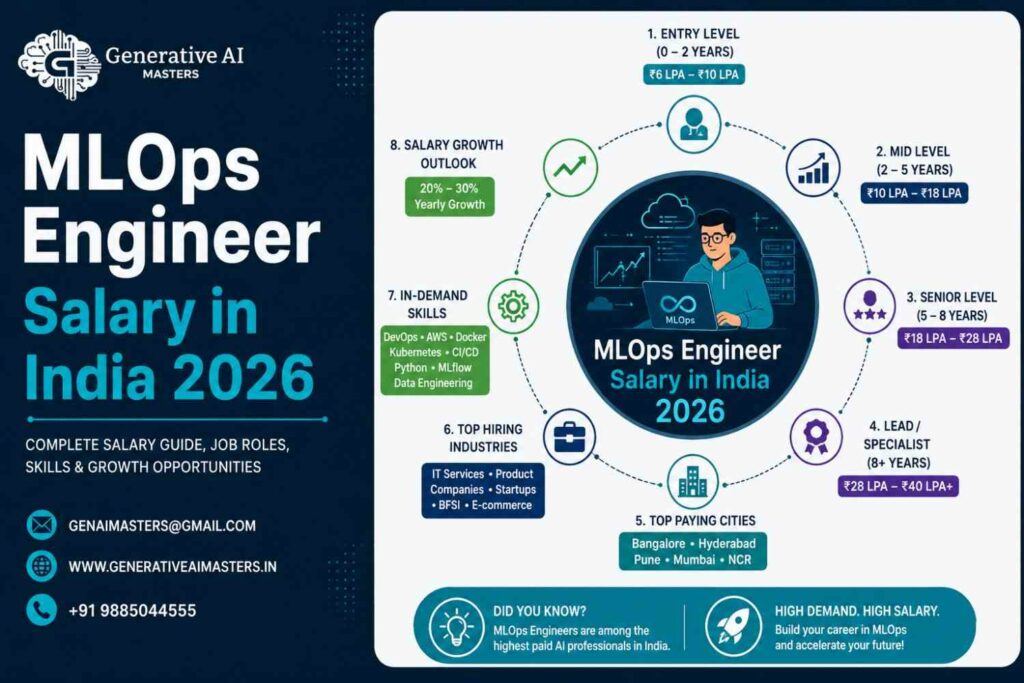
An MLOps Engineer applies DevOps discipline to machine learning systems. Instead of just building a model, they help organizations deploy, monitor, maintain, retrain when required, and scale machine learning systems reliably in production.
In practice, this means owning the bridge between data scientists who build models and the infrastructure that keeps those models running for real users — handling deployment pipelines, monitoring drift, managing compute resources, and ensuring a model behaves consistently across environments.
Core responsibilities include:
- Model deployment — packaging and releasing models into live systems
- Monitoring and optimization — tracking model performance and fixing degradation over time
- Infrastructure management — provisioning and maintaining the servers, containers, and cloud resources models run on
- Reproducibility — ensuring a model performs consistently regardless of where it’s deployed
As companies move from AI pilots to production-scale systems, MLOps has become an important part of production machine learning and AI infrastructure teams, and it now sits within the broader MLOps landscape tracked by the Cloud Native Computing Foundation.
MLOps increasingly overlaps with GenAI deployment work — if you’re building broader AI skills, our Generative AI Training in Hyderabad covers LLMs, RAG, and Agentic AI alongside deployment fundamentals.
MLOps Engineer Salary in India 2026
Experience Level | Typical Salary Range (LPA) | Notes |
Fresher / 0–2 years | ₹6 – ₹10 LPA | Broader ₹6–12.8 LPA at strong startups/product firms |
Mid-level / 2–5 years | ₹12 – ₹20 LPA | Can reach ₹22 LPA with cloud + MLOps tooling depth |
Senior / 5+ years | ₹20 – ₹35 LPA | Reports show a wide spread, ₹17–35+ LPA depending on employer |
Specialized / Lead roles | ₹35 – ₹60+ LPA | GenAI/MLOps specialists at top product companies and GCCs |
Salary ranges are indicative and vary by company, location, skill depth, industry, and compensation structure (fixed vs. variable pay).
MLOps Engineer Salary in India by Experience
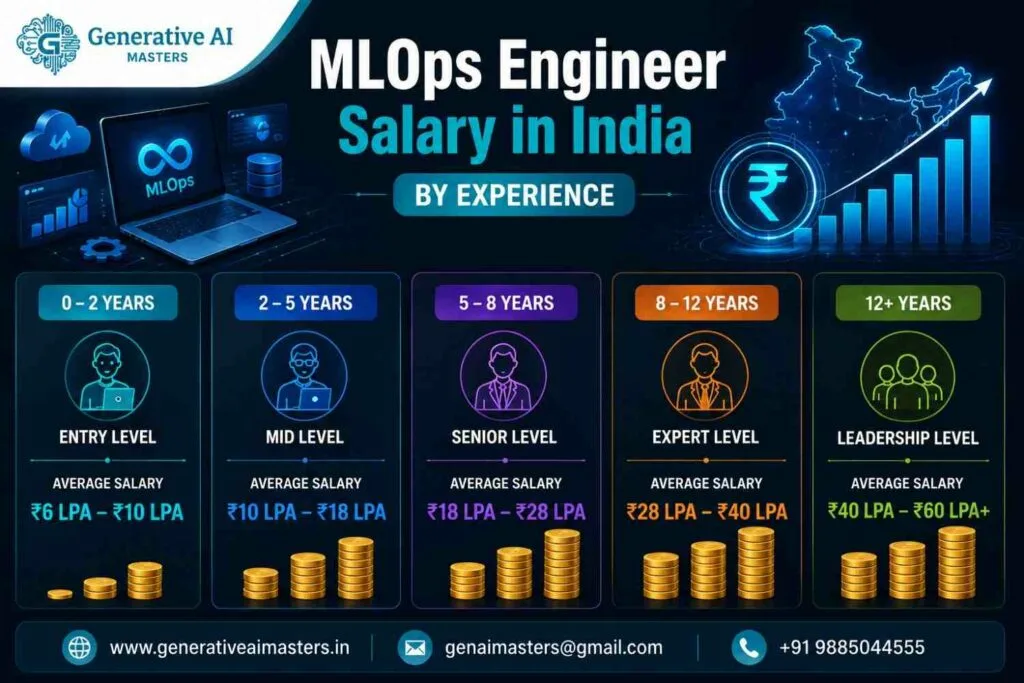
0–2 Years (Entry-Level)
Freshers and early-career MLOps engineers in India typically earn ₹6–10 LPA, with strong product-company or startup offers occasionally reaching ₹12–12.8 LPA. At this stage, work usually involves supporting deployment pipelines, monitoring dashboards, and infrastructure tasks under senior guidance.
2–5 Years (Mid-Level)
With a few years of hands-on deployment experience, salaries generally move to ₹12–20 LPA. Engineers at this level independently manage CI/CD pipelines for ML models, optimize infrastructure costs, and often mentor junior team members. Depth in cloud platforms and container orchestration is what typically separates the lower and upper ends of this band.
5+ Years (Senior-Level)
Senior MLOps engineers report salaries between ₹20–35 LPA, and specialized or leadership-track roles — particularly in GenAI infrastructure — have been reported crossing ₹50–60 LPA at top product companies and GCCs. At this stage, engineers typically own ML platform architecture, lead teams, and set standards for reliability and governance.
Pro Tip: Years of experience alone don’t drive pay at the senior level nearly as much as specialization does. An engineer with deep GenAI deployment or model-monitoring expertise will often out-earn someone with more total years but only generalist skills.
MLOps Engineer Salary in India by City
City | Entry-Level | Mid-Level | Senior-Level |
Bangalore | ₹7 – ₹12 LPA | ₹15 – ₹22 LPA | ₹25 – ₹35+ LPA |
Hyderabad | ₹6 – ₹10 LPA | ₹12 – ₹18 LPA | ₹20 – ₹28 LPA |
Mumbai | ₹7 – ₹12 LPA | ₹14 – ₹20 LPA | ₹22 – ₹30 LPA |
Pune | ₹6 – ₹9 LPA | ₹12 – ₹18 LPA | ₹20 – ₹28 LPA |
Delhi NCR | ₹6 – ₹10 LPA | ₹12 – ₹18 LPA | ₹20 – ₹30+ LPA |
Bangalore
It remains India’s highest-paying market for MLOps roles, driven by the concentration of product companies, GCCs, and startups competing for the same talent pool.
Hyderabad
It offers strong, fast-growing demand with a lower cost of living, making take-home value competitive even where headline numbers trail Bangalore.
Mumbai
It commands a premium in finance-adjacent MLOps work — fraud detection and risk-model deployment pay well given the stakes involved.
Pune and Delhi NCR
It track close to each other, with Pune’s IT-services base and NCR’s mix of startups and MNC offices keeping both cities competitive without matching Bangalore’s ceiling.
Smaller cities and Tier-2 hubs generally pay less in absolute terms, though the gap is partly offset by lower living costs.
MLOps Salary by Company Type
Company Type | Typical Pay Positioning |
Startups | Lower fixed pay, often offset by equity/ESOPs and faster scope growth |
IT Services Companies | Moderate, more standardized pay bands |
Product Companies | Higher fixed pay, strong for specialists |
GCCs (Global Capability Centers) | Often among the higher payers for specialized roles |
Company type is one of the biggest swing factors in MLOps compensation. GCCs and product companies can offer higher compensation for specialized MLOps roles, particularly when candidates have strong cloud, Kubernetes, ML platform, and GenAI infrastructure experience.
MLOps Training in Hyderabad
Deploy and monitor ML models with Docker, Kubernetes, CI/CD, MLflow and AWS, with real-time projects.
Next batch: 5 Oct 2026 · morning 10 AM & evening 7 PM IST
MLOps Engineer Salary vs Related AI Roles
Role | Typical Salary Range (India) |
MLOps Engineer | ₹6 – ₹35+ LPA |
ML Engineer | ₹6 – ₹30+ LPA |
Data Scientist | ₹6 – ₹28+ LPA |
DevOps Engineer | ₹5 – ₹25+ LPA |
AI Engineer / GenAI Engineer | ₹8 – ₹40+ LPA |
MLOps and DevOps salaries overlap significantly, but compensation can vary based on specialization, experience, company type, and technical responsibilities. MLOps roles may command higher packages when they involve advanced ML platforms, cloud infrastructure, or GenAI deployment. As GenAI deployment work grows, the line between “MLOps Engineer” and “AI/GenAI Infrastructure Engineer” is increasingly blurred, and pay at the top end reflects that overlap.
Curious how this compares to a pure GenAI role? See our Generative AI Engineer Salary guide.
Skills That Can Improve Eligibility for Higher-Paying MLOps Roles
The skills below don’t guarantee a specific salary bump, but they can improve eligibility for specialized, higher-paying roles:
- Cloud Platforms — AWS, Google Cloud, and Microsoft Azure
- Containerization & orchestration — Docker, Kubernetes
- CI/CD pipelines — automating model deployment and testing
- ML frameworks — TensorFlow, PyTorch
- MLOps-specific tools — MLflow, Kubeflow, and managed platforms like AWS SageMaker
- Infrastructure as Code — Terraform
- Model monitoring — drift detection, performance tracking
- Data pipelines — building reliable data flows for training and inference
- LLM/GenAI deployment — serving and scaling large language models in production
- Vector databases — supporting retrieval-augmented generation (RAG) systems
- AI Governance & Compliance — Increasingly Important as AI Regulations Evolve
Certifications such as AWS Certified Machine Learning, the Google Cloud Professional Machine Learning Engineer certification, or a Kubernetes certification can support salary negotiations, but they generally reinforce hands-on project experience rather than replace it.
For structured, hands-on training in these tools, our MLOps Training in Hyderabad covers Docker, Kubernetes, CI/CD, and MLflow with real deployment projects.
Factors Affecting MLOps Engineer Salary
- Experience level — years of hands-on production deployment work
- Location — metro tech hubs pay more than smaller cities
- Company Type and Size — Compensation can vary significantly across GCCs, product companies, startups, and IT services firms.
- Industry — finance and healthcare often pay a premium for regulated, high-stakes ML systems
- Skills and specialization — cloud, Kubernetes, and GenAI deployment expertise carry the most weight
- Educational background — a relevant degree helps, though it matters less than demonstrated production experience
How to Increase Your MLOps Salary
- Build a portfolio of real deployments, not just model-training notebooks — show pipelines, monitoring dashboards, and infrastructure you’ve actually shipped.
- Go deep on one or two high-value tools (e.g., Kubernetes + MLflow, or AWS SageMaker) rather than spreading thin across many.
- Add GenAI/LLM deployment experience — this is an increasingly relevant specialization within MLOps as organizations move GenAI systems into production.
- Target company type deliberately — a lateral move to a GCC or product company often has a bigger salary impact than another year at the same firm.
- Contribute visibly — GitHub projects, technical writing, or conference talks help during salary negotiations by demonstrating depth.
For a broader breakdown of in-demand AI skills beyond MLOps, check our AI Engineer skills guide.
MLOps Salary Trends in India 2026
Several forces are shaping MLOps compensation this year:
- AI adoption is maturing — companies are moving from pilots to production-scale ML, which increases demand for reliable deployment and monitoring expertise.
- GenAI infrastructure demand is rising sharply — engineers who can deploy and scale LLM-based systems are commanding some of the highest salaries in the broader MLOps category.
- AI governance is emerging as a differentiator — as regulatory expectations grow, engineers who understand compliance alongside technical deployment are increasingly valuable.
- Company type matters more than tenure — the pay gap between GCCs/product companies and smaller firms appears to be widening, meaning where you work now often affects salary more than how long you’ve worked.
Rather than assuming linear salary growth with each year of experience, it’s more accurate to say growth increasingly depends on specialization, employer type, and production-scale experience.
As GenAI deployment becomes core to MLOps, many engineers are picking up LLM and RAG skills through programs like our Generative AI course in Hyderabad to stay ahead of this shift.
For a fuller breakdown of where these applications show up across industries, see our detailed guide to Generative AI applications.
Salary Data Sources
Salary figures in this article are indicative estimates compiled from publicly available salary reports and hiring-market data, including Glassdoor India (broad-market averages and percentile ranges), and industry salary and hiring-trend reports published by training and recruitment platforms in 2026. Actual compensation varies based on employer, experience, location, technical specialization, fixed pay, variable pay, and equity.
No single source should be treated as an absolute figure — different platforms use different sample sizes and methodologies, which is why ranges in this guide are presented as bands rather than single numbers.
Key Takeaways
- MLOps Engineer salaries in India in 2026 can range from ₹6 LPA for entry-level roles to ₹35 LPA or more for experienced professionals.
- Professionals with specialized expertise in GenAI infrastructure, ML platforms, and cloud technologies may access higher-paying opportunities.
- Experience, technical skills, location, and company type all play an important role in determining salary.
- Bangalore, Hyderabad, Mumbai, Pune, and Delhi NCR are among the major cities offering MLOps opportunities in India.
- Skills in AWS, Azure, GCP, Docker, Kubernetes, CI/CD, MLflow, Terraform, and model monitoring can strengthen your profile.
- Knowledge of LLM deployment, RAG, vector databases, and GenAI infrastructure is becoming increasingly valuable for MLOps professionals.
- Certifications can support your profile, but hands-on projects and real-world deployment experience are more important.
Conclusion
MLOps Engineer salaries in India in 2026 span a wide range — roughly ₹6 LPA for freshers up to ₹35 LPA or more for senior, specialized professionals — and the biggest swing factors are company type, city, and depth of skill in cloud, Kubernetes, and increasingly GenAI deployment. Rather than expecting steady pay growth simply from clocking more years, the clearest path to a higher MLOps salary is building real production experience, specializing in high-demand areas like GenAI infrastructure or model monitoring, and being deliberate about the type of company you work for.
Want to build hands-on skills in Generative AI deployment and MLOps? Explore the Generative AI Masters training programs for real-time projects and expert-led sessions.
Frequently Asked Questions
1. What Is the Average MLOps Engineer Salary in India in 2026?
MLOps Engineer salaries in India vary by experience, company, location, and technical specialization. Entry-level roles typically start around ₹6–10 LPA, while experienced professionals can earn ₹20–35 LPA, with specialized or leadership roles potentially offering significantly more, particularly in GenAI infrastructure.
2. Which cities pay the most for MLOps engineers?
Bangalore consistently offers the highest MLOps salaries in India due to its concentration of product companies, GCCs, and startups. Mumbai and Delhi NCR follow closely, particularly for finance-related roles, while Hyderabad and Pune offer strong pay with a comparatively lower cost of living.
3. What factors affect MLOps engineer salaries?
Key factors include years of experience, location, company type (startup vs. product company vs. GCC), industry, specific technical skills (especially cloud and Kubernetes expertise), and educational background. Company type and specialization tend to have the largest impact on pay at the mid and senior levels.
4. How much does an MLOps engineer earn as a fresher in India?
Freshers typically earn between ₹6–10 LPA, though strong candidates with cloud or containerization project experience have reported offers up to ₹12–12.8 LPA at competitive product companies and startups.
5. What is the MLOps engineer salary after 5 years of experience?
Engineers with 5+ years of experience typically earn ₹20–35 LPA, with specialized professionals — particularly those with GenAI deployment expertise — reported earning well above this range at top product companies and GCCs.
6. Do MLOps engineers earn more than DevOps engineers?
MLOps and DevOps salaries overlap significantly, but compensation can vary based on specialization, experience, company type, and technical responsibilities. MLOps roles may command higher packages when they involve advanced ML platforms, cloud infrastructure, or GenAI deployment.
7. Which skills increase an MLOps engineer’s salary the most?
Cloud platform expertise (AWS, GCP, Azure), Kubernetes, CI/CD automation, and MLOps-specific tools like MLflow and Kubeflow are commonly associated with higher-paying roles. GenAI/LLM deployment skills and model-monitoring expertise are increasingly relevant as organizations move AI systems into production.
8. Do certifications actually increase MLOps salary?
Certifications such as AWS Certified Machine Learning or Google Cloud Professional ML Engineer can support salary negotiations and improve visibility to recruiters, but they typically work best alongside demonstrated, hands-on deployment experience rather than as a substitute for it.
9. How does company type affect MLOps salary in India?
Company type is one of the largest factors in MLOps compensation. GCCs and product companies can offer higher compensation for specialized MLOps roles compared to startups and IT services firms, particularly for candidates with strong cloud, Kubernetes, and ML platform experience.
10. Is MLOps a good career path for future salary growth in India?
Yes. As companies move from AI experimentation to production-scale systems, demand for engineers who can reliably deploy, monitor, and govern ML and GenAI systems continues to grow. Salary growth going forward is expected to track special

Mr. Dinesh Tunguturi Generative AI Trainer
GenAI Masters AI Experts | 60+ Articles Published on Generative AI, Prompt Engineering, LLMs & AI Careers
Mr. Dinesh is a Generative AI Trainer with expertise in Large Language Models (LLMs), Prompt Engineering, Agentic AI, RAG, and AI Automation. He helps students and professionals gain practical, job-ready AI skills through hands-on training, real-world projects, and industry-focused mentorship.
Turn this knowledge into a career: MLOps Training in Hyderabad
Deploy and monitor ML models with Docker, Kubernetes, CI/CD, MLflow and AWS, with real-time projects.
₹20,000 online · ₹25,000 classroom · 3 months · live classes · ★ 4.9 from 51 Google reviews