
Prompt Engineer Salary in India
Prompt Engineer salaries in India in 2026 typically range from ₹4–8 LPA for freshers to ₹30–60+ LPA for senior professionals who combine prompting with Python, RAG, and AI agent development. Bangalore, Hyderabad, and Mumbai pay the highest, while pure “prompting-only” roles plateau faster than hybrid AI engineering roles.
Table of Contents
Introduction to Prompt Engineer Salary in India

Generative AI has changed how companies build products, and prompt engineering sits right in the middle of that shift. If you’ve searched for “Prompt Engineer salary in India,” you’ve probably noticed something confusing: one website says ₹5 LPA, another says ₹40 LPA, and a third throws around ₹60 LPA like it’s normal.
Both can be true at the same time. Prompt engineering isn’t one job with one paycheck. It’s a title that covers everything from writing better chatbot instructions to building full LLM-powered applications. The pay gap between those two ends of the spectrum is enormous, and this guide breaks down exactly why.
Here, you’ll get a realistic view of Prompt Engineer salary in India in 2026 — by experience level, by city, by industry, and by the specific skills that actually move your pay upward. You’ll also learn what the role really involves, how to become a prompt engineer, and where this career is likely headed next. If you want the bigger picture first, our Generative AI Roadmap walks through the full learning path this role sits inside.
This is written for students exploring AI careers, working professionals considering a switch, and developers who want to know if prompt engineering is worth specializing in. No fluff, no inflated numbers — just what the current data shows.
Prompt Engineer Salary in India
The honest starting point is this: “Prompt Engineer” is not a tightly standardized job title in India the way “Software Engineer” or “Data Analyst” is. Companies list nearly identical responsibilities under titles like Generative AI Specialist, LLM Engineer, AI Automation Engineer, or AI Content Specialist. That inconsistency is exactly why salary figures across job portals look so different from one another.
That said, aggregating data from major job platforms like Indeed and Glassdoor, along with broader industry hiring trends tracked by bodies like NASSCOM, gives a fairly consistent overall picture for 2026.
Salary Table
Experience Level | Average Annual Salary (LPA) | Typical Range (LPA) |
Entry Level (0–1 yrs) | ₹5–6 LPA | ₹4–8 LPA |
Early Career (1–3 yrs) | ₹8–12 LPA | ₹6–15 LPA |
Mid Level (3–6 yrs) | ₹14–18 LPA | ₹12–20 LPA |
Senior Level (6+ yrs) | ₹28–35 LPA | ₹20–60 LPA |
A quick note on why the ranges are wide: engineers who pair prompting with Python, retrieval-augmented generation (RAG), and AI agent development consistently report pay at the higher end. Those who stay purely in “writing and testing prompts” territory tend to sit closer to the lower end, even with several years of experience.
Prompt Engineer Salary by Experience
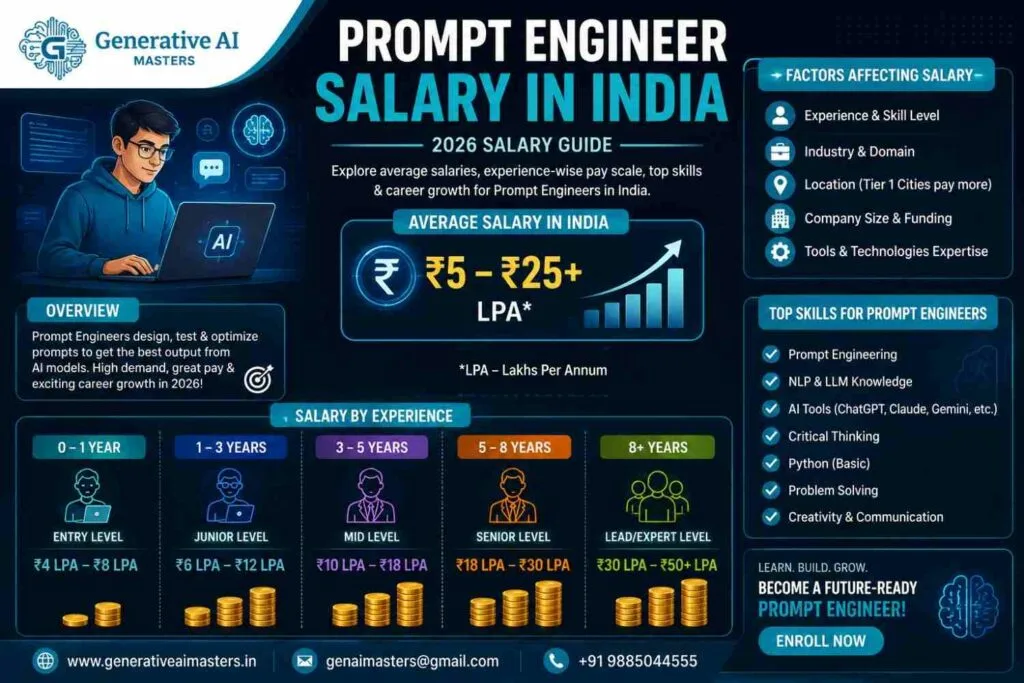
Career stage has the single biggest influence on prompt engineering pay in India, but how your salary grows depends heavily on whether you keep adding technical depth.
Entry Level
Freshers entering prompt engineering in 2026 can realistically expect ₹4–8 LPA. Most entry-level roles focus on prompt testing, output evaluation, dataset labeling, and supporting senior engineers on LLM projects. A strong GitHub portfolio, a few real prompting projects, and basic Python knowledge noticeably improve starting offers within this band.
Mid Level
With 3–6 years of experience, Prompt Engineers typically earn ₹12–20 LPA. At this stage, the job usually expands to include RAG pipeline design, evaluation frameworks, and light fine-tuning work. Professionals who stay purely in prompt-writing without adding these skills often find their salary growth slows down noticeably at this point.
Senior Level
Senior professionals — especially those functioning more like AI/LLM engineers than pure prompt writers — can earn ₹25–60 LPA at product companies, well-funded startups, and global tech hubs. At this level, the job typically blends prompt engineering with agentic AI development, model evaluation, and system design, which is why pay varies so widely based on how technical the role actually is.
Prompt Engineer Salary by Location
City matters a lot in India’s prompt engineering job market, mainly because AI hiring is still concentrated around a handful of tech hubs, as reflected in city-wise listings on platforms like Naukri.
City | Average Salary Range (LPA) | Why |
Bangalore | ₹15–20+ LPA | Highest concentration of AI-first startups, GCCs, and product companies |
Hyderabad | ₹13–18 LPA | Rapid AI research growth, strong enterprise automation hiring |
Pune | ₹10–15 LPA | Growing SaaS ecosystem, lower cost of living, early-career friendly |
Mumbai | ₹12–17 LPA | Strong fintech and product company presence |
Delhi NCR | ₹11–16 LPA | Mix of startups, enterprise IT, and policy-linked AI initiatives |
Chennai | ₹11–15 LPA | Rising AI adoption in manufacturing, education, and automotive |
Bangalore
Often called India’s AI hub, Bangalore hosts the largest share of prompt engineering and generative AI roles, driven by startups, global R&D centers, and product companies. It typically offers the highest average pay in this list.
Hyderabad
Hyderabad has seen fast growth in AI research and enterprise automation hiring, partly supported by state-level AI initiatives. Pay here trails Bangalore only slightly.
Pune
Pune combines a strong IT talent base with a growing SaaS and product ecosystem. Salaries are moderate compared to Bangalore or Hyderabad, but the lower cost of living makes it attractive for early-career prompt engineers.
Mumbai
Mumbai’s strength lies in fintech and enterprise product companies actively integrating generative AI into customer-facing and internal workflows, which keeps demand — and pay — fairly strong.
Delhi NCR
Delhi NCR offers a mix of established enterprise IT firms and newer AI startups, resulting in a wide salary band depending heavily on company type.
Chennai
Chennai’s prompt engineering job market is smaller but growing, with increasing AI integration in manufacturing, automotive, and edtech sectors.
Prompt Engineer Salary by Industry
Not every industry values prompt engineering equally. Here’s how it generally breaks down in 2026:
Industry | Salary Impact | Notes |
SaaS / Product Companies | Highest | Fastest AI adoption, highest pay premiums |
Fintech | High | Strong demand for compliant, domain-specific prompting |
IT Services (TCS, Infosys, Wipro, HCL) | Moderate | High volume of roles, but pay grows slower |
E-commerce | Moderate–High | Personalization and automation-driven demand |
Healthcare | Moderate | Growing, but slower due to regulatory caution |
Education Technology | Moderate | Rising demand, especially around AI tutoring tools |
Product-based and SaaS companies consistently pay more than traditional IT services firms for the same title, largely because they treat generative AI as a core product function rather than a support function.
Prompt Engineering Course in Hyderabad
Master prompt design for ChatGPT and GPT models with hands-on projects, certification and placement assistance.
Next batch: 5 Oct 2026 · morning 10 AM & evening 7 PM IST
Factors Affecting Prompt Engineer Salary
Several factors shift where you land within these ranges:
- Technical depth: Python, RAG, and AI agent skills unlock significantly higher pay than prompting alone.
- Company type: Product companies and well-funded startups generally out-pay traditional IT services firms.
- City and remote flexibility: Metro hubs and remote international clients pay more than local tier-2/tier-3 roles.
- Domain expertise: Fintech, healthcare, and legal AI prompting commands a premium due to compliance and accuracy requirements.
- Portfolio and proof of work: Demonstrated projects often matter more than certificates alone.
- Model and tool familiarity: Hands-on experience with GPT-based models, Claude, Gemini, and open-source LLMs via Hugging Face adds credibility.
See the full breakdown of these in the Skills Required to Earn a Higher Salary section below.
What Is Prompt Engineering?
Prompt engineering is the practice of designing, testing, and refining the inputs given to a large language model (LLM) so it produces accurate, relevant, and reliable outputs. It sits at the intersection of language, logic, and applied AI.
In 2026, prompt engineering rarely exists as a standalone, narrow task. It has expanded to include techniques like few-shot prompting, chain-of-thought prompting, and function or tool calling, and it increasingly overlaps with retrieval-augmented generation (RAG) and AI agent workflows. This expansion is a big reason why salaries vary so much — the “same” job title can mean very different levels of technical responsibility. For a deeper dive into these techniques, see our Prompt Engineering Roadmap.
Skills Required to Earn a Higher Salary
If your goal is to move toward the higher end of the salary range, these skills consistently show up in higher-paying job descriptions:
- Core prompting techniques — few-shot prompting, chain-of-thought prompting, structured output design
- Python programming — for scripting, automation, and API integration; Python.org has the official docs and beginner tutorials
- RAG and vector databases — tools like Chroma, FAISS, Pinecone, or Weaviate
- AI agent development — building tool-using, multi-step AI workflows
- LLM APIs — hands-on experience with the OpenAI API, Anthropic API, and Google AI Studio APIs
- Frameworks — familiarity with LangChain (see the official LangChain docs) or LlamaIndex for building applications
- Evaluation and guardrails — testing model outputs for accuracy, safety, and consistency
Pure prompt-writing skills alone are increasingly treated as an entry-level baseline rather than a specialization on their own.
How to Become a Prompt Engineer in India
There’s no single certification path here — most successful prompt engineers build skills through structured self-learning combined with real projects.
Step-by-Step Roadmap
- Learn AI and LLM fundamentals. Understand what large language models are, how transformers work at a conceptual level, and how models like GPT, Claude, and Gemini generate text. Our Generative AI Roadmap covers this stage in detail.
- Build basic Python skills. You don’t need to be a software engineer, but comfort with Python, APIs, and simple scripting is essential.
- Master core prompting techniques. Practice zero-shot, few-shot, and chain-of-thought prompting across different models and tasks. See the Prompt Engineering Roadmap for a structured path.
- Learn to use LLM APIs directly. Get hands-on with the OpenAI API, Anthropic API, and Google AI Studio to understand real-world integration.
- Study RAG and vector databases. Learn how retrieval-augmented generation improves accuracy for domain-specific tasks — see our RAG Learning Roadmap.
- Explore AI agents and tool calling. Understand how models can call functions, use tools, and complete multi-step tasks via our AI Agent Development Roadmap.
- Build real projects. A chatbot, an internal knowledge assistant, or a RAG-based Q&A tool demonstrates far more than a certificate does.
- Specialize in a domain. Fintech, healthcare, e-commerce, or legal AI prompting all offer salary premiums for demonstrated domain knowledge.
Prompt Engineer vs Generative AI Engineer
These two roles overlap heavily, but they’re not identical.
Aspect | Prompt Engineer | Generative AI Engineer |
Core focus | Designing and refining prompts | Building end-to-end AI systems |
Typical skills | Prompting techniques, evaluation | Python, RAG, fine-tuning, deployment |
Salary range (India) | ₹4–20 LPA typically | ₹15–60+ LPA typically |
Career ceiling | Plateaus without technical skills | Higher ceiling with system-design skills |
In practice, many job postings blur this line entirely. If you’re optimizing for salary growth, leaning toward the Generative AI Engineer skill set generally pays off more over time — our Generative AI Roadmap covers that full path from beginner to advanced.
Prompt Engineer Career Growth
A typical career path looks something like this:
- Years 0–2: Prompt Engineer / AI Content Specialist — focused on prompting, testing, and evaluation
- Years 2–4: AI/LLM Engineer — adds RAG, APIs, and light system-building
- Years 4–7: Senior AI Engineer / Applied AI Engineer — owns AI features end-to-end
- Years 7+: AI Architect / Lead — designs AI systems and mentors teams
The professionals who progress fastest are almost always the ones who keep adding technical breadth rather than staying purely in prompt-writing work.
Future of Prompt Engineering in India
The standalone “Prompt Engineer” job title has been shrinking in raw posting volume since around 2024, as many companies fold prompting responsibilities into broader AI or software engineering roles. That doesn’t mean the skill is disappearing — quite the opposite. Prompting ability is now expected as a baseline skill across a growing share of tech roles, even when it isn’t the job title itself.
Going forward, expect prompt engineering to keep merging with AI agent development, RAG system design, and applied LLM engineering, rather than existing as an isolated specialization. Broader labor-market research, including the World Economic Forum’s Future of Jobs Report, points in the same direction — AI-related skills are increasingly folded into existing technical roles rather than staying siloed in narrow job titles. For learners in India, this means the smartest long-term move is building prompting skills as part of a broader generative AI skill set, not as a standalone destination.
Conclusion
Prompt Engineer salary in India in 2026 isn’t a single number — it’s a range shaped almost entirely by how technical your skill set is. Someone writing prompts alone will likely plateau in the ₹10–15 LPA range, while someone who builds RAG pipelines, works with AI agents, and codes comfortably can realistically reach ₹30–60 LPA over time.
If you’re starting out, focus less on chasing the exact job title and more on building a genuinely useful skill set: solid prompting technique, working Python knowledge, and hands-on experience with real LLM tools and APIs. That combination — not the title on your offer letter — is what actually determines your long-term earning potential in this field.
Ready to build real Generative AI skills instead of just chasing a title? Start by picking one small project — a chatbot, a RAG-based assistant, or an AI agent — and build it end-to-end. That single project will teach you more than any salary number in this guide. For the complete step-by-step path, check out our Generative AI Roadmap.
Frequently Asked Questions
1. What is the average Prompt Engineer salary in India in 2026?
The average sits somewhere around ₹5–10 LPA overall, though this varies widely by experience and skill set. Entry-level roles start around ₹4–8 LPA, while senior professionals with strong technical skills can earn ₹30–60 LPA or more, especially at product companies and global tech hubs.
2. Do Prompt Engineers need to know coding?
Not always at the entry level, but coding particularly Python significantly increases both job opportunities and salary potential. Roles that combine prompting with coding and system-building consistently pay 60–150% more than prompting-only roles at similar experience levels.
3. Which city pays the highest Prompt Engineer salary in India?
Bangalore generally offers the highest average salaries, followed closely by Hyderabad and Mumbai. This is largely due to the concentration of AI-first startups, product companies, and global R&D centers in these cities.
4. Is Prompt Engineering a good career in India in 2026?
It can be, especially if approached as part of a broader generative AI skill set rather than a narrow specialization. The standalone title has room, but professionals who add RAG, AI agents, and coding skills tend to see stronger long-term career growth and pay.
5. How is Prompt Engineer different from Generative AI Engineer?
A Prompt Engineer focuses mainly on designing and refining prompts, while a Generative AI Engineer builds complete AI systems, including retrieval pipelines, integrations, and sometimes fine-tuning. In practice, many companies blend both responsibilities under one title.
6. Can freshers get a Prompt Engineering job in India?
Yes, though competition is real. Freshers with a strong project portfolio, basic Python skills, and hands-on experience with LLM APIs have a meaningfully better chance of landing entry-level roles in the ₹4–8 LPA range.
7. Do remote international roles pay more than Indian companies?
Generally, yes. Indian prompt engineers working remotely for U.S. or European clients often earn well above local market rates, sometimes several times the equivalent Indian salary, especially in freelance or contract arrangements.
8. What skills increase Prompt Engineer salary the most?
Python programming, RAG and vector database knowledge, AI agent development, and hands-on experience with LLM APIs from providers like OpenAI and Anthropic tend to have the biggest impact on salary growth.
9. Which industries pay Prompt Engineers the most in India?
SaaS and product companies typically pay the highest, followed by fintech. Traditional IT services firms hire in high volume but generally offer slower salary growth for the same title.
10. Is the Prompt Engineer job title disappearing?
The standalone title has been declining in job postings since around 2024 as responsibilities merge into broader AI engineering roles — a trend covered by outlets like IEEE Spectrum. The underlying skill, however, is becoming more widely expected across tech jobs rather than becoming less relevant.

Mr. Dinesh Tunguturi Generative AI Trainer
GenAI Masters AI Experts | 60+ Articles Published on Generative AI, Prompt Engineering, LLMs & AI Careers
Mr. Dinesh is a Generative AI Trainer with expertise in Large Language Models (LLMs), Prompt Engineering, Agentic AI, RAG, and AI Automation. He helps students and professionals gain practical, job-ready AI skills through hands-on training, real-world projects, and industry-focused mentorship.
Turn this knowledge into a career: Prompt Engineering Course in Hyderabad
Master prompt design for ChatGPT and GPT models with hands-on projects, certification and placement assistance.
₹20,000 online · ₹25,000 classroom · 3 months · live classes · ★ 4.9 from 51 Google reviews