
MLOps Roadmap in 2026 -Beginner to Advanced Guide

What Is MLOps?
- MLOps (Machine Learning Operations) is a complete end-to-end process that helps teams build, improve, deploy, monitor, and scale machine learning models in real-world environments.
- MLOps is the “system” that makes ML models work in real life, not just in Jupyter notebooks.
- A data scientist creates a model
- An MLOps engineer makes sure the model runs perfectly for millions of users
- MLOps keeps the model updated, secure, and fast—even when new data comes every day
MLOps = Machine Learning + DevOps + Automation
If you want to learn more about MLOPS Engineer Salary In India
How Should You Start Your MLOps Journey Today?
1. Start With Basic Python + Machine Learning
You don’t need to be an expert in ML.
But you must understand the basics like
- how data is cleaned
- how a model is trained
- what accuracy means
- difference between training & inference
Why?
Because MLOps cannot make sense without understanding how ML works.
2. Learn Git & GitHub (Your First DevOps Step)
Start using Git for every project.
Learn:
- git add
- git commit
- git push
- git pull
- branches
Why?
MLOps = teamwork + version control.
Git is used everywhere.
3. Learn Linux Basics (Very Important!)
Learn simple terminal commands:
- cd, ls, mv, rm
- bash scripting
- viewing logs
- monitoring processes
Why?
All MLOps pipelines run on Linux servers.
4. Learn Docker (Start Packaging Your Models)
Start containerizing simple ML models.
Learn
- creating Dockerfiles
- building images
- running containers
- exposing ports
Why?
Docker is the heart of modern MLOps.
5. Learn MLflow for Experiment Tracking
Install MLflow and start tracking
- parameters
- metrics
- models
Why?
MLflow helps you understand how production teams track models.
6. Learn DVC for Data Versioning
Create a small project and version your dataset.
Why?
Data changes → models change.
DVC helps you manage data like code.
7. Host Your First Model with FastAPI
Build a simple API
- load model
- create /predict endpoint
- run locally
Why?
APIs are the real way models are served to applications.
8. Deploy Your First Model on Cloud
Choose one cloud:
- AWS
- GCP
- Azure
Deploy your model using:
- EC2 (VM)
- S3 for storing files
- simple API hosting
Why?
Cloud deployment = required for every MLOps job.
9. Learn Airflow (Build Your First Pipeline)
Start with simple DAGs
- load data
- clean data
- train model
- save model
Why?
Airflow teaches you how to automate ML pipelines.
10. Learn Kubernetes Basics
After Docker → go to Kubernetes.
Learn
- pods
- deployments
- services
Why?
Most companies deploy ML on Kubernetes.
11. Start a Real End-to-End MLOps Project
Build a small E2E project
- Data versioning (DVC)
- experiment tracking (MLflow)
- API serving (FastAPI)
- dockerization
- cloud deployment
- monitoring dashboards
Why?
This is the real proof of your MLOps skills.
12. Document Everything
Write
- what tools you used
- architecture diagram
- commands
- lessons learned
Why?
Companies care about clarity and documentation.
13. Publish Your Work on GitHub + LinkedIn
Share:
- code
- diagrams
- deployment links
- how your pipeline works
Why?
Recruiters love visible work.
14. Keep Learning Every Week
Spend weekly 3–5 hours improving:
- cloud
- Kubernetes
- CI/CD
- monitoring tools
- new MLOps frameworks
Why?
MLOps changes fast; you must grow continuously.
If you want to learn more about MLOps Roles and Responsibilities

Real-World MLOps Use Cases
Banking & Finance
Banks use MLOps for
- fraud detection
- credit scoring
- customer churn
- risk analysis
Why MLOps is needed?
Because money-related predictions must be 99% accurate, monitored, and updated constantly.
Healthcare
Uses MLOps for
- medical image classification
- disease prediction
- drug discovery
Why important?
Because wrong models can affect human life.
MLOps ensures quality and reliability.
E-commerce
MLOps runs models for
- product recommendations
- delivery prediction
- customer segmentation
- pricing optimization
These models update every day with huge user data.
MLOps handles automatic retraining.
Manufacturing
Used for
- machine failure prediction
- quality control
- production optimization
Real-time monitoring is required → MLOps helps.
IT & SaaS Companies
They need MLOps to
- deploy models for millions of users
- run A/B testing
- create real-time ML APIs
Top MLOps Tools to Learn in 2026
MLOps tools 2026, best tools for MLOps, MLOps software list, tools for machine learning operations
This section explains every important MLOps tool in very simple English, with detailed explanations that help beginners understand
- What the tool does
- Why it is important
- When to use it
1. MLflow (Most Popular MLOps Tool)
Purpose: Experiment tracking, model versioning, managing ML lifecycle.
Why important
MLflow helps you track everything you try in machine learning—accuracy, versions, metrics, and parameters.
What you can do with MLflow
- Save model versions
- Compare multiple experiments
- Store metrics
- Deploy models
- Track hyperparameters
Simple Example
If you train 10 models, MLflow helps you see which model performed best.
2. DVC (Data Version Control)
Purpose: Data versioning and pipeline creation.
Why important
Data changes every day. DVC keeps track of different dataset versions.
DVC helps you
- version your datasets
- store data in cloud storage
- reproduce experiments easily
Simple Explanation
DVC works like Git, but for data instead of code.
3. Docker (Must-Have for MLOps)
Purpose: Packaging ML models so they run anywhere.
Why important
Without Docker, ML models may not work on other computers or servers.
Docker helps you
- create containers
- create consistent environments
- remove dependency issues
Simple Explanation
Docker packs your model and environment like a “delivery box” so it works everywhere.
4. Kubernetes (For Scaling ML Models)
Purpose: Deploy models at scale.
Why important
When thousands or millions of users use your model, Kubernetes keeps it running safely.
Kubernetes does
- auto-scaling
- load balancing
- rolling updates
- fault tolerance
Simple Explanation
Kubernetes is like a “manager” that handles many containers and keeps systems stable.
5. Airflow (Pipeline Orchestration)
Purpose: Create automated ML pipelines.
Why important
ML tasks need to run in sequence—data → training → evaluation → deployment.
Airflow helps you
- schedule tasks
- automate workflows
- monitor pipelines
Simple Explanation
Airflow is like a “task scheduler” for machine learning.
6. Kubeflow (MLOps on Kubernetes)
Purpose: End-to-end ML pipelines on Kubernetes.
Why important
Kubeflow makes it easier to run ML workflows at scale.
Kubeflow helps you
- train models on Kubernetes
- handle distributed training
- manage workflows
Simple Explanation
Kubeflow = Airflow + MLOps tools + Kubernetes, all in one.
7. Prometheus (Monitoring ML Models)
Purpose: Track model and system performance in real time.
Why important
ML models need continuous monitoring.
Prometheus helps track
- model errors
- latency
- CPU/GPU usage
- drift indicators
Simple Explanation
Prometheus checks if your model is healthy.
8. Grafana (Visualization for Monitoring)
Purpose: Show monitoring dashboards.
Why important:
Companies need to see model performance visually.
Grafana helps you
- create dashboards
- visualize errors and metrics
- track trends
Simple Explanation
Prometheus collects data, Grafana displays it as beautiful charts.
9. Seldon Core (Model Deployment in Production)
Purpose: Deploy machine learning models easily.
Why important
It supports large-scale, real-time model serving.
Seldon helps with
- deploying models
- managing APIs
- monitoring predictions
Simple Explanation
Seldon removes complexity from ML model deployment.
10. BentoML (Easy Model Packaging + Serving)
Purpose: Package ML models into production-ready services.
Why important
It simplifies deployment pipelines.
BentoML helps you
- create ML APIs
- deploy quickly
- manage multiple models
Simple Explanation:
BentoML makes model serving super easy.
11. FastAPI (High-Performance Model API Framework)
Purpose: Create APIs for ML models.
Why important
FastAPI is fast, modern, and easy to use.
FastAPI helps you
- expose ML models as API endpoints
- make real-time predictions
Simple Explanation
FastAPI converts your model into a web service.
12. GitHub Actions (CI/CD Automation)
Purpose: Automate deployments and pipelines.
Why important:
Automation is essential for MLOps.
GitHub Actions helps you
- test code
- run training scripts
- deploy models automatically
Simple Explanation
It runs tasks automatically whenever you update code.
13. AWS SageMaker (End-to-End ML Platform)
Purpose: ML training, deployment, monitoring.
Why important:
Many companies use AWS for MLOps.
SageMaker helps you
- train ML models faster
- deploy them easily
- monitor performance
Simple Explanation
SageMaker gives everything needed for MLOps in one place.
14. Google Vertex AI (GCP MLOps Platform)
Purpose: Build, deploy, and manage ML models.
Why important:
Simplifies complex pipeline work.
Vertex AI helps you
- automate ML pipelines
- monitor drift
- deploy models to production
Simple Explanation
Vertex AI is Google’s all-in-one ML operations platform.
15. Evidently AI (Model Monitoring Tool)
Purpose: Check model drift and data drift.
Why important
Models become inaccurate over time.
Evidently AI helps you
- detect drift
- compare data versions
- track model health
Future Job Market for MLOps Engineers in India (2026–2030)
India is entering a massive AI + automation boom, and MLOps engineers are becoming one of the most important roles in the entire AI industry. Between 2026 and 2030, the job market for MLOps will grow faster than traditional software engineering or machine learning jobs because companies are shifting to production-level AI systems.
1. Why MLOps Jobs Are Growing Fast in India
India has thousands of companies now using AI for
- Banking
- Healthcare
- Telecom
- E-commerce
- Manufacturing
- Logistics
- Insurance
- EdTech
- IT services
Earlier, companies only experimented with small ML models.
But after ChatGPT and GenAI, everyone wants
- Large-scale AI apps
- Real-time predictions
- Automated pipelines
- Better monitoring
- Faster deployments
- Cloud-based ML systems
To manage this entire process…
MLOps engineers are required.
This is why MLOps jobs are growing explosively.
2. Shortage of Skilled MLOps Engineers (High Demand, Low Supply)
Right now in India
- Thousands of ML engineers exist
- But very few MLOps engineers exist
- Companies struggle to find skilled talent
This skills gap means
- Higher salaries
- Faster promotions
- More job opportunities
- Remote and international offers
Because companies don’t just want ML models —
They want production-ready solutions, which only MLOps can deliver.
3. Salary Growth for MLOps Engineers in India
Here is a realistic salary range for 2026:
Freshers (0–1 years): ₹6–10 LPA
If you know basics: Docker + MLflow + Cloud.
Mid-Level (2–4 years): ₹12–25 LPA
If you know Kubernetes + Airflow/Kubeflow.
Senior (5–8 years): ₹25–45 LPA
If you handle scaling, drift monitoring, CI/CD pipelines.
Expert / Architect (8–12+ years): ₹50 LPA – ₹1 Cr+
If you design enterprise-level end-to-end pipelines.
Salaries keep increasing because demand is high and supply is low.
4. MLOps Roles That Will Explode by 2026–2030
These job titles will become very common:
MLOps Engineer
Build and manage pipelines.
ML Infrastructure Engineer
Focus on cloud, scaling, GPU systems.
AI Platform Engineer
Build internal AI tools for the company.
LLMOps Engineer
Specialize in Generative AI and LLM workflows.
AI Deployment Engineer
Deploy models as APIs.
Model Monitoring & Reliability Engineer
Detect drift, failures, and errors.
LLMOps will grow even faster because companies need:
- RAG pipelines
- Vector databases
- LLM monitoring
- LLM deployments
This creates a new sub-field inside MLOps.
5. Companies Hiring MLOps Engineers in India (2026)
Top IT Companies
- TCS, Infosys, Wipro, HCL, Tech Mahindra, Cognizant
Product Companies
- Google, Microsoft, Amazon, Salesforce, Adobe
Startups
- Zepto, Swiggy, Zomato, Razorpay, CRED, Meesho, Dunzo
FinTech
- Paytm, PhonePe, Groww, Zerodha, SBI, ICICI
E-commerce
- Flipkart, Myntra, Amazon India
- Every company using AI will need MLOps — this is why demand is exploding.
6. Future Prediction What Will Happen to MLOps by 2030?
Based on global trends
80% of companies will shift to cloud-based AI
- MLOps engineers will handle these migrations.
LLMOps will become a separate, high-paying role
- Companies will maintain large LLM pipelines.
AI will run on automation
- MLOps engineers will design self-updating systems.
Model monitoring will become mandatory
- Because models degrade over time.
Companies will move from local ML to production-grade ML
- This increases the need for strong MLOps skills.
- MLOps will become a permanent, essential job in all industries — not temporary.
If you want to learn more about MLOps Roles and Responsibilities
Skills Required to Become an MLOps Engineer in 2026
To become an MLOps Engineer in 2026, you need a mix of machine learning knowledge, cloud skills, DevOps tools, and automation skills. Don’t worry — you don’t need to be an expert in everything immediately.
1. Python Programming (Basic to Intermediate Level)
Python is the heart of ML and MLOps.
You need Python because
- it is used for data work
- it is used to build models
- it is used to write ML pipelines
- it integrates with cloud and MLOps tools
What you must learn in Python
variables, loops, functions
lists, dictionaries
file handling
virtual environments (venv, conda)
packages (numpy, pandas, scikit-learn)
Python is the first and most important skill.
2. Machine Learning Basics
You do not need to be a hardcore ML researcher.
But you must know the basics of
- data cleaning
- train-test split
- supervised vs unsupervised models
- regression and classification
- model evaluation (accuracy, precision, recall, AUC)
This helps you understand how ML models behave in production.
3. Linux & Command Line
In companies, all servers run on Linux, not Windows.
You should know
- navigating folders
- installing packages
- reading logs
- permissions
- writing simple bash scripts
Even basic Linux knowledge makes you powerful in MLOps.
4. Git & GitHub
Everything in MLOps needs version control
- code
- data
- models
- pipelines
Git helps teams work together safely.
Learn
- git clone
- git add
- git commit
- git push
- branches
- pull requests
5. Model Experiment Tracking Tools
Examples
- MLflow
- Weights & Biases
- ai
These tools help track
- different model versions
- accuracy
- hyperparameters
- experiments
This is very important in large companies.
6. Data Versioning Tools
ML models change when data changes.
So we need tools to manage data versions.
Tools
- DVC
- LakeFS
- Delta Lake
These tools store and track large datasets in a clean way.
7. Docker (Containerization)
Docker helps you pack your model and code so it runs same everywhere.
Why Docker is important
- no dependency issues
- no missing library error
- easy deployment
- reproducible environment
Without Docker, deploying ML models becomes difficult.
8. Cloud Platforms (AWS, Azure, GCP)
Most companies run ML models on cloud, not local servers.
You must know how to use
AWS
- S3
- EC2
- Lambda
- EKS
- SageMaker
GCP
- Cloud Storage
- Compute Engine
- Vertex AI
- BigQuery
Azure
- Storage
- AKS
- Azure ML
You don’t need everything.
Start with AWS or GCP basics.
9. CI/CD Tools (Automation Tools)
CI/CD = Continuous Integration / Continuous Deployment.
These tools automatically
- test code
- build images
- deploy models
- run workflows
Tools
- GitHub Actions
- GitLab CI
- Jenkins
- CircleCI
CI/CD is the backbone of automation in MLOps.
10. Kubernetes (Very High Demand in 2026)
Kubernetes helps deploy ML models at scale.
It handles
- load balancing
- auto-scaling
- rolling updates
- high availability
In 2026, Kubernetes will become a must-have skill for MLOps engineers.
You don’t need to master it fully — basic understanding is enough at the start.
11. ML Model Deployment Frameworks
You need to know at least one tool to deploy models.
Options
Easy Tools
- FastAPI
- Flask
ML-Specific Tools
- BentoML
- TorchServe
- TF Serving
For pipelines
- Airflow
- Kubeflow
- Prefect
These help you build production-ready ML workflows.
12. Monitoring & Alerting Tools
After deployment, models must be monitored 24/7.
Tools
- Prometheus
- Grafana
- Kibana
- EvidentlyAI
Monitoring helps track
- drift
- delays
- errors
- accuracy drops
This is one of the most important responsibilities of an MLOps engineer.
13. Soft Skills (Highly Important)
Technical skills are not enough.
You also need
- communication skills
- teamwork
- documentation
- problem-solving
- logical thinking
MLOps engineers work with data scientists, developers, and cloud teams — so communication is key.
14. Real-World Project Experience
This is more important than certificates.
Example projects
- build a pipeline using MLflow + Docker
- deploy a model on AWS EC2
- set up CI/CD using GitHub Actions
- create a full MLOps workflow with Airflow
Companies hire based on REAL PROJECTS, not theory.
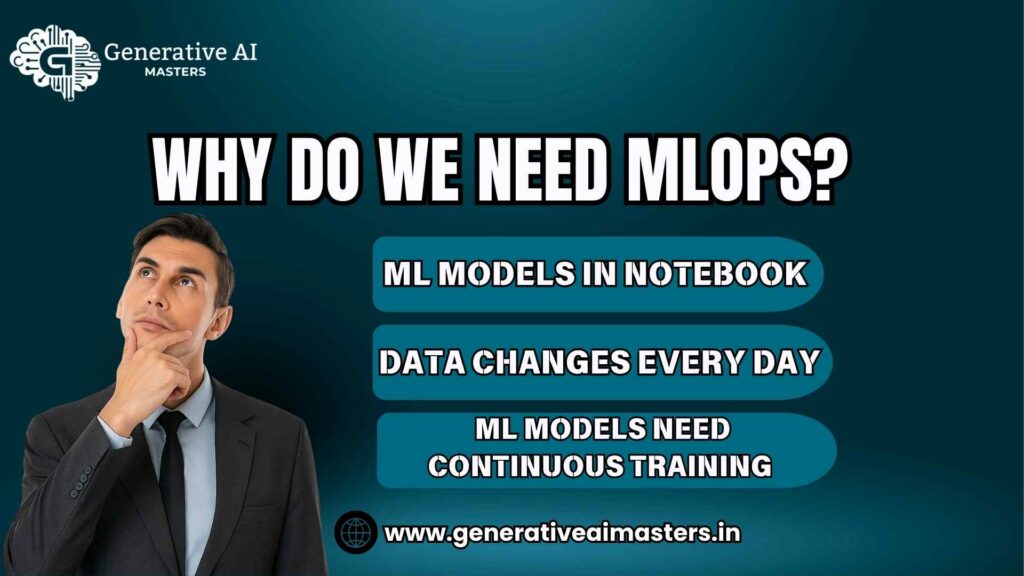
Why Do We Need MLOps?
ML Models in Notebook Are NOT Production-Ready
A model may work perfectly on your laptop, but when you try to use it in the real world, many problems appear:
- The model becomes slow
- Data coming from real users is different
- The model may crash
- Predictions may become wrong over time
- The code might not run on the server
- Dependencies conflict
- GPU/CPU requirements change
- MLOps fixes these issues by preparing the model for real-world usage.
Data Changes Every Day (Data Drift Problem)
Real-world data is never constant. It keeps changing.
Example
- User behavior changes
- Market trends change
- Customer patterns change
- Weather changes
- Product popularity changes
A model that was accurate today may become completely wrong after 3 months.
This is called data drift.
MLOps helps detect this drift and retrains the model automatically.
ML Models Need Continuous Training (CT)
In production, models must learn from new data continuously.
Without continuous training
- accuracy drops
- model becomes outdated
- business loses money
- user experience becomes bad
MLOps allows automatic retraining and redeployment without human effort.
ML Models Need Version Control
Companies build multiple versions of models
- v1: basic version
- v2: improved accuracy
- v3: works faster
- v4: new dataset used
Without tracking these versions, teams get confused.
MLOps keeps track of
model version
data version
code version
experiment version
This allows teams to reproduce results anytime.
Deployment Without MLOps Is Painful
Deploying an ML model is very different from deploying normal software.
Challenges
- it needs the right environment
- it needs GPU/CPU setup
- it needs specific libraries
- it needs fast APIs
- it needs high reliability
MLOps automates deployment using:
- Docker
- Kubernetes
- CI/CD pipelines
So deployment becomes smooth and repeatable.
Real-Time Monitoring Is Essential
Once a model is live, we must monitor
- Is the model giving correct predictions?
- Is the response time slow?
- Is accuracy decreasing?
- Are there any errors?
- Is the model biased?
Example
A loan approval model in a bank must be accurate every day.
If it starts making mistakes, it may approve wrong loans → company loses crores.
MLOps tools continuously monitor these problems and generate alerts.
Scaling ML Models to Millions of Users Is Hard
A model that works for 100 users won’t work for 10 lakh users.
To scale ML models, we need:
- auto-scaling servers
- load balancing
- distributed systems
- GPU clusters
- model caching
MLOps helps handle massive traffic without crashing.
ML Operations Need Automation
Manual processes create problems
slow deployment
human errors
inconsistent results
team dependency
no repeatability
MLOps brings automation
automated training
automated testing
automated deployment
automated monitoring
automated rollback
This makes AI systems more stable and fast.
Teams Must Collaborate Smoothly
ML projects involve multiple teams
- Data scientists
- ML engineers
- Data engineers
- DevOps engineers
- Cloud engineers
Everyone must work in sync.
MLOps acts like a “bridge” between all teams and creates a smooth workflow.
ML Models Must Be Secure & Auditable
Security is extremely important in
- banking
- healthcare
- government systems
- insurance
- telecom
Models must follow
- security rules
- compliance standards
- audit logs
- user access control
MLOps ensures all ML processes are safe, controlled, and documented.
How Do You Gain Practical MLOps Experience?
1. Start with Small End-to-End ML Projects
Before doing MLOps, build simple ML projects so you understand the model lifecycle.
Example small ML projects
- House price prediction
- Sentiment analysis
- Image classification
- Sales forecasting
Why this helps
You must first understand how models are built before learning how to deploy and manage them.
2. Build Your First MLOps Pipeline (Small Level)
Take any small ML project and add:
- Data versioning using DVC
- Experiment tracking using MLflow
- Model serving using FastAPI
- Docker container for your model
- This is your first practical MLOps experience.
Why this helps
You learn the core steps used in real companies.
3. Create Automated Workflows Using Airflow
Next, automate your complete ML process:
Airflow pipeline example
- Load data
- Clean data
- Train model
- Evaluate model
- Deploy model
Why this helps
Automation is the heart of MLOps.
Companies expect you to build production-ready pipelines.
4. Learn Cloud + Deploy Models on Real Cloud Servers
Choose any one cloud
AWS (Recommended)
Deploy models on:
- EC2
- S3
- Lambda
- SageMaker
GCP
- Vertex AI
- GKE
Azure
- Azure ML
- AKS
Why this helps
Real companies deploy everything on cloud.
Hands-on cloud experience makes you job-ready.
5. Practice Kubernetes Deployments (Most Important Skill)
Start small
Learn to deploy
- Docker containers
- APIs
- ML models
- Batch jobs
Then try
- Auto-scaling
- Load balancing
- Rolling updates
Why this helps
All large companies use Kubernetes.
Kubernetes experience = HIGH salary + FAST hiring.
6. Implement Monitoring (Real-World Skill)
Use tools like
- Prometheus → collect metrics
- Grafana → show dashboards
- EvidentlyAI → detect model drift
Monitor
- prediction errors
- latency
- data drift
- model accuracy drop
Why this helps
Monitoring is mandatory in every real MLOps job.
7. Build 3–5 Full End-to-End MLOps Projects
These projects must include:
- Data pipeline
- Training pipeline
- Deployment pipeline
- Monitoring
- Retraining automation
Example project ideas
- Real-time fraud detection pipeline
- Churn prediction model with drift monitoring
- LLM-based RAG pipeline with vector DB
- Sales forecasting automated pipeline
- Image classification deployed with Kubernetes
Why this helps
Projects = Proof of your skills
Companies hire people with strong portfolios.
8. Contribute to Open Source MLOps Tools
You can contribute to:
- MLflow
- DVC
- Airflow
- Kubeflow
- BentoML
- Seldon Core
Why this helps
Open-source contributions make your resume 10× stronger.
9. Join Hackathons & Kaggle Competitions
You learn
- working under deadlines
- solving real problems
- collaborating with teams
Why this helps
Companies love candidates with competitive experience.
10. Do Freelancing or Internship Projects
Use platforms like
- Upwork
- Fiverr
- TopTal
- Internshala
Project work may include
- creating ML APIs
- automating training jobs
- deploying models to cloud
- building dashboards
Why this helps
Real clients → real experience → real confidence.
11. Build a Strong GitHub Portfolio
Add
- Project code
- Dockerfiles
- YAML files
- Training pipelines
- Monitoring dashboards
- Deployment scripts
Why this helps
Recruiters always check your GitHub before shortlisting you.
Write documentati
12. Document Everything
on for each project
- What problem you solved
- Architecture diagram
- Tools used
- Steps followed
- Final output
Why this helps
Shows companies you understand the full process.
Which Certifications & Courses Actually Help in 2026?
What to Look for in a Good MLOps Certification/Course (in 2026)
Before listing courses — quick checklist of what makes a course worthwhile
- It covers full ML lifecycle + Ops: not just ML theory, but data pipelines, deployment, versioning, monitoring.
- It includes hands-on labs / real projects (not just videos).
- It uses industry-standard tools (Docker, Kubernetes, MLflow, cloud–AWS/GCP/Azure, CI/CD, etc.).
- It gives you certificate + project(s) — useful for your résumé / portfolio.
- Preferably, it’s updated recently (2024/2025/2026), since MLOps tools evolve quickly.
- Covers cloud + infra + DevOps + ML — because MLOps is cross-disciplinary.
Recommended MLOps Courses & Certifications for 2026
Here are courses/programs that — based on curriculum, tools covered, and relevance — actually help if you want to build MLOps skills
Course / Program | What’s good / Why useful |
BITS Pilani Professional Certificate in AI Engineering and MLOps | ~ 36–38 weeks, hands-on with real-world projects, covers full stack (modeling → deployment → scaling → production), good for engineers shifting to MLOps. |
Coursera MLOps Specialization (by industry instructors) | Well-structured, cloud & MLflow + deployment + production workflows, good for beginners to understand MLOps end-to-end. |
ProjectPro MLOps Course (online) | Shorter course (6–12 weeks) that focuses on practical, real-world ML/MLops tasks — good for quick start or supplementary learning. |
Edureka MLOps Certification Training Course | Covers MLops lifecycle, common tools (MLflow, SageMaker), CI/CD, cloud platforms — useful for Indian learners and those seeking guided trainer-based learning. |
IISc + TalentSprint Advanced AI & MLOps Programme | From a reputed institute (IISc), focused on high-quality curriculum, labs + capstone projects — good for advanced learners. |
How Certifications Help vs What They Alone Don’t Do
How they help
- Give structured learning path — you get systematic exposure to ML + Ops + infra.
- Provide certificates & proof for resume — good for recruiters to see “I have done MLOps training.”
- Help you build a portfolio (many include capstone projects).
- Teach you practical tools (Docker, Kubernetes, MLflow, Cloud, CI/CD) which are demanded by companies.
- Help you transition (e.g. from ML / data science or DevOps to MLOps) in a guided way.
What they alone don’t guarantee
- Job readiness — unless you also build real projects. Certification + theory is not enough.
- Deep understanding — you need to practice, build, break, fix, and deploy on real infra.
- Constant upskilling — the MLOps world changes fast; you must keep updating your skills beyond any certification.
My Recommendation: How to Use Courses Smartly
If I were you and starting in 2026, this is how I’d use certifications
- Start with a structured course (like BITS-Pilani or Coursera) to learn fundamentals.
- Simultaneously build 1–2 small real projects — deploy a model, dockerize, setup monitoring.
- Then take advanced/focused courses (IISc or ProjectPro) that teach scaling, cloud infra, CI/CD, monitoring.
- Maintain a GitHub portfolio — show your deployed pipelines — that speaks louder than certificates.
- Keep learning — as tools change fast, use courses + self-practice to stay updated.
Conclusion
MLOps is becoming one of the most important skills in the AI world, especially in 2026. As companies train more machine learning models, they need engineers who can deploy, monitor, and manage these models in real production systems. That is exactly why MLOps is growing so fast. If you start today with the right roadmap—Python basics, Git, Linux, Docker, MLflow, DVC, FastAPI, cloud, Airflow, and Kubernetes—you can build a strong career in this field. The best part is that you don’t need to be a deep ML expert. What you need is consistent practice, real hands-on projects, and the ability to automate ML workflows. With continuous learning and good portfolio projects, anyone can become a job-ready MLOps engineer. The future belongs to people who can take ML models from notebooks to production, and MLOps gives you the skills to do exactly that.