
MLOps Roles and Responsibilities
MLOps roles and responsibilities cover the people who build, deploy, monitor, and maintain machine learning systems in production. Core roles include the MLOps Engineer, ML Engineer, Data Engineer, Data Scientist, DevOps/Platform Engineer, and ML Architect. In 2026, these roles increasingly overlap with LLMOps and AI platform engineering as teams operationalize generative AI alongside traditional ML.
Table of Contents
Introduction to MLOps Roles and Responsibilities
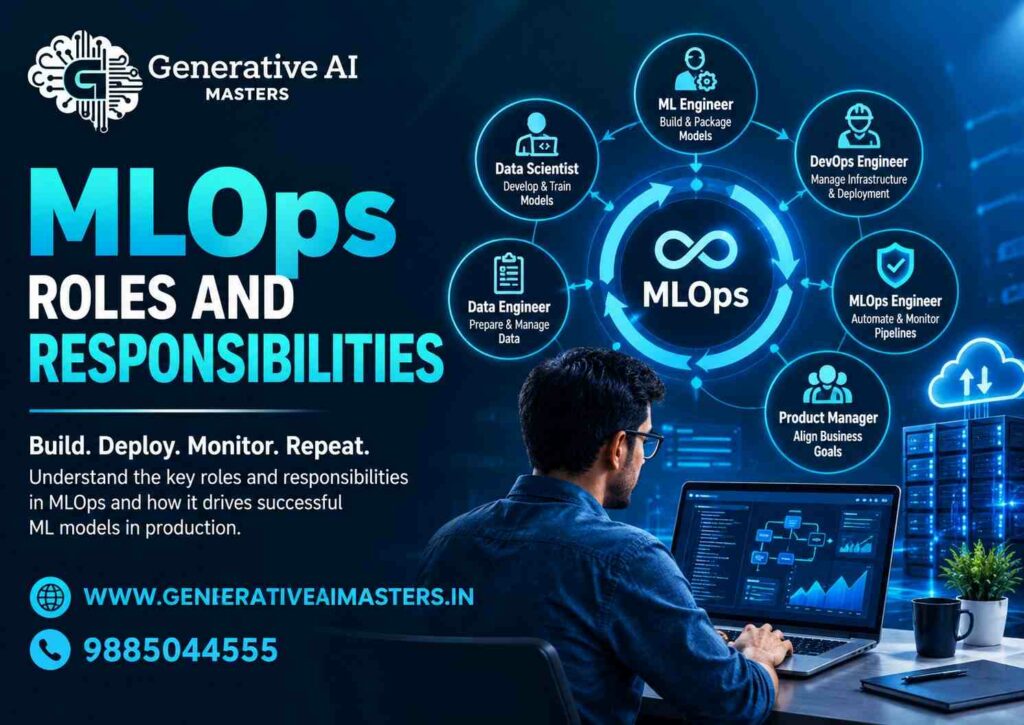
If you’ve ever wondered why a machine learning model that works perfectly in a notebook falls apart in production, the answer usually isn’t the model. It’s the people, processes, and roles around it.
MLOps, short for Machine Learning Operations, exists to close that gap. But “MLOps” isn’t one job. It’s a set of roles that work together to take a model from an idea to something running reliably at scale, month after month.
This guide breaks down every major MLOps role, what each person actually does day-to-day, the skills and tools associated with each role, and how these roles have shifted for 2026 as teams start managing large language models (LLMs) and generative AI systems alongside traditional ML.
Whether you’re a student deciding which MLOps role to aim for, a data scientist trying to understand who owns what, or a hiring manager building a team, this guide gives you a clear, practical map. If you’d rather follow a guided MLOps training path instead of self-learning, that’s worth keeping in mind as you read through each role below.
What is MLOps?
MLOps is the discipline of taking machine learning models from development into reliable, monitored, and scalable production use. It borrows practices from DevOps automation, continuous integration, continuous delivery and applies them to the unique challenges of ML, such as data drift, model retraining, and versioning of both code and data.
Unlike traditional software, an ML system’s behavior depends on data, not just code. That single difference is why MLOps needs its own set of specialized roles instead of simply reusing a DevOps team. Google Cloud’s MLOps architecture guide is a good reference if you want to see how this maps to a real production pipeline.
Why MLOps Roles and Responsibilities Matter
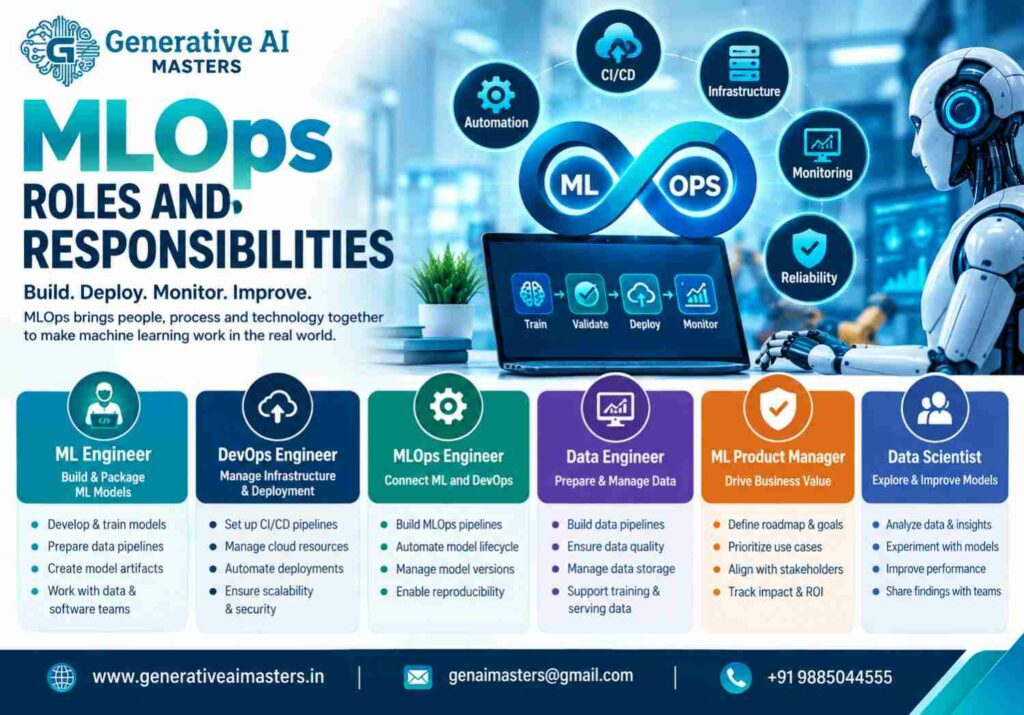
A model is only valuable if it keeps working after launch. Without clearly defined roles, common failures show up again and again:
- Models get deployed but nobody monitors their accuracy over time
- Data pipelines break silently and predictions quietly degrade
- Data scientists spend weeks fixing infrastructure instead of improving models
- No one owns retraining, so outdated models keep running for months
Clear roles fix this by assigning ownership at every stage: data, training, deployment, monitoring, and governance. When responsibilities are well defined, teams ship faster and catch problems before they reach users.
Complete Overview of MLOps Roles
Most MLOps teams whether inside a startup or a large enterprise are built around a small set of core roles. Some companies merge two or three of these into one job title; larger organizations split them further.
Role | Primary Focus | Core Responsibilities | Common Tools |
MLOps Engineer | Automating the ML lifecycle | CI/CD for models, deployment pipelines, monitoring setup | MLflow, Kubeflow, Airflow, Docker, Kubernetes |
Data Engineer | Data pipelines and infrastructure | Building ETL/ELT pipelines, data quality, feature pipelines | Spark, Airflow, dbt, Snowflake, Kafka |
Data Scientist | Model development | Experimentation, feature engineering, model evaluation | Python, Pandas, Scikit-learn, PyTorch, Jupyter |
ML Engineer | Production-ready models | Productionizing models, optimizing inference, packaging | PyTorch, TensorFlow, ONNX, FastAPI |
DevOps/Platform Engineer | Infrastructure and reliability | Cloud infrastructure, scaling, CI/CD for the whole platform | Terraform, Kubernetes, AWS/GCP/Azure |
ML Architect | System design | Designing end-to-end ML system architecture, tool selection | Cloud platforms, system design tools |
AI/ML Governance Lead | Compliance and safety | Model risk, bias checks, auditability, guardrails | Model cards, audit logs, evaluation frameworks |
LLMOps Engineer (2026) | Operating LLM-based systems | Prompt pipelines, RAG systems, LLM monitoring, cost control | LangChain, LlamaIndex, vector databases, LLM gateways |
MLOps Engineer: Roles and Responsibilities
The MLOps Engineer is the person most directly responsible for the “operations” half of MLOps. They build the automated pipelines that move a model from a trained artifact to a live, monitored service.
Core responsibilities:
- Building CI/CD pipelines specifically for ML models, not just application code
- Automating model packaging, versioning, and deployment
- Setting up model monitoring for accuracy, latency, and data drift
- Managing model registries (MLflow, SageMaker Model Registry, Vertex AI)
- Coordinating rollback strategies when a new model underperforms
- Working closely with data scientists to translate research code into production-ready pipelines
Pro Tip: MLOps Engineers who understand both software engineering and basic ML concepts are far more effective than those who know only one side. You don’t need to build models from scratch, but you must understand how they behave when data changes. The MLflow documentation is a solid starting point for learning model registries and experiment tracking hands-on.
Data Engineer: Roles and Responsibilities
Every ML system runs on data pipelines, and data engineers own that pipeline from raw source to model-ready features.
Core responsibilities:
- Designing and maintaining ETL/ELT pipelines that feed both training and inference
- Ensuring data quality, schema consistency, and freshness
- Building and maintaining feature stores
- Handling large-scale batch and streaming data processing
- Coordinating with data scientists on what features are actually usable in production
Without reliable data engineering, even the best model degrades quickly, because production data always drifts from training data over time.
Data Scientist: Roles and Responsibilities
Data scientists focus on the modeling side: turning a business problem into a working model. In an MLOps context, their responsibilities extend slightly beyond pure research.
Core responsibilities:
- Exploratory data analysis and feature engineering
- Selecting and training models, tuning hyperparameters
- Evaluating model performance against business metrics, not just accuracy
- Documenting experiments so they’re reproducible by others
- Collaborating with ML engineers to hand off models for production readiness
Common Mistake: Treating a Jupyter notebook as the final deliverable. In a mature MLOps setup, a notebook is a starting point — the real deliverable is reproducible, version-controlled, production-ready code.
DevOps / Platform Engineer: Roles and Responsibilities
This role focuses less on ML specifics and more on the infrastructure that everything else runs on.
Core responsibilities:
- Provisioning and managing cloud infrastructure (compute, storage, networking)
- Managing Kubernetes clusters used for training and serving models
- Setting up general CI/CD pipelines and infrastructure-as-code (Terraform)
- Ensuring uptime, scalability, and cost efficiency of the ML platform
- Enforcing security practices across the ML stack
New to container orchestration? The official Kubernetes documentation is the most reliable place to learn the concepts this role depends on daily.
AI/ML Governance and Compliance: Roles and Responsibilities
This role has grown significantly by 2026 as regulations around AI use have matured.
Core responsibilities:
- Maintaining model documentation (model cards, data lineage, risk assessments)
- Running bias and fairness evaluations before and after deployment
- Setting up audit trails for regulated industries (finance, healthcare)
- Defining guardrails for what models can and cannot do in production
- Coordinating with legal and security teams on AI risk policy
Many governance teams now align their process with the NIST AI Risk Management Framework, which gives a structured, vendor-neutral way to evaluate AI risk.
MLOps Roles by Experience Level
Level | Typical Role Focus | Skills to Master | Expected Outcome |
Beginner | Data Engineer / Junior ML Engineer support | Python, SQL, basic pipelines, Git | Can build and maintain simple data pipelines |
Intermediate | ML Engineer / MLOps Engineer | Docker, CI/CD, model serving, cloud basics | Can deploy and monitor a model independently |
Advanced | Senior MLOps Engineer / ML Architect | Kubernetes, distributed systems, multi-model platforms | Can design and scale a full ML platform |
Expert | ML Architect / Governance Lead / Staff Engineer | System design, cost optimization, AI governance | Can set organization-wide MLOps and AI strategy |
If you’re benchmarking your skills against a cloud platform, Amazon’s SageMaker MLOps guide is a useful checkpoint for what “intermediate to advanced” looks like in practice.
How MLOps Roles Collaborate: A Real-World Workflow
Understanding responsibilities in isolation only tells half the story. Here’s how these roles typically interact on a single project:
- Data Engineer builds the pipeline that gathers and cleans raw data.
- Data Scientist explores the data and trains candidate models.
- ML Engineer optimizes the winning model for production use.
- MLOps Engineer builds the CI/CD pipeline to deploy and version the model.
- DevOps/Platform Engineer ensures the infrastructure scales and stays available.
- ML Architect reviews the design to confirm it fits the broader system.
- Governance Lead signs off on compliance and risk documentation before launch.
No single role works in isolation MLOps succeeds when handoffs between these roles are smooth and well documented.
MLOps Roles in 2026: What's Changed
By 2026, MLOps responsibilities have expanded well beyond traditional predictive ML to include generative AI and LLM-based systems. This has created new sub-responsibilities inside existing roles, and in some organizations, entirely new roles.
What’s different in 2026:
- LLMOps has become a specialization. Teams now manage prompt versioning, retrieval-augmented generation (RAG) pipelines, and vector databases (Pinecone, Weaviate, Chroma) alongside traditional model pipelines.
- Cost monitoring is now a core responsibility. Because LLM inference costs scale with usage, MLOps and platform teams actively track token spend, not just compute utilization.
- Agentic AI systems need new monitoring patterns. AI agents that call tools and APIs autonomously require tracing and guardrail systems that traditional model monitoring didn’t need.
- Governance roles have grown in scope, driven by AI regulation and internal risk policies around generative AI outputs.
- Cross-functional fluency matters more. MLOps Engineers in 2026 are expected to understand both classic ML pipelines and LLM-specific tooling like LangChain or LlamaIndex.
Quick Tip: If you’re planning a career in MLOps today, learning both traditional MLOps tooling (MLflow, Kubernetes, Airflow) and LLMOps concepts (RAG, vector databases, prompt evaluation) will make you significantly more competitive. For a broader view of how these pieces connect, this Generative AI Roadmap walks through the full learning path, and if agentic systems interest you specifically, an Agentic AI course is worth exploring alongside your MLOps skills.
Microsoft’s Azure Machine Learning model management docs are a good example of how a major cloud platform is folding LLMOps concepts into its standard MLOps tooling.
Skills Required Across MLOps Roles
These overlap heavily with the broader skills required for an AI engineer in 2026, since most MLOps roles sit inside a larger AI engineering skill set rather than existing in isolation.
Skill Category | Examples | Most Relevant Roles |
Programming | Python, SQL, Bash | All roles |
Data Pipelines | Airflow, dbt, Spark, Kafka | Data Engineer |
ML Frameworks | PyTorch, TensorFlow, Scikit-learn | Data Scientist, ML Engineer |
Containers & Orchestration | Docker, Kubernetes | ML Engineer, MLOps Engineer, DevOps |
CI/CD | GitHub Actions, Jenkins, GitLab CI | MLOps Engineer, DevOps |
Cloud Platforms | AWS, GCP, Azure | DevOps, MLOps Engineer, ML Architect |
Monitoring | Prometheus, Grafana, Evidently AI | MLOps Engineer |
LLMOps Tools | LangChain, LlamaIndex, vector DBs | LLMOps Engineer, ML Engineer |
Governance | Model documentation, audit tools | Governance Lead |
Common Mistakes in Assigning MLOps Roles
- Expecting one person to be “the MLOps team.” MLOps requires collaboration across data, modeling, and infrastructure; it’s rarely a single-person job at any real scale.
- Letting data scientists own production infrastructure. Their strength is modeling, not managing Kubernetes clusters or CI/CD pipelines.
- Skipping monitoring ownership. Someone must explicitly own model monitoring, or performance issues go unnoticed for months.
- Ignoring governance until forced to. Waiting for a compliance issue to define AI governance responsibilities is far more costly than planning early.
- Treating LLMOps as identical to MLOps. LLM-based systems introduce new failure modes prompt drift, hallucination, retrieval quality that traditional MLOps monitoring doesn’t catch.
Conclusion
MLOps works when responsibilities are clear. Data engineers keep the pipelines healthy, data scientists build the models, ML engineers make them production-ready, MLOps engineers automate deployment and monitoring, platform teams keep everything running, architects design the system, and governance leads keep it safe and compliant.
As generative AI and LLM-based systems become part of everyday production workloads, these roles are expanding rather than disappearing — the fundamentals of MLOps still apply, just with new tools and new failure modes to watch for. If you’re building a career here, understand the full lifecycle first, then specialize in the role that fits your strengths, and back it up with real-world projects you can show in an interview.
This article is brought to you by Generative AI Masters, which offers hands-on Generative AI Training in Hyderabad covering LLMs, RAG, LangChain, Agentic AI, and MLOps through live, project-based batches.
Frequently Asked Questions
1. What is the difference between an MLOps Engineer and Data Scientist?
A Data Scientist focuses on building and evaluating models exploring data, engineering features, and choosing the right algorithm. An MLOps Engineer focuses on operationalizing that model: automating deployment, monitoring performance in production, and managing infrastructure. They collaborate closely, but their day-to-day work is different.
2. Do I need a software engineering background for MLOps roles?
For most MLOps and ML Engineer roles, yes strong software engineering fundamentals (Git, testing, APIs, containers) matter as much as ML knowledge. Data Scientist roles can lean more heavily on statistics and modeling, with software skills becoming important once you move toward production work.
3. Is MLOps the same as DevOps?
No. DevOps focuses on software delivery and infrastructure reliability in general. MLOps applies similar automation principles specifically to machine learning, adding responsibilities like data versioning, model monitoring, and retraining pipelines that don’t exist in traditional DevOps.
4. What tools should I learn first for an MLOps role?
Start with Python, Docker, and Git, since these are foundational across every MLOps role. From there, learn a workflow orchestration tool like Airflow, a model tracking tool like MLflow, and basic Kubernetes concepts for deployment.
5. How is LLMOps different from traditional MLOps?
LLMOps focuses on operating large language model systems: prompt management, retrieval-augmented generation, vector databases, and monitoring for issues like hallucination or cost overruns. Traditional MLOps focuses more on structured-data models with defined accuracy metrics. In 2026, many teams need both skill sets.
6. Can a small team handle all MLOps roles?
Yes, especially at startups, where one or two engineers often cover data engineering, ML engineering, and MLOps together. As the system and data volume grow, these responsibilities typically split into dedicated roles.
7. What does an ML Architect actually design?
An ML Architect designs the full system: how data flows from source to model, which infrastructure and tools are used for training and serving, how monitoring and retraining will work, and how the system scales as usage grows.
8.Who is responsible for model monitoring after deployment?
This typically falls to the MLOps Engineer, sometimes shared with the Platform/DevOps team. They track metrics like prediction accuracy, latency, and data drift, and trigger alerts or retraining when performance drops.
9. What skills matter most for career growth in MLOps?
Beyond technical tools, understanding the full ML lifecycle from data to deployment to monitoring matters more than mastering any single tool. Strong communication with data scientists and platform teams is equally important, since MLOps is inherently cross-functional. Practicing with real Generative AI interview questions is also a practical way to test how well you understand these role boundaries before an actual interview.
10. Is governance a technical MLOps role or a compliance role?
It’s both. AI/ML Governance Leads need enough technical understanding to evaluate models and pipelines, combined with compliance knowledge to translate legal and ethical requirements into concrete engineering checks.

Mr. Dinesh Tunguturi Generative AI Trainer
GenAI Masters AI Experts | 60+ Articles Published on Generative AI, Prompt Engineering, LLMs & AI Careers
Mr. Dinesh is a Generative AI Trainer with expertise in Large Language Models (LLMs), Prompt Engineering, Agentic AI, RAG, and AI Automation. He helps students and professionals gain practical, job-ready AI skills through hands-on training, real-world projects, and industry-focused mentorship.