Types of AI Systems Explained for Beginners
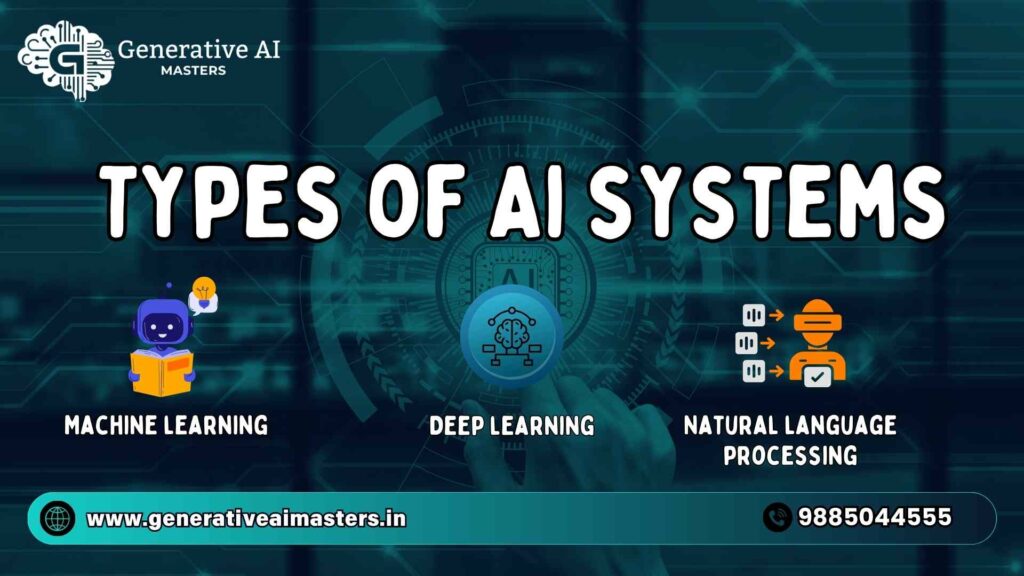
Artificial Intelligence is now part of our daily life, from mobile assistants to smart robots and medical tools. But many people still get confused when they hear about the types of AI systems and how they actually work. In this guide, we will clearly explain the different types of artificial intelligence in a simple way — with real-world examples, benefits, and challenges. You will learn how AI grows from basic systems that follow rules, to future systems that may think and learn like humans. We will also look at AI examples in real life, so you can easily understand where AI is used today and how it is changing businesses, education, healthcare, and everyday activities. By the end, you will have a complete understanding of AI types and how they shape our world.
Types of AI Based on Capability
When we talk about types of AI based on capability, we are trying to understand:
- how powerful the AI is
- how independently it can think
- how much it can learn from experience
- how close it is to human intelligence
Not all AI is the same. Some AI systems only follow instructions. Others can learn from data. And some future systems may one day think and reason like humans — or even beyond.
There are three main capability levels:
1️. Narrow AI
2️.General AI
3.Super AI
1. Narrow AI (Weak AI) — The AI We Use Today
Narrow AI is called weak AI, but in reality, it is very powerful in its own limited area.
It is “narrow” because
it is designed only for one task or one purpose.
It cannot understand the world.
It cannot think about different topics.
It cannot question itself.
It only does what it is trained to do.
How Narrow AI Works
Narrow AI learns from data. Developers feed
- images
- text
- audio
- numbers
- patterns
The AI studies the data and learns how to
- recognize objects
- predict results
- make suggestions
- respond to questions
But it does not truly “understand”.
It does not have emotions.
It does not have common sense.
Real-Life Examples of Narrow AI
- Google Translate translating languages
- Netflix recommending movies
- Amazon showing product suggestions
- Face unlock on smartphones
- Chatbots answering basic customer queries
- AI cameras detecting objects
All of these systems are experts at one job only.
For example
- A chess AI can beat world champions —
but it cannot cook food, talk about emotions, or drive a car. - This is the limit of Narrow AI.
2. General AI (Strong AI) — Human-Like Intelligence
- General AI is the next major step in AI evolution.
- This type of AI would
- understand, learn, and think like a human across many different areas.
It would not just follow rules.
It would reason.
It would be creative.
What General AI Could Do
A true General AI system could
- learn new subjects on its own
- solve problems it has never seen before
- understand emotions, tone, and context
- plan for the future
- think logically and creatively
For example
Imagine a robot that can
- study medicine
- learn to play guitar
- speak multiple languages
- understand jokes
- solve a new math problem
- cook food
- comfort someone who is sad
all without special programming.
That would be General AI.
Status Today
Right now
We do NOT have real General AI.
We only have advanced Narrow AI that looks smart, but still has limits.
Researchers are working hard, using
- brain simulations
- deep learning
- reinforcement learning
- cognitive science
But real human-level AI is still in the future.
3. Super AI — Beyond Human Intelligence
- Super AI is the highest, most advanced level of AI.
- This is when AI becomes
- more intelligent than humans in every possible way.
That means
- stronger memory
- faster thinking
- more accurate decisions
- better creativity
- deep emotional understanding
- perfect long-term planning
What Super AI Could Do
Super AI might one day
- solve diseases with no cures
- design new scientific inventions
- predict disasters early
- create smarter cities
- help solve global poverty and climate issues
But at the same time…
Risks of Super AI
If not controlled carefully, Super AI could
- ignore human rules
- make decisions we do not understand
- change systems without permission
- become dangerous if misused
That is why scientists talk a lot about
- AI safety
- ethics
- government regulations
- human control systems
Status Today
Super AI
- does not exist
- only exists in theory, books, movies, and research ideas
But many experts believe that someday, it may become real.
Easy Memory Trick
Narrow AI = Specialist
(does one job very well)
General AI = Human-like learner
(can do many different things)
Super AI = Beyond human
(smarter than every human being)
Types of AI Based on Functionality
This model explains how much awareness, learning ability, and memory an AI system has.
We usually divide AI (by functionality) into four main types
1️.Reactive Machines
2️.Limited Memory AI
3️.Theory of Mind AI
4️.Self-Aware AI
1. Reactive Machines — The Most Basic AI
Reactive machines are the oldest and simplest type of AI.
They
- do not have memory
- cannot learn from past experience
- only respond to the current situation
They react based on what they see right now.
How Reactive AI Works
Think of it like
“If this happens → then do that.”
- No learning.
- No thinking.
- No understanding of past events.
Examples of Reactive AI
- Chess-playing AI (like IBM Deep Blue)
- Basic spam filters
- Simple robots that only move based on sensors
For example
A chess AI looks at the board and picks the best move.
But it doesn’t remember past games or learn strategy later.
Where Reactive AI is Useful
- simple automation
- fast decision systems
- machines that must react quickly
Limitations
- cannot improve over time
- cannot plan for the future
- cannot store learning
2. Limited Memory AI — The AI We Mostly Use Today
Limited Memory AI is smarter than reactive machines.
It can
- learn from past data
- remember patterns
- improve performance over time
But the memory is temporary and limited.
How Limited Memory Works
AI is trained on huge datasets like:
- images
- text
- driving data
- medical records
Then it uses that training to make predictions in real time.
Examples of Limited Memory AI
- Self-driving cars (remember signs, people, speed, lanes)
- Chatbots and virtual assistants
- Recommendation systems (YouTube, Netflix, Amazon)
- Face recognition systems
- Fraud detection tools
For example
A self-driving car
- remembers nearby vehicles
- uses maps
- learns traffic rules
- adjusts its driving
But it does not truly “understand” driving like humans do.
Strengths
- can learn from experience
- improves accuracy over time
- widely used in real applications
Limitations
- memory is not permanent
- cannot become fully independent
- still needs human guidance
3. Theory of Mind AI — Understanding Emotions and Social Behavior
This type of AI is still under research.
Theory of Mind AI focuses on
understanding human emotions, beliefs, intentions, and social behavior.
The goal is to create AI that can
- read facial expressions
- understand tone and mood
- react differently in emotional situations
What Theory of Mind AI Could Do
Imagine AI that
- comforts someone who feels sad
- understands frustration in a conversation
- works as a real companion
- supports doctors with emotional insights
It would behave more naturally — like another human.
Current Progress
We see early forms in
- social robots
- emotional AI assistants
- mental health chat systems
- advanced humanoid robots
But…
True Theory of Mind AI is not fully ready yet.
Scientists still need to teach AI
- empathy
- social understanding
- real communication skills
4. Self-Aware AI — The Most Advanced (Future AI)
Self-aware AI is the final stage.
This AI would
understand itself, its own thoughts, emotions, and existence.
It would know
- “I am an AI”
- “I am performing this task”
- “I have goals and awareness”
This is similar to human consciousness.
What Self-Aware AI Could Do
Such AI could
- think beyond programming
- make independent decisions
- understand emotions deeply
- develop self-motivation
But because it is so powerful, it also raises concerns
- Control
- Ethics
- Safety
- responsibility
Current Status
Right now
- Self-aware AI does NOT exist.
- It is only theoretical and discussed in research and movies.
Scientists are still debating
- Should humans build it?
- If yes, how do we control it?
- What rules and laws are needed?
If you want to learn more about Generative AI Syllabus
Difference Between Capability vs Functionality AI Types
What “Capability” means
Capability explains
- how powerful the AI is
- how close it is to human intelligence
- how much it can think and learn
Types based on capability
- Narrow AI
- General AI
- Super AI
These focus on how smart the AI can become.
What “Functionality” means
Functionality explains
- how the AI works
- how it makes decisions
- how it uses memory and awareness
Types based on functionality
- Reactive Machines
- Limited Memory AI
- Theory of Mind AI
- Self-Aware AI
These focus on how the AI behaves and operates.
Key Differences (Side by Side)
- Capability talks about intelligence level.
- Functionality talks about working style.
- Capability looks at present and future growth of AI.
- Functionality looks at design and technical behavior.
- Capability asks: “How smart can this AI become?”
- Functionality asks: “How does this AI process information?”
- Capability explains whether AI is weak, human-like, or smarter than humans.
- Functionality explains whether AI reacts, learns, understands emotions, or becomes self-aware.
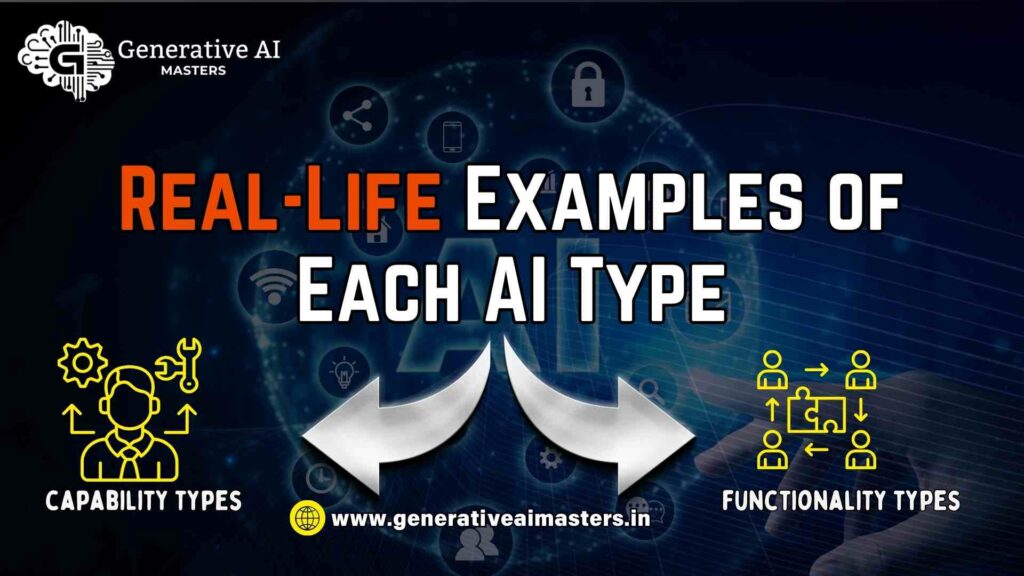
Real-Life Examples of Each AI Type
This will help readers easily connect theory with real life.
We’ll match examples with both
- capability types
- functionality types
And explain them clearly, not in short lines.
1. Examples of Narrow AI (Weak AI)
Narrow AI is everywhere around us.
It is built for one specific job only.
Example 1: Google Maps & Navigation
When you use Google Maps
- it tracks traffic
- shows fastest routes
- predicts arrival time
- suggests alternative paths
It learns from
- past traffic data
- user locations
- road condition updates
But Google Maps cannot
- cook food
- write stories
- understand emotions
It is smart only for navigation.
Example 2: Recommendation Systems
You see this in
- Netflix (movies)
- YouTube (videos)
- Amazon (products)
- Spotify (songs)
The AI studies your behavior
- what you watch
- what you skip
- what you like
- what you search
Then it suggests similar content.
Again — only one purpose recommendations.
Example 3: AI Chatbots
Website chatbots help with
- order status
- booking tickets
- answering FAQs
But they do not truly think or understand emotions deeply.
They follow rules and patterns.
2. Examples of General AI (Future Goal)
General AI does not exist yet, but researchers build simulations and prototypes.
Imagine
Example Idea: A Human-Like Robot Assistant
A true general AI robot would be able to
- clean the house
- talk naturally
- learn new languages
- repair machines
- teach children
- understand emotions
—all without being programmed for each task separately.
Today, we only see early experiments, like
- advanced research robots
- AI models learning multiple tasks
But none are truly human-level yet.
3. Examples of Super AI (Only Theory)
Super AI exists only in
- research papers
- science discussions
- movies
Examples from movies
- “Her”
- Ex Machina”
- Terminator”
In theory, Super AI could
- solve global problems
- manage entire cities
- design new technologies
- improve itself without help
But again — not real yet.
Real-Life Examples Based on Functionality
1. Reactive Machine AI Examples
These systems react instantly and do not learn.
Example: IBM Deep Blue (Chess AI)
It beat world champion Garry Kasparov.
How it works
- checks chessboard
- evaluates moves
- chooses best option
But
- no memory
- no learning
- no emotions
2. Limited Memory AI Examples
This is what we use in most modern systems.
Example: Self-Driving Cars
Self-driving cars use sensors and cameras to
- detect pedestrians
- read road signs
- track other cars
- follow lanes
They learn from
- driving history
- road maps
- environment data
But memory is limited — not like humans.
Example: Face Recognition
Used in
- smartphones
- security systems
- airports
AI
- remembers facial patterns
- compares them with stored data
- identifies the person
But it still lacks true understanding.
3. Theory of Mind AI Examples (Early Stage)
Still experimental — but we see attempts.
Example: Social Robots
Robots designed for elderly care or kids
- detect sadness or happiness
- respond with gentle voice
- try to comfort users
They are not perfect yet, but they aim to understand emotions.
4. Self-Aware AI Examples
Currently
- No real self-aware AI
- only theory and fiction
Researchers are still studying
- human brain
- consciousness
- awareness systems
But we are far away from real self-aware AI.
Quick Wrap-Up
Real-life AI today is mostly
- Narrow AI
- Limited Memory AI
Future AI may move toward:
- General AI
- Theory of Mind
- Super AI
- Self-Aware AI
But those are still in development and theory.
Advantages and Disadvantages of Narrow AI (Weak AI)
Advantages
- Works very fast and accurate for one task
- Reduces human workload
- Saves time and effort
- Easy to train for specific problems
- Already used in many apps and tools
- Improves productivity in business and daily life
Disadvantages
- Cannot think outside its task
- Does not understand emotions or context
- Fully depends on training data
- Makes mistakes when task is different
- Cannot transfer knowledge to new areas
- Needs human control and monitoring
Advantages and Disadvantages of General AI
Advantages
- Can think and learn like humans
- Can work in many different fields
- Can solve new and complex situations
- Reduces the need for manual work
- Can help in science, medicine, and research
Disadvantages
- Does not exist yet in real life
- Very hard to build and train
- May create job loss in future
- Raises ethical and safety concerns
- Risk of losing control if misused
Advantages and Disadvantages of Super AI
Advantages
- Smarter than humans in every area
- Can solve global level problems
- Can discover new science and technologies
- Can make fast and accurate decisions
- Can automate almost everything
Disadvantages
- Only theoretical and risky
- May become impossible to control
- Can replace human decision power
- Can cause major ethical problems
- Can be dangerous if built without rules
Advantages and Disadvantages of Reactive Machines
Advantages
- Very fast responses
- Simple design and easy to build
- Works well for fixed tasks
- No storage needed for memory
- Stable and predictable results
Disadvantages
- Cannot learn from past experience
- Cannot improve performance
- Cannot plan for future
- Only reacts to present situation
- Very limited use cases
Advantages and Disadvantages of Limited Memory AI
Advantages
- Learns from past data
- Improves accuracy over time
- Useful in real-world systems
- Supports automation and decision making
- Can handle complex tasks like driving and detecting fraud
Disadvantages
- Memory is limited
- Still depends on training data
- Cannot fully understand emotions or meaning
- Needs continuous updates and maintenance
- Can make biased or wrong predictions
Advantages and Disadvantages of Theory of Mind AI
Advantages
- Can understand emotions and behavior
- Better human and machine communication
- Helpful in healthcare and mental support
- Can be used in social robots and assistants
Disadvantages
- Still in research stage
- Very hard to design and test
- Privacy and emotional misuse problems
- High development cost
Advantages and Disadvantages of Self-Aware AI
Advantages
- Highest level of intelligence
- Makes independent decisions
- Can manage complex global systems
- Can think deeply about goals and results
Disadvantages
- Does not exist yet
- Very dangerous if uncontrolled
- Can replace human power and authority
- Strong ethical and moral risks
- Hard to predict behavior
If you want to learn more about Generative AI Roadmap for Beginners
How to Choose the Right AI System for Your Needs
Choosing the right AI system depends on your goal, budget, and type of work. Not every AI tool fits every problem. Before selecting any AI system, it is important to think clearly about what you really need.
1. First, understand your problem
Ask yourself simple questions
- What problem am I trying to solve?
- Do I need automation, prediction, or decision support?
- Do I want AI for business, study, health, marketing, or personal work?
When your problem is clear, choosing becomes easier.
2. Decide the type of output you expect
Think about what you want AI to produce:
- text or content
- numbers or predictions
- images or designs
- voice responses
- recommendations
Different AI systems are built for different results. Do not choose AI without knowing the output.
3. Check how much data you have
AI needs data to learn. More data usually means better accuracy.
- If you have small data, simple Narrow AI tools are enough.
- If you have large data sets, machine learning systems are better.
- If you have no data, rule-based AI may be safer.
Never choose heavy AI systems when your data is weak.
4. Look at cost and resources
AI can be cheap or very expensive depending on type.
- cloud AI tools cost less
- custom AI development costs more
- advanced systems need powerful hardware
Always check:
- setup cost
- training cost
- maintenance cost
Choose what fits your budget.
5. Check accuracy and reliability
Good AI must give correct results most of the time.
- test with sample data
- compare results with human judgment
- check if mistakes are dangerous
If the AI makes many wrong decisions, do not use it for critical work.
6. Make sure data is safe and private
AI works on your data, so privacy is important.
- choose tools that protect user information
- avoid systems that share your data without permission
- check whether encryption and security features exist
Never risk sensitive data with unknown AI tools.
7. Look at transparency and control
You should understand how AI makes decisions.
- choose AI that explains its results
- avoid “black box” systems when decisions are important
- make sure humans can override AI
AI should help humans, not replace them completely.
8. Check ease of use
If AI is too hard to use, people will avoid it.
- simple dashboard
- clear instructions
- easy integration with other software
Choose AI that your team or users can easily learn.
9. Think about future growth
Your AI system should grow with your needs.
- can you add new features later
- can it manage more data in future
- can it integrate with new tools
Do not choose AI that becomes useless after a short time.
The four types of AI based on functionalities
1. Reactive Machine AI
Reactive AI is the most basic form of artificial intelligence.
It does not remember anything and it does not learn from past actions.
It only reacts to what it sees right now.
Reactive AI works like this
- if situation happens
- AI reacts based on programmed rules
It cannot improve, change, or plan ahead.
Examples
- chess-playing AI
- basic spam filters
- simple robots that follow sensors
Where it is useful
- simple decision systems
- fixed and repeated tasks
- places where speed matters more than learning
Main limitation
- it cannot grow, learn, or understand context
2. Limited Memory AI
Limited Memory AI is more advanced and is used in most modern AI systems.
This type of AI can learn from past data and store small information for a short time.
How it works
- AI is trained using large datasets
- it studies patterns
- it uses memory for better future decisions
Examples
- self-driving cars
- face recognition systems
- chatbots and virtual assistants
- fraud detection systems
Benefits
- improves accuracy with more data
- makes better, smarter predictions
- works well in real-world systems
Limitations
- memory is not permanent
- still needs humans to control and guide
- cannot fully understand emotions or meaning
3. Theory of Mind AI
Theory of Mind AI is still under research.
This type of AI tries to understand:
- emotions
- behavior
- intentions
- social relationships
Its goal is to communicate naturally with humans and respond in a human-like way.
Possible uses
- emotional support robots
- healthcare assistants
- human-robot interaction systems
- customer support systems with empathy
Current reality
- we only have early experiments
- it is not fully developed
- scientists are still working on emotional understanding and trust
Main challenge
- teaching AI real empathy, context, and responsible behavior
4. Self-Aware AI
Self-aware AI is the future, and it does not exist yet.
This type of AI would have consciousness.
It would understand itself as an independent being.
It would know
- who it is
- what it is doing
- why it is doing something
Possible abilities
- think independently
- make personal decisions
- set its own goals
- analyze deep emotions
Because it is so powerful, it also brings big concerns
- control and safety
- ethics and responsibility
- risk of AI becoming too independent
Scientists are still debating whether we should build this type of AI at all.
Additional Capabilities and Practical Applications of AI Technologies
AI is not only about robots or chatbots. Modern AI systems can perform many powerful tasks that help people, businesses, and governments work smarter.
1. Data Analysis and Pattern Detection
AI can read huge amounts of data faster than humans and find hidden patterns.
What it can do
- analyze millions of records in seconds
- find trends and relationships
- predict future outcomes
Where it is used
- business sales analysis
- stock market insights
- medical research
- customer behavior tracking
This helps organizations make better decisions with real facts.
2. Natural Language Processing (NLP)
AI can understand, read, and generate human language.
What it can do
- translate languages
- summarize long text
- answer questions
- write emails, blogs, and chat replies
Where it is used
- chatbots
- virtual assistants
- grammar correction tools
- translation apps
This makes communication faster and easier.
3. Computer Vision
AI can “see” and understand images and videos.
What it does
- recognizes faces
- detects objects
- scans medical images
- identifies products
Where it is used
- mobile face unlock
- security cameras
- self-driving cars
- X-ray and MRI analysis
Doctors, police, and industries benefit greatly from this.
4. Automation and Robotics
AI helps machines work automatically without human effort.
What it can do
- repeat tasks
- move objects
- perform dangerous work
Where it is used
- manufacturing factories
- warehouses and delivery
- farming machines
- cleaning robots
This reduces risk, cost, and human fatigue.
5. Prediction and Forecasting
AI can predict what is likely to happen next.
What it predicts
- weather changes
- customer purchases
- disease risks
- machine failure
Where it is used
- E-commerce recommendations
- agriculture planning
- insurance assessment
- maintenance systems
Businesses use this to plan better and reduce losses.
6. Personalization
AI can give each user a customized experience.
What it personalizes
- ads
- products
- music and movie suggestions
- learning content
Where it is used
- shopping websites
- streaming platforms
- online learning apps
- digital marketing
People receive content that matches their interests.
7. Decision Support Systems
AI helps people make smarter decisions, but does not fully replace humans.
How it helps
- suggests best choices
- compares options
- gives risk warnings
Where it is used
- hospitals for treatment planning
- banks for loan approvals
- businesses for strategy
- government policy planning
Humans still make the final decision — AI supports them.
8. Security and Fraud Detection
AI can notice unusual activities quickly.
What it detects
- fake transactions
- hacking attempts
- identity theft
Where it is used
- banks
- cybersecurity tools
- online payment systems
This protects money, data, and user accounts.
9. Education and Learning
AI supports smarter and more flexible learning.
What it does
- creates personal study plans
- checks homework
- explains difficult topics
- tracks student progress
Where it is used
- online learning platforms
- tutoring apps
- virtual classrooms
Students learn at their own speed.
10. Healthcare Support
AI is becoming a strong assistant for doctors.
What it helps with
- scanning medical images
- predicting disease risk
- supporting diagnosis
- managing patient records
Where it is used
- hospitals
- clinics
- medical research centers
AI does not replace doctors — it helps them save more lives.
Conclusion
Artificial intelligence has grown from simple rule-based systems to highly advanced technologies that can analyze data, understand language, see images, and support complex decisions. Today, AI is not limited to one field. It is helping businesses improve performance, doctors make faster decisions, teachers support students, and users enjoy more personalized digital experiences. At the same time, AI must be used carefully, with attention to privacy, fairness, and human control. When used responsibly, AI becomes a powerful tool that saves time, reduces costs, and opens new opportunities. Understanding these capabilities and real-life applications helps us choose the right AI systems and prepare for a future where humans and AI work together.
FAQS
1. What are the different types of AI systems?
AI systems are mainly classified in two ways: based on capability and based on functionality.
- Based on capability:
- Narrow AI (Weak AI) – designed for one specific task
- General AI (Strong AI) – human-level intelligence (still in research)
- Super AI – smarter than humans (theoretical/future)
- Based on functionality
- Reactive Machines – respond to the present
- Limited Memory AI – learn from past data
- Theory of Mind AI – understand emotions and intentions (in research)
- Self-Aware AI – fully conscious AI (theoretical)
2. What are some real-life examples of AI systems?
AI is already part of our daily life. Some common examples are
- Narrow AI: Siri, Alexa, Google Maps, Netflix recommendations, chatbots
- Limited Memory AI: Self-driving cars, face recognition, fraud detection systems
- Theory of Mind AI: Social robots and emotional assistants (early stage)
- Self-Aware AI: Only theoretical, not yet available
AI is also widely used in healthcare, finance, education, marketing, and manufacturing.
3. What are the main advantages of AI?
AI provides several important benefits
- Works faster and more accurately than humans
- Automates repetitive tasks and saves time
- Helps in making better decisions using data
- Provides personalization in apps and services
- Supports innovation in business, healthcare, and technology
4. What are the limitations or risks of AI?
AI also has challenges and risks
- Bias in data can lead to unfair results
- Privacy issues when handling sensitive information
- High cost for development and maintenance
- Dependence on quality data for accurate predictions
- Limited understanding of context or emotions in many systems
5. How can I evaluate the right AI system for my needs?
To choose the right AI system, consider these points
- Define your problem clearly
- Decide what output you want (text, images, predictions, recommendations)
- Check how much data you have and if it is good quality
- Review cost and required resources
- Test accuracy and reliability
- Ensure data safety and privacy
- Check transparency and human control
- Look at usability and ease of use
- Consider future growth and scalability
6. What is the difference between AI capability types and functionality types?
- Capability types focus on intelligence level:
- How smart the AI is and how much it can learn
- Narrow AI, General AI, Super AI
- Functionality types focus on operation
- How AI works, reacts, or learns
- Reactive Machines, Limited Memory, Theory of Mind, Self-Aware
In short: capability = intelligence, functionality = behavior.
7. What are the practical applications of AI technologies?
AI is used in multiple domains, such as
- Healthcare: disease prediction, medical imaging, patient management
- Finance: fraud detection, stock prediction, customer service
- Education: personalized learning, tutoring systems, grading assistance
- Business: sales analysis, recommendations, marketing automation
- Security: surveillance, threat detection, cybersecurity
- Daily Life: virtual assistants, smart homes, self-driving cars
- AI helps save time, reduce cost, improve accuracy, and make smarter decisions.
8. Can AI replace human jobs?
AI can replace certain tasks, especially repetitive and routine work.
However
- Humans are needed for creativity, empathy, strategy, and decision-making
- AI creates new jobs in development, maintenance, data analysis, and supervision
- The future is about collaboration between humans and AI, not total replacement
9. What is the future of AI systems?
Future AI will become smarter, more adaptive, and more human-like.
- General AI may think like humans across multiple domains
- Theory of Mind AI will understand emotions
- Super AI may surpass human intelligence (theoretical)
But responsible development, ethical use, and strong regulations are necessary to avoid misuse or risks.
10. How do AI systems learn and improve?
AI learns from data.
- Narrow AI: uses specific datasets to perform one task
- Limited Memory AI: learns from past data to improve decisions
- Theory of Mind AI: aims to understand emotions and interactions
- Self-Aware AI: theoretical, could learn independently
The better the quality and amount of data, the smarter the AI becomes.
Continuous testing and updates are important to maintain accuracy.