Generative AI Certifications
Generative AI Certifications are industry-recognized credentials that validate your ability to build, deploy, and manage AI systems using large language models, prompt engineering, and RAG applications. They matter because employers now treat AI skills as a baseline requirement. Certified professionals unlock roles like Generative AI Engineer, LLM Engineer, and AI Product Developer, with strong demand and salary premiums across India’s fast-growing AI job market.
Table of Contents
Generative AI Certifications Introduction
If you have searched “how do I get into AI” even once in the last year, you already know the field moved fast. Two years ago, Generative AI was a buzzword. Today it is a line item in nearly every company’s hiring plan. And the single clearest way to signal that you can actually do the work, not just talk about it, is a credential that proves it.
That is exactly what Generative AI Certifications are designed to do. They are structured, assessment-backed credentials that confirm you can work with large language models, write effective prompts, build retrieval-augmented generation (RAG) systems, and ship AI features that hold up in production.
Why does this matter so much right now? Because Generative AI is booming globally. Enterprises are racing to embed AI into customer support, software development, marketing, finance, and operations. In India specifically, NASSCOM has reported AI talent demand growing roughly 40% year over year, while the supply of genuinely skilled professionals grows far slower. That gap is the opportunity. Indian IT majors, global capability centres (GCCs), and product startups are all hiring AI professionals, and they are paying a premium for people who can prove their skills.
For students, freshers, working professionals, and career switchers, the takeaway is simple: a recognized certification meaningfully increases your employability. It gives recruiters a reason to shortlist you, gives you a structured learning path, and gives you the vocabulary and hands-on experience to clear technical interviews. This guide walks you through everything, from what these certifications are, to the best ones in 2026, what they cost, what they pay, and how to choose the right path for your goals.
What Are Generative AI Certifications?
Generative AI Certifications are credentials, awarded by technology companies, cloud providers, universities, or specialized training institutes, that verify you can understand and apply generative AI technologies in real-world settings.
Unlike a generic “AI course completion” badge, a strong certification typically validates a specific, testable set of competencies. Depending on the program, that can include:
- Foundational AI literacy — understanding how generative AI, machine learning, and large language models (LLMs) actually work
- Prompt engineering — designing instructions that get reliable, high-quality output from models
- Application development — building chatbots, copilots, and AI agents using APIs
- RAG applications — connecting models to your own data using vector databases for accurate, grounded answers
- Responsible AI — handling bias, safety, governance, and security
There are broadly two families of credentials. Business and leader-level certifications (like Google Cloud’s Generative AI Leader) focus on strategy, use cases, and responsible adoption, no coding required. Developer and engineer-level certifications focus on hands-on building. Knowing which family fits your career stage is half the battle, and we cover that later in this guide.
Why Generative AI Certifications Are Important in 2026
In 2026, AI fluency has shifted from “nice to have” to “expected.” Recent industry analyses suggest a large share of companies are already operationalizing AI rather than experimenting with it, and AI-related skills now appear in a rapidly rising percentage of job postings. When a skill becomes baseline, the people who can prove it move to the front of the queue.
Here is why earning Generative AI Certifications carries real weight this year:
- The talent gap is structural. India produces a large volume of engineering graduates, but only a small fraction have genuine, production-ready AI/ML skills. Certification plus a project portfolio puts you in that smaller, better-paid pool.
- Hiring signals are changing. Many employers increasingly value demonstrated, verifiable skills over degree pedigree alone. A credential issued by a recognized provider is a portable, checkable signal.
- The technology is now embedded in core roles. AI is no longer a separate department. Developers, analysts, marketers, and product managers are all expected to use AI tools well, which is why both technical and business-track certifications are expanding.
- It future-proofs you. Certification programs are being refreshed to cover agentic AI, RAG, and LLM operations, exactly the skills enterprises are hiring for next.
A certification will not replace real experience. But in a crowded 2026 job market, it is one of the most efficient ways to get noticed and to structure your learning around what employers actually need.
Generative AI Certifications Career Opportunities in India
A certification is a means to an end, and the end is a strong, well-paid role. The good news: the range of
Generative AI career opportunities in India has expanded dramatically.
Common roles that certified professionals target include:
- Generative AI Engineer — builds applications on top of models like GPT, Gemini, and Claude
- LLM Engineer — specializes in fine-tuning, evaluation, and deployment of large language models
- Prompt Engineer — designs and optimizes prompts and prompt pipelines (strongest when paired with coding skills)
- AI Product Engineer / AI Application Developer — integrates AI features into real products
- RAG / AI Search Engineer — builds retrieval systems using vector databases
- MLOps / LLMOps Engineer — keeps AI systems reliable in production
- AI Solutions Architect — designs enterprise-scale AI systems
Industry outlooks point to India hosting well over a million active AI/ML roles by the end of 2026, with projections climbing toward several million by 2030. Generative AI specialists, in particular, command a premium over generalist ML engineers because the skills are scarce and the business impact is immediate.
Want the full numbers? See the detailed breakdown in our guide to Generative AI salary in India.
Why Generative AI Is One of the Fastest-Growing Careers in India
Three forces are compounding at the same time, and that is what makes this one of India’s fastest-growing career tracks.
- Demand is outpacing supply. NASSCOM data points to AI demand growing around 40% annually, while skilled supply grows only 15–20%. Basic economics does the rest: scarce, valuable skills push compensation up.
- India is becoming a global AI delivery hub. Global capability centres for banks, retailers, and tech firms are scaling AI teams in Bengaluru, Hyderabad, Pune, and Chennai. These centres pay competitively and want certified, job-ready talent.
- The startup ecosystem is exploding. India has seen a sharp multiplier in generative-AI-focused startups. New companies mean new roles, often with equity and faster growth.
For someone starting out, the practical implication is encouraging: freshers with strong, demonstrable projects and a recognized certification are landing offers that outpace many traditional software roles. The window is open, but it rewards people who start building now.
Industries Hiring Certified Generative AI Professionals
Generative AI is no longer confined to tech companies. Adoption has spread across the economy, which means your certification can travel with you into almost any sector.
Industry | How Generative AI Is Used |
IT & Software Services | Code generation, automated testing, AI copilots, client AI solutions |
Banking & FinTech | Fraud detection support, document processing, customer chatbots, research |
Healthcare & Pharma | Clinical documentation, summarization, drug-discovery research support |
E-commerce & Retail | Product descriptions, search, personalization, support automation |
Media & Marketing | Content creation, ad copy, campaign personalization |
Education & EdTech | Tutoring assistants, content generation, assessment tools |
Manufacturing & Automotive | Knowledge assistants, predictive maintenance support, design help |
Consulting & GCCs | Enterprise AI strategy, internal copilots, automation at scale |
The breadth matters. It means a certified professional is not locked into a single industry, and domain knowledge (say, finance or healthcare) on top of AI skills often adds a meaningful pay bump.
Top Companies Hiring Generative AI Certified Professionals
Across India, hiring spans three broad employer types, and each pays and operates differently.
IT services and consulting majors: TCS, Infosys, Wipro, HCLTech, Tech Mahindra, Accenture, Cognizant, and Capgemini are all building large AI practices and reskilling thousands of engineers.
Global product and tech companies: Microsoft, Google, Amazon, Adobe, Salesforce, and NVIDIA run major India engineering operations focused on AI.
Global capability centres (GCCs): Walmart Global Tech, JPMorgan, Goldman Sachs, and many banking and retail GCCs hire AI talent at competitive, often product-company-level pay.
Product startups and AI-first firms: Flipkart, fintech leaders, and a fast-growing wave of GenAI startups offer high-growth roles, frequently with equity.
A quick reality check: salaries vary widely between these groups. Product companies and AI-first startups frequently pay two to three times more than IT-services firms for a similar title, so where you apply matters as much as which certification you hold.
Benefits of Earning Generative AI Certifications
Beyond the obvious “it looks good on a resume,” a well-chosen certification delivers concrete benefits:
- Faster shortlisting. Recruiters use credentials as a filter. A recognized certification helps you clear the first screen.
- Structured, current learning. Good programs force you through the right topics in the right order, instead of random tutorials.
- Hands-on proof. The strongest certifications are project- or scenario-based, so you finish with portfolio work, not just a score.
- Salary leverage. Industry data (including Scaler’s analyses) suggests adding GenAI, LLM, or MLOps skills to a base profile can lift offers by 20–40% at equivalent experience.
- Career mobility. Credentials are portable across companies and even countries, which helps with remote and global roles.
- Confidence in interviews. You speak the language, know the trade-offs, and can defend your design choices.
One honest caveat: a certificate alone is not a magic ticket. The professionals who benefit most pair certification with real, deployed projects.
Skills Required Before Pursuing Generative AI Certifications
You do not need a PhD to start, but a little preparation makes certification far smoother. Depending on whether you target a business-track or developer-track credential, helpful foundations include:
- Python programming — the default language for AI development (essential for technical tracks)
- Basic machine learning concepts — what training, inference, and evaluation mean
- Understanding of LLMs — how transformer-based models generate text
- Prompt engineering fundamentals — zero-shot, few-shot, and chain-of-thought prompting
- APIs and JSON — how applications talk to models
- Cloud basics — familiarity with AWS, Azure, or Google Cloud helps for vendor exams
- Math comfort — light statistics and probability for deeper roles
For business and leader-level certifications, the technical bar is much lower. The focus there is on use cases, strategy, responsible AI, and knowing when and where to apply generative AI, not on writing code.
Most Popular Generative AI Certifications in 2026
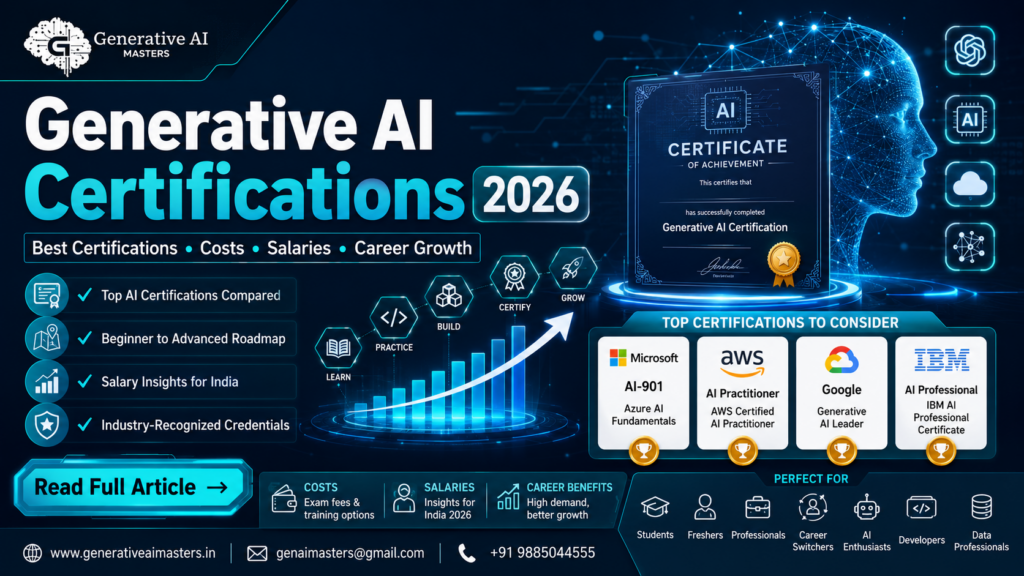
Here are the credentials worth knowing this year. A quick, important note before you read: the certification landscape is changing fast, with several exams retiring and being replaced in 2026, so always confirm current exam codes and availability on the official provider page before you enroll.
OpenAI Certifications
OpenAI launched its first formal certification program in late 2025, starting with AI Foundations and building toward a broader OpenAI Certification, delivered through Coursera and inside ChatGPT, with credentialing partners ETS and Credly by Pearson. The catch in 2026: access is rolling out through employer, public-sector, and university pilots first (initially US-centric), with broader public availability expanding through the year. It is one to watch closely and prepare for via OpenAI Academy, but check current global availability before counting on it. (Official source)
Microsoft AI Certifications
Microsoft offers a clear, role-based ladder. Note the 2026 transition: the popular AI-900 (Azure AI Fundamentals) and AI-102 (Azure AI Engineer Associate) exams retire on June 30, 2026, and are replaced by AI-901 and AI-103 respectively. Microsoft is also introducing business-track credentials (the AB-series) for non-coders. AI-900/AI-901 is a great entry point; AI-103 suits developers building generative AI solutions on Azure. (Official source)
Google Generative AI Certifications
Google Cloud’s Generative AI Leader certification is a business-focused credential, no coding required, that validates your ability to identify use cases, guide responsible adoption, and apply tools like Gemini and Vertex AI. The exam is roughly 90 minutes with 50–60 questions. Developers can also pursue Google Cloud’s Professional Machine Learning Engineer certification for hands-on depth. (Official source)
AWS AI Certifications
AWS restructured its AI lineup to match real job roles. The current path runs from AWS Certified AI Practitioner (foundational, generative-AI focused) to AWS Certified Machine Learning Engineer – Associate, up to the newer AWS Certified Generative AI Developer – Professional (built around Amazon Bedrock, RAG, agents, and vector databases). Note: the older Machine Learning – Specialty exam retired on March 31, 2026. (AI Practitioner · Generative AI Developer – Professional)
NVIDIA AI Certifications
NVIDIA offers associate-level certifications focused on generative AI and large language models, plus newer agentic-AI credentials. These appeal to engineers working close to model deployment, GPU-accelerated workloads, and AI infrastructure. They pair well with cloud certifications for infrastructure-heavy roles.
IBM AI Certifications
IBM provides widely accessible professional certificates, primarily delivered through Coursera, covering AI engineering and generative AI engineering. These are strong, beginner-friendly options that combine structured coursework with hands-on labs and are a popular choice for self-paced learners building a foundation.
Generative AI Masters Certification Program
For learners who want guided, instructor-led preparation rather than self-study, Generative AI Masters offers a structured training program with a course-completion certificate plus dedicated preparation for the major industry and vendor certifications above. The emphasis is on live training, real-time projects, prompt engineering, OpenAI API work, AI agents, and RAG applications, so you finish with both a credential and a portfolio. Think of it as the on-ramp that gets you ready to earn the globally recognized vendor certifications, not a replacement for them.
Essential Tools Every Certified Generative AI Professional Should Learn
Certifications teach concepts; tools turn concepts into shippable products. Here are the essentials worth mastering.
Tool / Skill | What It’s For |
ChatGPT | Day-to-day reasoning, drafting, and prototyping AI workflows |
OpenAI API | Building applications programmatically on top of GPT models |
Claude AI | Long-context reasoning, analysis, and assistant-style applications |
Gemini AI | Google’s multimodal models for text, image, and code tasks |
LangChain | Framework for chaining LLM calls, tools, and memory into apps |
LlamaIndex | Connecting LLMs to your own data sources for RAG |
Pinecone | Managed vector database for semantic search and retrieval |
Vector Databases | Storing embeddings to power accurate, grounded AI answers |
Hugging Face | Open-source models, datasets, and deployment tooling |
Python | The core programming language for all AI development |
Prompt Engineering | Designing reliable instructions and prompt pipelines |
AI Agents | Building autonomous, multi-step AI systems that use tools |
RAG Applications | Combining retrieval with generation for factual, current responses |
You do not need all thirteen on day one. A practical sequence is: Python → prompt engineering → OpenAI/Claude APIs → LangChain or LlamaIndex → a vector database → then RAG and AI agents. Master that stack and you can build most of what enterprises are hiring for today.
Generative AI Certification Cost in India
Certification / Program | Type | Approximate Cost (India) |
Microsoft AI-900 / AI-901 (Fundamentals) | Vendor exam | ~₹8,000–9,000 (≈ $99) |
Google Cloud Generative AI Leader | Vendor exam | ~₹8,000–9,000 (≈ $99) |
AWS Certified AI Practitioner | Vendor exam | ~₹8,500 (≈ $100) |
AWS Certified Generative AI Developer – Professional | Vendor exam | ~₹25,000 (≈ $300) |
IBM / Coursera Professional Certificates | Online (subscription) | ~₹3,000–4,000 / month |
Study materials, labs & practice tests | Add-on | ~₹8,000–15,000 |
Instructor-led GenAI training programs | Bootcamp / institute | ~₹40,000–1,20,000 |
A smart budget approach for most learners: invest in one structured training program to build skills and a portfolio, then sit one or two affordable foundational vendor exams (Microsoft, Google, or AWS) to validate them. That combination usually delivers the best return without overspending.
Generative AI Career Path After Certification
Think of your journey in four stages. Each builds on the last, and the certification you choose should match the stage you are in.
Level | Skills to Build | Typical Job Roles |
Beginner | Python, ML basics, prompt engineering, using ChatGPT/Claude APIs | AI Associate, Junior AI Developer, Prompt Engineer (entry) |
Intermediate | LangChain/LlamaIndex, vector databases, basic RAG, app deployment | Generative AI Developer, AI Application Engineer |
Advanced | Fine-tuning, advanced RAG, AI agents, evaluation, LLMOps | Generative AI Engineer, LLM Engineer, MLOps Engineer |
Expert | System design, multi-agent architectures, scaling, governance | AI Solutions Architect, AI Lead, Principal AI Engineer |
The professionals who climb fastest treat each stage as “learn, build, ship, repeat.” Certifications mark your progress and unlock the next tier of roles, but the deployed projects are what convince hiring managers.
Generative AI Certifications vs Traditional AI Certifications
It is worth understanding how these newer credentials differ from the classic data-science and machine-learning certifications that came before.
Aspect | Generative AI Certifications | Traditional AI / ML Certifications |
Core focus | LLMs, prompt engineering, RAG, AI agents, foundation models | Classical ML, statistics, supervised/unsupervised learning |
Primary tools | OpenAI/Claude/Gemini APIs, LangChain, vector databases | scikit-learn, TensorFlow, PyTorch, pandas |
Typical output | AI apps, copilots, chatbots, retrieval systems | Predictive models, classifiers, recommendation engines |
Math intensity | Moderate (heavier for fine-tuning/research) | High (algorithms, optimization, statistics) |
Market demand (2026) | Very high and rising fast | Steady, foundational |
Salary premium | 25–40% over generalist ML roles | Strong, but lower than GenAI specialists |
Best for | App builders, fast time-to-value, product roles | Researchers, data scientists, deep ML roles |
The honest verdict: these are complementary, not competing. The strongest profiles combine a solid ML foundation with generative AI specialization. That blend is exactly what commands the highest offers in 2026.
Conclusion
Generative AI has moved from hype to hiring priority, and Generative AI Certifications are now one of the most efficient ways to prove you can do the work, get shortlisted, and step into a high-growth, well-paid career. Whether you are a student exploring your first credential, a fresher building a portfolio, a working professional adding role-relevant skills, a developer going deep on RAG and AI agents, or an entrepreneur learning to lead AI adoption, there is a clear path forward, and the market is rewarding the people who start early.
The smartest approach is simple: learn through structured, hands-on training, build real projects, and validate your skills with recognized certifications. That combination is what turns “I’m interested in AI” into “I build AI systems that ship.”
If you are ready to take that step, Generative AI Masters can help you get there with live instructor-led training, real-time projects, prompt engineering, OpenAI API work, AI agents, RAG applications, resume building, interview preparation, and placement assistance.
Join Generative AI Training in Hyderabad at Generative AI Masters. Attend a free demo class, explore real Generative AI careers, work toward industry-recognized certifications, and start learning Generative AI today. Your next role in AI starts with the decision to begin.
FAQS
1. What are Generative AI Certifications?
Generative AI Certifications are credentials from technology companies, cloud providers, or training institutes that verify your ability to work with generative AI. They confirm skills like prompt engineering, building applications with large language models, creating RAG systems, and applying responsible AI practices. Some are business-focused (strategy and use cases, no coding), while others are developer-focused (hands-on building). They help you prove your skills to employers and structure your learning around what the industry actually needs.
2. Are Generative AI Certifications worth it in 2026?
For most learners, yes. AI skills now appear in a rising share of job postings, and demand for qualified professionals is growing far faster than supply. A recognized certification helps you clear recruiter screens, gives you a structured learning path, and can lift offers by 20–40% when it reflects real, in-demand skills. The biggest returns come when you pair certification with deployed projects, so treat the credential as part of a portfolio, not a standalone shortcut.
3. Which Generative AI certification is best for beginners?
Beginners do well starting with an affordable, foundational credential. Strong options include Microsoft AI-901 (Azure AI Fundamentals), Google Cloud’s Generative AI Leader (no coding required), AWS Certified AI Practitioner, or an IBM professional certificate on Coursera. These build core understanding without requiring deep programming. From there, you can progress to developer-level certifications. If you prefer guided learning, an instructor-led program adds structure, projects, and mentorship.
4. Do I need coding skills for Generative AI Certifications?
It depends on the credential. Business and leader-level certifications, like Google’s Generative AI Leader, require no coding and focus on strategy, use cases, and responsible adoption. Developer and engineer-level certifications, such as AWS Certified Generative AI Developer – Professional or Microsoft AI-103, do expect programming, usually Python, plus familiarity with APIs and cloud services. Choose the track that matches your goals: non-technical professionals can certify without code, while builders should strengthen Python first.
5. How much do Generative AI Certifications cost in India?
Costs vary by type. Foundational vendor exams (Microsoft, Google, AWS) typically run around ₹8,000–9,000. Professional-level exams like the AWS Generative AI Developer cost more, around ₹25,000. Online subscription certificates (IBM/Coursera) run roughly ₹3,000–4,000 per month, while instructor-led training programs range from about ₹40,000 to ₹1,20,000. Prices change and depend on region and currency, so always confirm current fees on the official provider page before enrolling.
6. What is the salary after a Generative AI certification in India?
Salaries depend on role, city, and demonstrated skill. As indicative 2026 ranges: freshers with strong projects earn roughly ₹6–12 LPA, mid-level professionals ₹12–25 LPA (higher at product companies), seniors ₹30–60 LPA, and leads or architects ₹50–80 LPA and above, with top total compensation reaching ₹1 crore. These are public-data ranges, not guarantees. Specialization and shipped projects influence pay more than years of experience alone.
7. Can freshers get jobs with Generative AI Certifications?
Yes. Freshers with a recognized certification and two or three real, demonstrable projects are landing competitive offers, often higher than traditional software roles. The key is practical proof: recruiters value a working portfolio (deployed chatbots, RAG apps, AI agents) alongside the credential. Targeting product companies and AI-first startups, where portfolio matters more than experience, improves outcomes. Career mentorship and interview preparation, available through structured programs, also help freshers convert skills into offers.
8. How long does it take to earn a Generative AI certification?
Timelines vary by program and your starting point. Foundational vendor exams can be prepared for in roughly two to six weeks of focused study. Developer-level certifications take longer, often two to four months, because they require hands-on practice. Instructor-led training programs typically run a few months and combine learning with project building. Project-based and scenario-style assessments reward applied repetition over cramming, so plan for consistent practice rather than a single study weekend.
9. Are OpenAI certifications available in India?
OpenAI launched its first certifications in late 2025, delivered via Coursera and inside ChatGPT, with partners ETS and Credly. However, in 2026 access is rolling out first through employer, public-sector, and university pilots, initially US-centric, with broader public availability expanding through the year. Global access, including India, is still maturing. You can prepare now through OpenAI Academy, but verify current availability on OpenAI’s official page before relying on it for a fixed deadline.
10. Which is better: a vendor certification or an institute program?
They serve different purposes and work best together. Vendor certifications (Microsoft, Google, AWS, NVIDIA, IBM) are globally recognized and portable, ideal for proving validated skills. Institute programs, like Generative AI Masters, provide live teaching, real-time projects, mentorship, and certification preparation, ideal for building skills and a portfolio from scratch. A common winning approach: use a structured program to learn and build, then sit one or two vendor exams to formally validate your skills.
The honest verdict: these are complementary, not competing. The strongest profiles combine a solid ML foundation with generative AI specialization. That blend is exactly what commands the highest offers in 2026.

Mr. Dinesh Tunguturi Generative AI Trainer
GenAI Masters AI Experts | 60+ Articles Published on Generative AI, Prompt Engineering, LLMs & AI Careers
Mr. Dinesh is a Generative AI Trainer with expertise in Large Language Models (LLMs), Prompt Engineering, Agentic AI, RAG, and AI Automation. He helps students and professionals gain practical, job-ready AI skills through hands-on training, real-world projects, and industry-focused mentorship.