Machine Learning Projects With Source Code
Machine learning projects with source code let learners study working, real-world code instead of theory alone. In 2026, the best projects span classic ML (regression, classification), deep learning, NLP, computer vision, and generative AI/LLM apps. Each project should include a dataset, a documented codebase, and a clear skill outcome so learners can reproduce, modify, and extend it.
Table of Contents
Introduction to Machine Learning Projects With Source Code
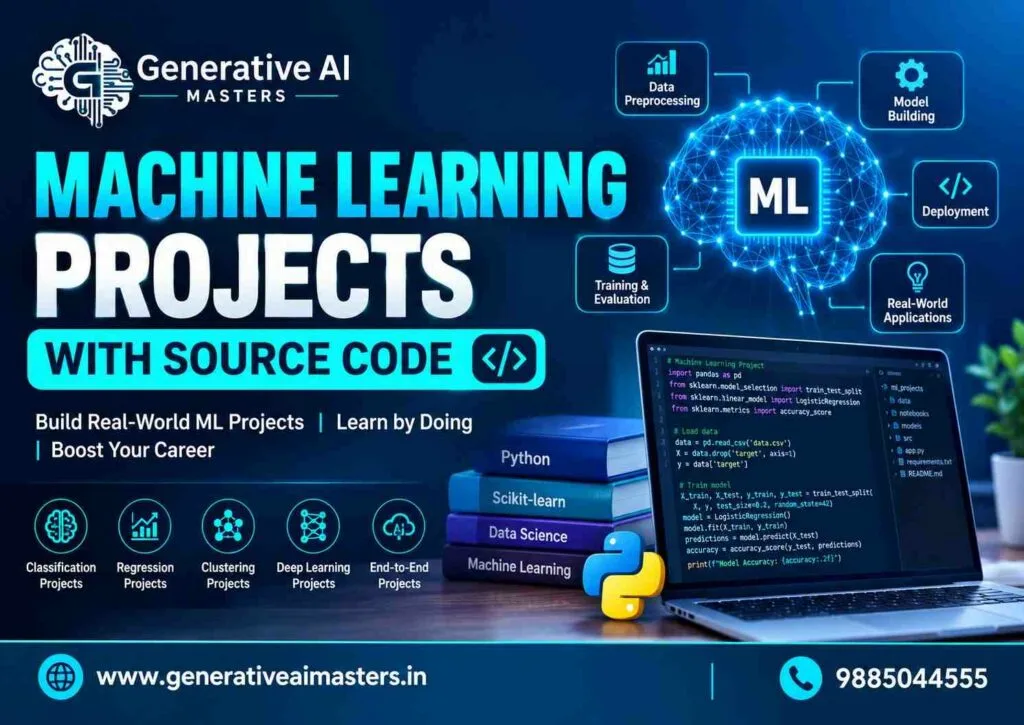
Reading about machine learning only gets you so far. The fastest way to actually understand it is to open real, working code, run it, break it, and rebuild it. That’s exactly what this guide gives you: a complete, up-to-date (2026) collection of machine learning projects with source code, organized from beginner to advanced, with the tools, datasets, and skills each project teaches.
Whether you’re a student building your first model, a developer switching careers into AI, or a working professional upskilling for generative AI roles, this guide is built around one goal helping you learn by building, not just by reading.
What Are Machine Learning Projects With Source Code?
A machine learning project with source code is a complete, working implementation of data, model, and code that you can download, run, and modify yourself. Instead of just reading how an algorithm works, you see it applied to a real dataset, with every step from data cleaning to model evaluation laid out in code.
This matters because machine learning is a hands-on skill. You don’t truly understand cross-validation, feature engineering, or overfitting until you’ve fought with them inside actual code. Source code turns abstract concepts into something you can inspect, test, and improve.
Why Build Machine Learning Projects With Source Code
Projects close the gap between theory and practice. A few concrete reasons they matter in 2026:
- They build real problem-solving skills. Tutorials show you the “happy path.” Real projects force you to debug messy data, mismatched shapes, and failed training runs the same issues you’ll face in any real job.
- They create a portfolio. A GitHub profile with working, documented ML projects is one of the strongest signals of practical skill, far more convincing than a certificate alone.
- They reveal how pieces connect. A project shows you how data preprocessing, model selection, evaluation, and deployment fit together as one pipeline, not isolated lessons.
- They keep you current. In 2026, most new ML projects blend classic machine learning with generative AI components (embeddings, LLM APIs, vector search), so building projects keeps your skills aligned with how ML is actually used today.
How to Choose the Right ML Project for Your Level
Pick a project that stretches you slightly beyond your current comfort zone, not one that overwhelms you.
- New to programming or ML: Start with simple, well-documented datasets (tabular data, small images) and classic algorithms like linear regression or decision trees.
- Comfortable with Python and basic ML: Move to projects involving real-world messy data, feature engineering, and model comparison.
- Confident with ML fundamentals: Take on deep learning, NLP, or computer vision projects using PyTorch or TensorFlow.
- Ready for 2026-relevant skills: Build projects that combine ML with generative AI RAG systems, AI agents, and LLM-powered applications.
Generative AI Training in Hyderabad
Learn LLMs, RAG, fine-tuning and AI agents with live classes, 15+ projects and placement support.
Next batch: 5 Oct 2026 · morning 10 AM & evening 7 PM IST
Machine Learning Projects Overview by Difficulty
Difficulty | Example Projects | Recommended Tools | Expected Outcome |
Beginner | House price prediction, Iris classification, spam email detector | Python, Pandas, scikit-learn | Understand data preprocessing and basic model training |
Intermediate | Customer churn prediction, movie recommendation system, sentiment analysis | scikit-learn, NLTK, Matplotlib | Learn feature engineering and model evaluation |
Advanced | Image classification with CNNs, object detection, time-series forecasting | TensorFlow, PyTorch, OpenCV | Build and tune deep learning models |
Expert / 2026-focused | RAG chatbot, AI agent with tool calling, fine-tuned LLM app | LangChain, Hugging Face, vector databases | Deploy real generative AI applications |
Beginner Machine Learning Projects With Source Code
These projects are ideal if you’re just starting out with Python and scikit-learn. Each one uses small, well-known datasets so you can focus on learning the workflow, not fighting messy data.
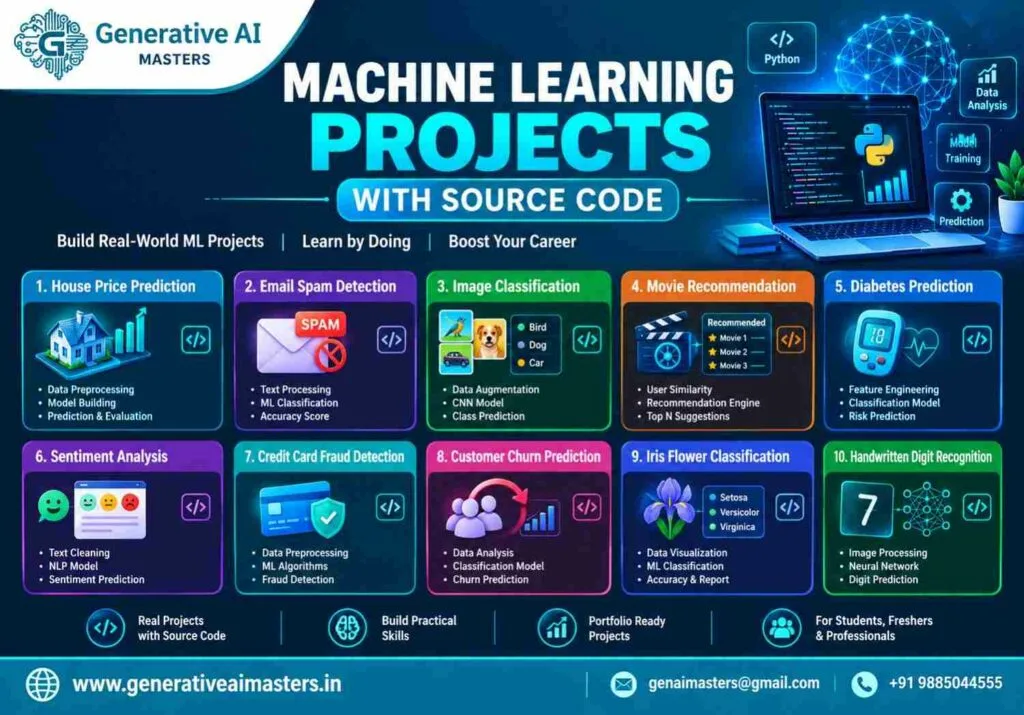
- House Price Prediction
- Purpose: Predict housing prices from features like size, location, and number of rooms.
- Skills learned: Linear regression, handling missing values, train-test splitting.
- Technologies: Python, Pandas, scikit-learn.
- Outcome: You’ll understand the full regression workflow from raw CSV data to a working prediction model.
- Iris Flower Classification
- Purpose: Classify flowers into species based on petal and sepal measurements.
- Skills learned: Classification basics, data visualization, model accuracy evaluation.
- Technologies: Python, scikit-learn, Matplotlib.
- Outcome: A gentle introduction to supervised classification, often the first project most learners build.
- Spam Email Detector
- Purpose: Classify emails or messages as spam or not spam.
- Skills learned: Text preprocessing, Naive Bayes, basic NLP.
- Technologies: Python, scikit-learn, NLTK.
- Outcome: Your first taste of applying ML to text data.
- Titanic Survival Prediction
- Purpose: Predict passenger survival using the classic Titanic dataset.
- Skills learned: Handling categorical data, feature engineering, logistic regression.
- Technologies: Python, Pandas, scikit-learn.
- Outcome: One of the most widely used beginner datasets, great for practicing data cleaning.
- Student Performance Predictor
- Purpose: Predict exam scores based on study habits and demographics.
- Skills learned: Exploratory data analysis (EDA), regression modeling.
- Technologies: Python, Pandas, Seaborn.
- Outcome: Strong practice in EDA, one of the most underrated ML skills.
Pro Tip: Don’t just run these projects. Change the dataset, swap the algorithm, and compare results. That’s where real learning happens.
Intermediate Machine Learning Projects With Source Code
Once you’re comfortable with the basics, move to projects that involve messier data and more decision-making.
- Customer Churn Prediction
- Purpose: Predict which customers are likely to stop using a service.
- Skills learned: Feature engineering, handling imbalanced data, model comparison.
- Technologies: Python, scikit-learn, XGBoost.
- Outcome: Real business-style ML, common in fintech and SaaS companies.
- Movie Recommendation System
- Purpose: Recommend movies based on user preferences and ratings.
- Skills learned: Collaborative filtering, similarity metrics, matrix factorization.
- Technologies: Python, Pandas, Surprise library.
- Outcome: Understand how recommendation engines like those used by streaming platforms work.
- Sentiment Analysis on Product Reviews
- Purpose: Classify reviews as positive, negative, or neutral.
- Skills learned: Text vectorization (TF-IDF), classification, NLP pipelines.
- Technologies: Python, scikit-learn, NLTK or spaCy.
- Outcome: A strong stepping stone toward deeper NLP and LLM-based projects.
- Credit Card Fraud Detection
- Purpose: Identify fraudulent transactions in a highly imbalanced dataset.
- Skills learned: Anomaly detection, precision-recall tradeoffs, resampling techniques.
- Technologies: Python, scikit-learn, imbalanced-learn.
- Outcome: Practical exposure to real-world imbalanced classification problems.
- Sales Forecasting
- Purpose: Predict future sales using historical time-series data.
- Skills learned: Time-series analysis, trend and seasonality decomposition.
- Technologies: Python, Pandas, statsmodels or Prophet.
- Outcome: Foundational skill for forecasting roles across industries.
Advanced Machine Learning Projects With Source Code
These projects move into deep learning and require comfort with neural networks, typically built using PyTorch or TensorFlow.
- Handwritten Digit Recognition (MNIST)
- Purpose: Classify handwritten digits using a neural network.
- Skills learned: Neural network basics, backpropagation, model training loops.
- Technologies: Python, TensorFlow or PyTorch.
- Outcome: Your first deep learning project is a rite of passage for most ML learners.
- Image Classification with CNNs
- Purpose: Classify images (e.g., cats vs. dogs) using convolutional neural networks.
- Skills learned: Convolutional layers, pooling, transfer learning.
- Technologies: Python, TensorFlow/Keras or PyTorch.
- Outcome: Core computer vision skills used in real production systems.
- Object Detection System
- Purpose: Detects and localizes multiple objects in an image or video.
- Skills learned: Bounding box prediction, pretrained detection models.
- Technologies: Python, OpenCV, YOLO or a similar detection framework.
- Outcome: A practical, resume-ready computer vision project.
- Stock Price Prediction with LSTM
- Purpose: Forecast stock prices using sequential deep learning models.
- Skills learned: Recurrent neural networks, sequence modeling.
- Technologies: Python, TensorFlow/Keras, Pandas.
- Outcome: Deeper understanding of time-series deep learning (with the caveat that real markets are far noisier than any demo dataset).
ML Project Skills by Learning Level
Level | Skills to Master | Expected Outcome |
Beginner | Data cleaning, regression, classification basics | Comfortable building simple models end to end |
Intermediate | Feature engineering, model evaluation, NLP basics | Able to handle real, messy datasets confidently |
Advanced | Neural networks, CNNs, time-series deep learning | Capable of building and tuning deep learning models |
Expert | RAG, embeddings, AI agents, fine-tuning | Able to build production-style generative AI applications |
Best Tools, Platforms and Datasets for ML Projects in 2026
You don’t need expensive infrastructure to build strong ML projects. These tools cover almost every project in this guide:
- Languages & libraries: Python, NumPy, Pandas, scikit-learn, PyTorch, TensorFlow.
- NLP & LLM tools: Hugging Face, LangChain, LlamaIndex, OpenAI API, Anthropic API, Google AI Studio.
- Vector databases: Chroma, FAISS, Pinecone, Weaviate.
- Datasets: Kaggle, the UCI Machine Learning Repository, and Hugging Face Datasets are the most reliable sources for free, well-documented data.
- Hosting source code: GitHub is the standard place to store, document, and share your project code.
Conclusion
Machine learning is best learned by building. Start with simple, well-documented beginner projects to understand the core workflow, then move into intermediate projects that involve messier, real-world data. From there, deep learning, NLP, and computer vision projects will sharpen your technical depth.
In 2026, don’t stop at classic ML. The most valuable portfolios now include at least one generative AI project, a RAG chatbot, an AI agent, or a fine-tuned model since these reflect how machine learning is actually being applied today. Pick one project from this guide, build it fully, understand every line of its source code, and then move to the next step. That steady, project-by-project progression is what turns ML knowledge into a real, demonstrable skill.
Frequently Asked Questions
1. What are the best machine learning projects with source code for beginners?
House price prediction, Iris flower classification, spam email detection, and Titanic survival prediction are ideal starting points. They use small, clean, well-documented datasets, so you can focus on learning the core workflow data preprocessing, model training, and evaluation without getting stuck on messy data.
2. Where can I find machine learning projects with source code for free?
Kaggle, GitHub, and Hugging Face are the most reliable free sources. Kaggle offers datasets alongside community notebooks showing working code, GitHub hosts full open-source project repositories, and Hugging Face provides both datasets and pretrained models you can build on.
3. Do I need to know Python before starting ML projects?
Yes, basic Python is essential. You should be comfortable with variables, loops, functions, and libraries like Pandas and NumPy before starting your first project. You don’t need to be an expert; many learners pick up advanced Python skills alongside their first few ML projects.
4. How long does it take to complete a beginner ML project?
A well-documented beginner project typically takes a few hours to a couple of days, depending on your familiarity with Python and the dataset. The goal isn’t speed, it’s understanding each step well enough to explain and modify the code yourself.
5. What is the difference between a machine learning project and a generative AI project?
Traditional ML projects predict or classify outcomes from structured or text data, like forecasting sales or detecting spam. Generative AI projects create new content, text, images, or code often using large language models, and increasingly involve techniques like RAG, embeddings, and prompt engineering.
6. Which machine learning projects look best on a resume?
Projects that solve a real, relatable problem and include clean documentation tend to stand out most for example, a recommendation system, a fraud detection model, or a RAG-based chatbot. Deploying at least one project as a working app or API adds significant credibility.
7. Should beginners start with machine learning or deep learning projects?
Start with classic machine learning. Concepts like regression, classification, and model evaluation form the foundation that deep learning builds on. Jumping straight into neural networks without this foundation often leads to confusion about why models behave the way they do.
8. What tools are most commonly used in 2026 machine learning projects?
Python remains the core language, with scikit-learn for classical ML and PyTorch or TensorFlow for deep learning. For generative AI projects, LangChain, Hugging Face, and vector databases like Chroma or Pinecone have become standard additions.
9. Can I build machine learning projects without powerful hardware?
Yes, for most beginner and intermediate projects, a standard laptop is enough. For deep learning or LLM fine-tuning projects, free cloud platforms with GPU access (such as Google Colab) let you train models without owning specialized hardware.
10. How do I go from small ML projects to real generative AI applications?
Progress step by step: master Python and classic ML, then deep learning fundamentals, then NLP. From there, move into large language models, prompt engineering, and finally RAG and AI agent projects. Each stage builds directly on the skills from the one before it.

Mr. Dinesh Tunguturi Generative AI Trainer
GenAI Masters AI Experts | 60+ Articles Published on Generative AI, Prompt Engineering, LLMs & AI Careers
Mr. Dinesh is a Generative AI Trainer with expertise in Large Language Models (LLMs), Prompt Engineering, Agentic AI, RAG, and AI Automation. He helps students and professionals gain practical, job-ready AI skills through hands-on training, real-world projects, and industry-focused mentorship.
Turn this knowledge into a career: Generative AI Training in Hyderabad
Learn LLMs, RAG, fine-tuning and AI agents with live classes, 15+ projects and placement support.
₹35,000 online · ₹40,000 classroom · 60+ live hours · 3 months · ★ 4.9 from 51 Google reviews