
Generative AI vs Machine Learning
Machine learning is a branch of AI where systems learn patterns from data to predict, classify, or recommend. Generative AI is a subset of machine learning that creates new content, such as text, images, code, and audio, by learning how data is structured. The key difference is the output: traditional machine learning predicts or decides, while generative AI produces something new. Most real products combine both to get the best results.
Table of Contents
Introduction to Generative AI vs Machine Learning
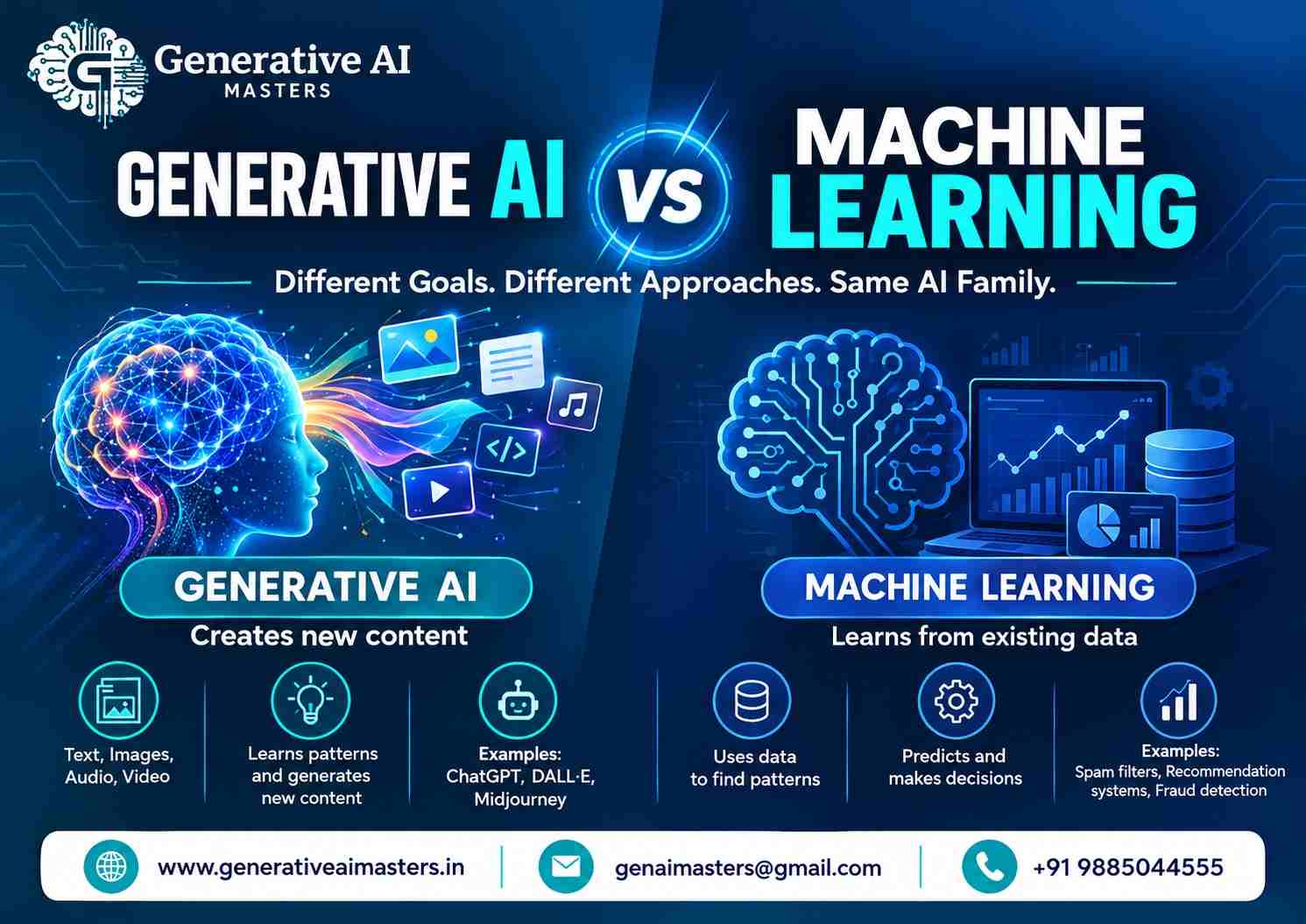
People often use these two terms as if they mean the same thing. Others treat them as rivals. Both views cause confusion.
Machine learning (ML) is a way of building software that learns from data instead of following fixed rules. You show a model many examples, and it finds patterns it can use on new data. Spam filters, fraud alerts, and movie suggestions all work this way.
Generative AI is a part of machine learning that focuses on creating. It writes emails, produces images, drafts code, and holds conversations. ChatGPT, Claude, Gemini, and Midjourney are well-known examples.
So the relationship is simple. Generative AI sits inside machine learning, and machine learning sits inside artificial intelligence.
This guide is for students, working professionals, developers, marketers, founders, and business teams. If you are thinking about generative AI training in Hyderabad, this comparison is the best place to begin. Knowing where machine learning ends and generative AI begins helps you choose what to learn first, and in what order.
By the end, you will know:
- What each term means, in plain language
- How each one works behind the scenes
- The key differences, side by side
- Real-world examples and use cases
- When to choose one over the other
- Which to learn first
- The common myths, and the questions people ask most
What Is Machine Learning?
Machine learning is a method where computers learn patterns from data and use them to make predictions or decisions, without being given step-by-step rules.
Think about teaching a child to recognize dogs. You don’t list every feature of a dog. You show many pictures, and the child works it out. Machine learning follows the same idea, with numbers and far more examples.
Most ML falls into three learning styles:
- Supervised learning: The model learns from labeled examples, such as emails marked “spam” or “not spam.”
- Unsupervised learning: The model finds hidden groups in unlabeled data, such as customer segments.
- Reinforcement learning: The model learns by trial and error, guided by rewards. Game-playing systems and robotics often use this.
Common ML tasks include:
- Classification: Is this transaction fraud?
- Regression: What price will this house sell for?
- Clustering: Which customers behave alike?
- Recommendation: What should this user watch next?
- Forecasting: How much stock will we need next month?
If you want a free, structured primer, Google’s Machine Learning Crash Course covers these learning styles with exercises and short videos.
How Machine Learning Works
Machine learning works in a loop: collect data, train a model, test it, deploy it, and keep improving it.
The usual workflow looks like this:
- Define the problem. For example, predict which customers will cancel.
- Collect and clean data. Messy data gives messy results.
- Choose features. These are the inputs the model looks at, such as age or purchase history.
- Train the model. The algorithm adjusts itself to reduce its mistakes.
- Evaluate. Test it on data it has never seen.
- Deploy and monitor. Watch for performance drops over time.
Traditional ML often works well with structured data, like spreadsheets and database tables. A well-tuned model can run on a normal laptop or a modest server.
Most beginners practice this workflow with the scikit-learn library, and the scikit-learn user guide explains each algorithm clearly with examples.
What Is Generative AI?
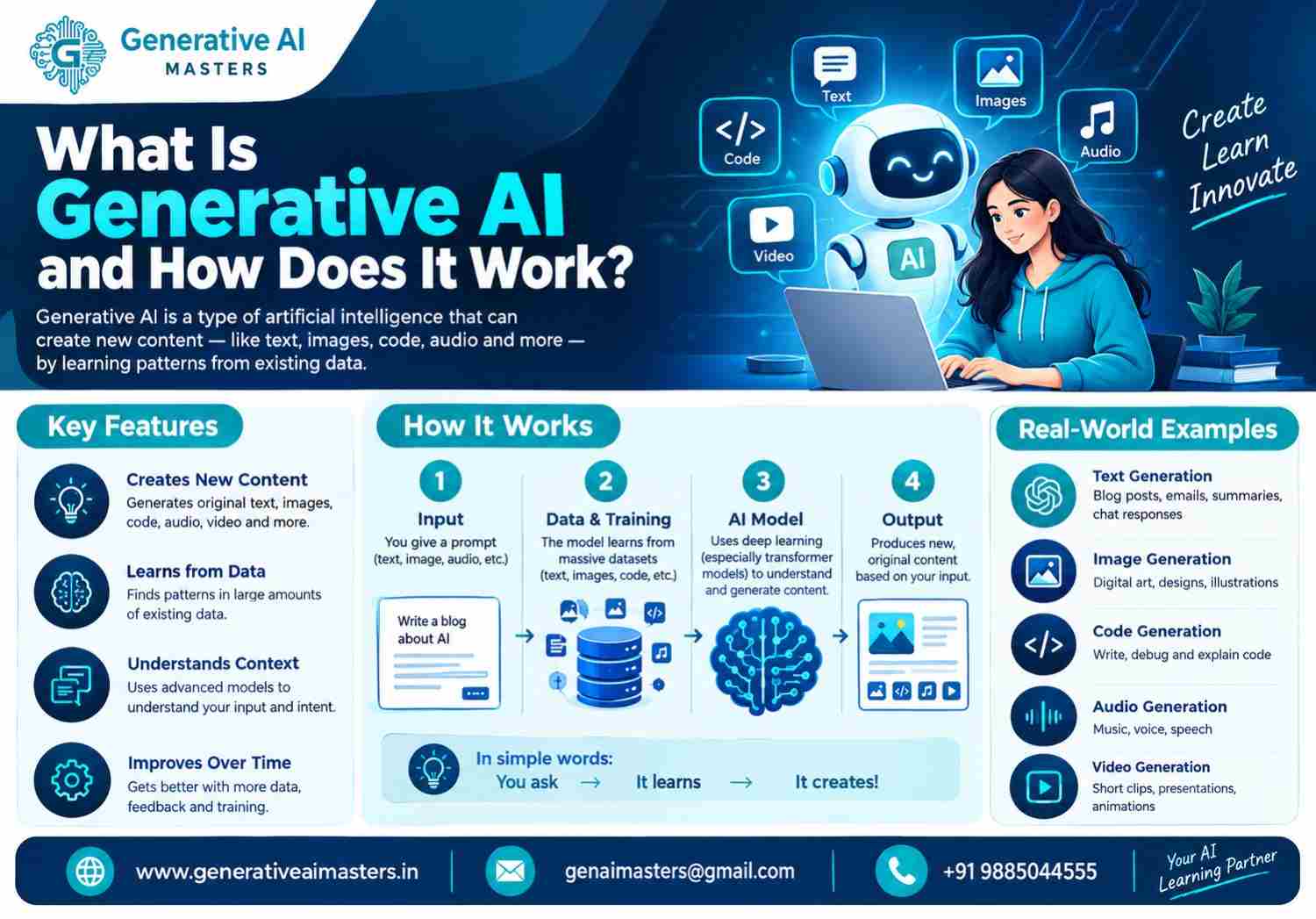
Generative AI is a type of artificial intelligence that learns the structure of existing data and uses it to produce new, original-looking content, including text, images, audio, video, and code.
Here is a helpful analogy. A traditional ML model is like a judge. It looks at something and gives a verdict. A generative model is like a writer or painter. It starts with a prompt and produces something that did not exist before.
Generative AI is powered mainly by deep learning and a design called the transformer. This design was introduced in the 2017 research paper “Attention Is All You Need”. Transformers let a model weigh which parts of the input matter most, and that is what keeps modern chatbots coherent across long conversations.
The main types of generative models are:
- Large language models (LLMs): Generate and understand text. Companies such as OpenAI, Anthropic, Google DeepMind, and Meta AI build them.
- Diffusion models: Create images and video by gradually turning random noise into a clear picture.
- Generative adversarial networks (GANs): Two networks compete, one creating and one judging.
- Variational autoencoders (VAEs): Learn compact representations of data and generate new variations.
How Generative AI Works
Generative AI works by learning patterns from huge datasets and then producing new content one piece at a time, based on probability.
For a large language model, the process goes like this:
- Pre-training. The model reads enormous amounts of text and learns to predict the next word, or more precisely the next token.
- Fine-tuning and alignment. Developers refine the model with curated examples and human feedback so that it follows instructions and stays helpful and safe.
- Prompting. You give instructions, and the model writes a response token by token.
- Optional grounding. Techniques like retrieval-augmented generation (RAG) let the model look up fresh or private information before it answers.
Many teams use these models through an API. The OpenAI API documentation shows how requests and responses work, and other providers, including Anthropic and Google, offer similar tools.
Here is what makes this different from classic ML. A traditional model is usually trained for one job, such as predicting churn. A foundation model is trained broadly, then handles many jobs, such as summarizing, translating, coding, and answering questions, often with just a prompt.
Generative AI vs Machine Learning: Key Differences
The main difference is purpose. Machine learning analyzes data to predict or classify. Generative AI learns from data to create new content.
Table 1: Side-by-Side Comparison
Feature | Traditional Machine Learning | Generative AI |
Main goal | Predict, classify, detect, recommend | Create text, images, code, audio, video |
Typical output | A label, number, score, or ranking | New, original-looking content |
Relationship | The broader field | A subset of ML, mostly deep learning |
Data used | Often structured and task-specific | Huge, mostly unstructured (text, images) |
Data needed | Small to large | Very large for training; small for prompting |
Common models | Linear regression, decision trees, random forests, XGBoost | Transformers, LLMs, diffusion models, GANs |
Computing needs | Low to moderate | High, especially for training |
Task scope | Usually one task per model | One model, many tasks |
How you use it | Often build and train your own | Often use a pre-trained model through an API |
Explainability | Easier in simpler models | Harder; often a black box |
Evaluation | Clear metrics (accuracy, precision, recall) | Mixed: quality, accuracy, safety, human review |
Main risks | Bias, overfitting, data drift | Hallucination, bias, copyright, misuse |
Example tools | scikit-learn, XGBoost | ChatGPT, Claude, Gemini, Midjourney |
Real-World Examples of Machine Learning
- Fraud detection: Banks flag unusual card activity in real time.
- Recommendation engines: Streaming and shopping platforms suggest what you may like.
- Demand forecasting: Retailers predict how much stock to order.
- Medical imaging support: Models highlight patterns in scans for clinicians to review.
- Predictive maintenance: Factories spot likely machine failures early.
- Spam filtering: Email services separate junk from real messages.
- Churn prediction: Businesses find at-risk customers before they leave.
Real-World Examples of Generative AI
- Conversational assistants: ChatGPT, Claude, Gemini, and Microsoft Copilot answer questions and draft content.
- Code assistants: Tools like GitHub Copilot suggest and explain code.
- Image generation: Create illustrations, mockups, and concept art from text.
- Document summarization: Turn long reports into key points.
- Support drafting: Suggest replies based on company knowledge.
- Synthetic data: Create realistic test data when real data is scarce or private.
- Translation and localization: Adapt content across languages and tones.
When Should You Use Machine Learning vs Generative AI?
Use machine learning when you need a reliable prediction or decision from your own data. Use generative AI when you need to create, summarize, or converse in natural language.
Table 2: Use-Case Decision Guide
Your Goal | Better Fit | Why |
Predict next month’s sales | Machine learning | Numeric forecasting from past data |
Detect fraud | Machine learning | Needs fast, measurable, consistent decisions |
Write product descriptions | Generative AI | Content creation |
Summarize 50-page reports | Generative AI | Language understanding and writing |
Segment customers | Machine learning | Clustering on structured data |
Build a support chatbot | Generative AI (often with RAG) | Natural conversation |
Recommend products | Machine learning | Ranking based on behavior |
Create marketing images | Generative AI | Image generation |
Predict equipment failure | Machine learning | Sensor and time-series patterns |
Draft code from instructions | Generative AI | Code generation |
Sort support tickets by urgency | Either | ML is cheaper at scale; an LLM is faster to set up |
Generative AI Training in Hyderabad
Learn LLMs, RAG, fine-tuning and AI agents with live classes, 15+ projects and placement support.
Next batch: 5 Oct 2026 · morning 10 AM & evening 7 PM IST
Can Generative AI and Machine Learning Work Together?
Yes. The best real-world systems usually combine both.
Take an online store as an example. It may use:
- ML to predict which customers are likely to leave
- ML to decide which discount suits each person
- Generative AI to write a personal email with that offer
- ML to measure which emails get the best response
Each tool does the job it is best at. This mix is often called a hybrid or compound AI system.
Here is a second example. A support team uses ML to sort incoming tickets by urgency, then uses an LLM with RAG to draft a reply from the company’s help articles. A human agent checks the draft before sending. The prediction is handled by ML, and the writing is handled by generative AI.
Key Concepts That Connect Both Fields
A few ideas show up in both worlds. Understanding them makes the comparison much clearer.
Neural networks. These are layers of connected nodes that learn patterns from data. Simple ML may not use them at all. Generative AI depends on them.
Training data. Both fields rely on it. Better data leads to better results, and biased data leads to biased results.
Embeddings. These turn words, images, or other data into lists of numbers that capture meaning. They are used in recommendation systems and in generative AI search, including RAG.
Fine-tuning. This means adapting an existing model to a specific task using extra data. It exists in both classic ML and generative AI.
Evaluation. You must test models before trusting them. ML uses clear metrics like accuracy. Generative AI needs those plus human review for quality, truthfulness, and safety.
Overfitting. A model that memorizes its training data instead of learning general patterns will fail on new data. Both fields watch for it.
Advantages and Limitations
Machine Learning
Strengths
- Efficient and affordable to run
- Strong on structured data
- Easier to measure and audit
- Reliable for repeated decisions
Limitations
- Needs good, often labeled, data
- Usually narrow, with one model per task
- Often requires feature engineering and expertise
- Cannot produce natural-sounding content
Generative AI
Strengths
- Flexible across many tasks
- Works well with unstructured data
- Fast to prototype with prompts
- Offers a natural language interface
Limitations
- Can produce wrong or made-up information
- Higher computing and running costs
- Harder to explain
- Raises privacy, copyright, and safety questions
Responsible use matters for both. The NIST AI Risk Management Framework is a widely referenced guide for identifying and managing AI risks, and it is a useful read for teams building or buying AI systems.
Common Myths About Generative AI and Machine Learning
Myth 1: They are the same thing.
Not quite. Generative AI is one branch of machine learning.
Myth 2: Generative AI will replace all machine learning.
No. For forecasting, fraud detection, and recommendations, traditional ML is often the better and cheaper tool.
Myth 3: Generative AI understands like a human.
It recognizes patterns in data. It does not have human understanding or awareness.
Myth 4: More data always means a better model.
Quality matters as much as quantity. Noisy or biased data creates noisy or biased results.
Myth 5: Generative AI is always accurate.
It can be wrong. Important outputs need human review.
Myth 6: You need to be a programmer to use generative AI.
You can start with prompting and AI tools. Programming helps when you want to build your own applications.
Which Should You Learn First?
Learn machine learning fundamentals first, then move to generative AI. The basics make everything after them easier to understand.
Table 3: Suggested Learning Order
Stage | What to Learn | Why It Matters |
1. Foundations | Python, basic statistics, NumPy, Pandas | The base for both fields |
2. Core ML | Supervised and unsupervised learning, model evaluation | Shows how models learn and fail |
3. Deep learning | Neural networks with PyTorch or TensorFlow | Powers generative AI |
4. Transformers and LLMs | Attention, tokens, embeddings | The engine behind modern generative AI |
5. Prompting | Clear instructions, few-shot examples, chain-of-thought | Better results without extra code |
6. Generative AI apps | APIs, RAG, vector databases, agents | Turns models into products |
7. Responsible AI | Evaluation, guardrails, safety | Keeps systems trustworthy |
The official PyTorch tutorials are a good place to practice stage 3 hands-on, and Hugging Face offers open models and datasets for stages 4 and 5.
If you are a non-technical professional, you can start with prompting and AI tools right away, then add ML basics as you need them. A structured, instructor-led program can keep that order clear and help you practice with real projects.
Beginner Projects to Practice Both
Machine learning project (beginner). Predict house prices or customer churn using scikit-learn.
- Purpose: Learn the full ML workflow.
- Skills: Data cleaning, training, evaluation.
- Tools: Python, Pandas, scikit-learn.
Generative AI project (beginner). Build a chatbot that answers questions about a document you upload.
- Purpose: Learn how LLMs use outside information.
- Skills: Prompting, API calls, basic RAG.
- Tools: Python, an LLM API, a vector database such as Chroma or FAISS.
Combined project (intermediate). Build a customer-feedback tool.
- Purpose: See both fields working together.
- Skills: Classification, summarization, evaluation.
- Tools: An ML classifier for sentiment, plus an LLM to summarize the main complaints.
Practicing both shows you where each tool shines and where it struggles.
How to Start Learning Generative AI and Machine Learning in Hyderabad
The best way to start is to follow the learning order above: Python, core machine learning, deep learning, then generative AI tools, with a project at every stage.
Hyderabad has a large technology community, so learners can find meetups, hackathons, and study groups alongside online resources. That makes it easier to practice with others and get feedback.
When choosing how to learn, look for these signs of a good program:
- ✔ It teaches machine learning basics before jumping to generative AI
- ✔ It includes hands-on projects, not only theory
- ✔ It covers prompting, APIs, RAG, and responsible AI
- ✔ It lets you build something you can show to others
- ✔ The syllabus is clear about what you will learn each week
Pro tip: Ask any program to show you a sample project from past learners. It tells you more than a syllabus does.
Key Takeaways
- Generative AI is a subset of machine learning, which is a subset of AI.
- Traditional ML predicts and classifies. Generative AI creates.
- ML shines on structured data and measurable decisions. Generative AI shines on language, images, and code.
- Generative AI is more flexible, but also costlier and less predictable.
- The strongest systems combine both.
- Learn ML fundamentals first, then deep learning, transformers, and generative AI tools.
- Always evaluate outputs. Accuracy and safety matter in both fields.
Conclusion
Generative AI and machine learning are not competitors. They are parts of the same family.
Machine learning gives computers the ability to learn from data and make smart predictions. Generative AI builds on that foundation to create new text, images, and code. One answers “what will happen?” and the other answers “what could this look like?”
Start with your goal. If you need a prediction, a score, or a decision, reach for machine learning. If you need to draft, summarize, or hold a conversation, reach for generative AI. If your problem has both parts, use both.
Whichever path you take, learn by doing. Build a small ML model, then build a small chatbot. Compare how they behave. That hands-on contrast will teach you more than any definition.
Ready to turn this knowledge into skills? Explore our generative AI training in Hyderabad program and start building real projects step by step.
Frequently Asked Questions
1. What is the main difference between generative AI and machine learning?
Machine learning learns patterns from data to predict, classify, or recommend. Generative AI learns those patterns too, but uses them to create new content like text, images, or code. The simplest test is the output: a decision or score points to traditional ML, while newly created content points to generative AI. Generative AI is technically a subset of machine learning.
2. Is generative AI a type of machine learning?
Yes. Generative AI is a subset of machine learning, built mostly on deep learning. It uses neural networks, especially transformers, trained on large datasets. All generative AI relies on machine learning, but not all machine learning is generative. Fraud detection and sales forecasting, for example, are machine learning without being generative.
3. Is ChatGPT machine learning or generative AI?
ChatGPT is both. It is a generative AI application built on a large language model, and large language models are created using machine learning, specifically deep learning with transformers. So ChatGPT is a generative AI product that rests on machine learning technology. The same is true of Claude and Gemini.
4. Which is better: generative AI or machine learning?
Neither is better overall. They solve different problems. Machine learning is stronger for predictions, classification, and forecasting from structured data, and it is usually cheaper to run. Generative AI is stronger for creating content, summarizing, and natural conversation. Many successful products use both together, so the better choice depends on your goal.
5. Should I learn machine learning before generative AI?
It helps, but it is not required to start. Machine learning basics explain how models learn, why they fail, and how to evaluate them, which makes generative AI easier to understand. If you only want to use AI tools, you can begin with prompting. If you want to build AI systems, learn Python and core ML first.
6. Does generative AI need more data than machine learning?
Training a generative model from scratch needs far more data and computing power than most traditional ML models. However, most people do not train one from scratch. They use a pre-trained model through an API and add small amounts of their own data through prompting, RAG, or fine-tuning, which needs much less.
7. Can generative AI replace machine learning?
Not in most cases. Generative AI is excellent at language and content tasks, but traditional ML is usually faster, cheaper, and more accurate for forecasting, fraud detection, and recommendations. Businesses increasingly combine the two instead of replacing one with the other, using each where it performs best.
8. What are examples of generative AI and machine learning?
Machine learning examples include spam filters, fraud detection, product recommendations, and sales forecasting. Generative AI examples include ChatGPT, Claude, and Gemini for text, Midjourney for images, and GitHub Copilot for code. Many apps combine both, such as a store that predicts customer behavior and then writes personalized messages.
9. What is the difference between deep learning and generative AI?
Deep learning is a technique that uses multi-layered neural networks to learn from data. Generative AI is a goal: creating new content. Most generative AI uses deep learning, but deep learning also powers non-generative tasks like image recognition and speech-to-text. So deep learning is the method, and generative AI is one of its uses.
10. What are the risks of generative AI compared with machine learning?
Both can reflect bias in their training data. Generative AI adds extra risks: it can hallucinate false information, raise copyright and privacy concerns, and be misused to create misleading content. Traditional ML more often struggles with overfitting and data drift. Human review, testing, and clear guardrails help reduce the risks of both.

Mr. Dinesh Tunguturi Generative AI Trainer
GenAI Masters AI Experts | 60+ Articles Published on Generative AI, Prompt Engineering, LLMs & AI Careers
Mr. Dinesh is a Generative AI Trainer with expertise in Large Language Models (LLMs), Prompt Engineering, Agentic AI, RAG, and AI Automation. He helps students and professionals gain practical, job-ready AI skills through hands-on training, real-world projects, and industry-focused mentorship.
Turn this knowledge into a career: Generative AI Training in Hyderabad
Learn LLMs, RAG, fine-tuning and AI agents with live classes, 15+ projects and placement support.
₹35,000 online · ₹40,000 classroom · 60+ live hours · 3 months · ★ 4.9 from 51 Google reviews