Generative AI in Healthcare
Generative AI in healthcare uses large language models and multimodal AI to create clinical summaries, support diagnosis, speed up drug discovery, and automate documentation. It works alongside doctors rather than replacing them, helping hospitals reduce administrative workload while improving patient engagement, though it still requires human oversight, strong data privacy safeguards, and careful validation before clinical use.
Table of Contents
Introduction to Generative AI in Healthcare
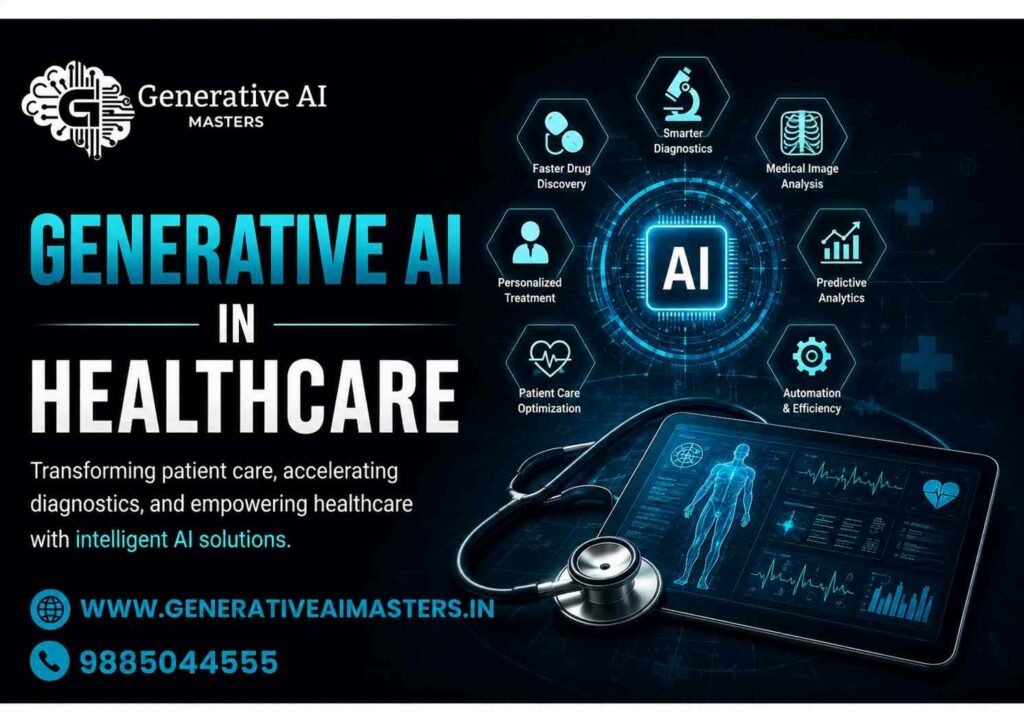
Generative AI in healthcare is changing how doctors diagnose patients, how researchers discover new drugs, and how hospitals handle everyday paperwork. Instead of simply analyzing data like older AI systems, generative AI can create clinical summaries, draft patient communication, suggest treatment options, and even generate synthetic medical images for training. This guide explains what generative AI in healthcare actually means, where it is already being used, the real benefits and risks, and what the future looks like as adoption grows through 2026 and beyond.
Whether you’re a healthcare professional trying to understand this technology, a student exploring AI in medicine, or a decision-maker evaluating tools for your organization, this article breaks everything down in plain language — no unnecessary jargon, no hype
What Is Generative AI in Healthcare?
Generative AI in healthcare is the use of AI models — typically large language models (LLMs) or multimodal AI systems — to generate new, useful outputs from medical data instead of only classifying or predicting it.
In practice, this means an AI system can read a doctor’s spoken notes and generate a structured clinical summary, analyze a scan and generate a draft radiology report, or process research papers and generate a plain-language explanation for a patient. The key difference from earlier “predictive” healthcare AI is that generative AI produces new content — text, images, or structured data — rather than just flagging patterns.
It’s important to understand that generative AI in healthcare is designed to support clinicians and administrators, not replace medical judgment. Every output still needs human review before it influences patient care.
How Does Generative AI Work in Healthcare?
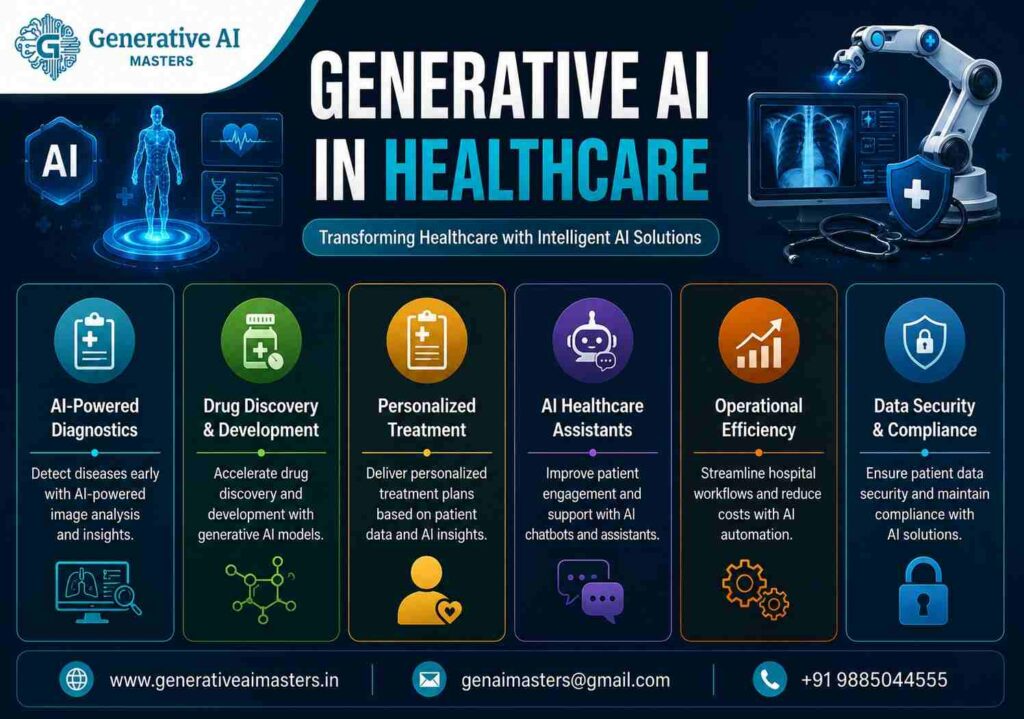
Most generative AI tools used in healthcare are built on large language models trained on vast amounts of text, and increasingly on multimodal models that can also process images, audio, and structured records.
In a healthcare setting, this typically works in a few stages:
- Data input: The model receives input such as a doctor’s dictation, a patient’s medical history, lab results, or a scanned image.
- Context retrieval: Many healthcare AI tools use Retrieval-Augmented Generation (RAG) to pull relevant, verified medical knowledge — such as clinical guidelines or a patient’s own records — before generating a response, which reduces the risk of made-up information.
- Generation: The model produces an output, such as a summary, a draft note, or a suggested next step.
- Human review: A clinician or trained staff member checks the output before it’s used for any decision or documentation.
This retrieval-plus-review approach is one of the main ways healthcare organizations reduce the risk of AI “hallucinations” — a term for when an AI generates plausible-sounding but incorrect information. A peer-reviewed implementation science review of generative AI in healthcare published via NIH’s PubMed Central outlines similar staged approaches for safe clinical adoption.
Generative AI in Healthcare in 2026
By 2026, generative AI in healthcare has moved well beyond simple chatbots. A few shifts define where things stand today:
- Multimodal AI systems can now interpret text, medical images, and audio together, allowing a single tool to read a scan, listen to a consultation, and generate a combined summary.
- AI agents are being used for multi-step workflows, such as gathering patient intake information, checking it against records, and drafting a summary for the clinician — not just answering one-off questions.
- Clinical documentation tools built on generative AI are widely used to reduce the time doctors spend on notes, a major driver of burnout in earlier years.
- RAG for medical knowledge has become standard practice, grounding AI responses in verified clinical guidelines and a patient’s actual records rather than general training data alone.
- Healthcare chatbots now handle more complex triage and follow-up conversations, while still escalating urgent cases to human staff.
- Drug discovery teams use generative models to propose and test molecular structures far faster than traditional lab-only methods.
- Wearables paired with AI generate personalized health insights from continuous data like heart rate and sleep patterns.
- AI-assisted research helps clinicians and scientists quickly summarize new studies and identify relevant findings.
The overall direction in 2026 is toward AI that is more accurate, more grounded in real clinical data, and more tightly integrated into existing hospital systems — rather than standalone tools used in isolation. Google Cloud’s work on Med-PaLM 2, its medical large language model, is one example of this shift toward models built specifically for medical accuracy rather than general-purpose use.
Benefits of Generative AI in Healthcare
Benefit | What It Means in Practice |
Faster diagnosis support | AI can draft preliminary findings from scans or symptoms, giving clinicians a head start rather than starting from a blank page. |
Personalized patient care | Treatment suggestions can factor in a patient’s unique history, making care plans more tailored than generic protocols. |
Reduced administrative workload | Automated documentation and claims drafting free up hours that clinicians previously spent on paperwork. |
Better clinical decision support | AI-generated summaries of guidelines and patient data help doctors make more informed choices, faster. |
Faster drug discovery | Generative models can explore chemical possibilities far more quickly than traditional lab methods alone. |
Improved patient engagement | Chatbots and AI assistants make it easier for patients to get quick answers and stay informed between visits. |
Cost and time efficiency | Automating repetitive tasks reduces operational costs and speeds up routine processes across a healthcare organization. |
Better healthcare accessibility | AI-powered tools can extend basic guidance and triage support to patients in areas with limited access to specialists. |
Generative AI Healthcare Use Cases
Beyond the categories above, here’s how these applications show up in day-to-day practice:
- AI medical assistants that help clinicians prepare for appointments by summarizing a patient’s recent history.
- Clinical note generation from real-time conversations during consultations.
- Patient chatbots that answer FAQs, explain lab results in plain language, or provide medication reminders.
- Drug discovery pipelines that use generative models to screen thousands of potential compounds.
- Medical image analysis tools that draft initial findings for radiologists and pathologists to review.
- Healthcare documentation systems that convert unstructured notes into standardized formats for electronic health records.
- Remote monitoring platforms that translate wearable data into simple, actionable summaries for both patients and care teams.
Examples of Generative AI in Healthcare
To make this more concrete, here are practical examples of generative AI at work: an AI scribe that drafts a doctor’s visit notes in real time, an imaging assistant that flags a possible abnormality on a scan for radiologist review, a chatbot that helps a patient understand their discharge instructions, and a research assistant that summarizes recent clinical trial results for a physician preparing a treatment plan.
Applications of Generative AI in Healthcare
- Medical Diagnosis & Imaging Generative AI can assist radiologists by drafting preliminary reports from X-rays, MRIs, and CT scans, highlighting areas that need closer review. It doesn’t replace the radiologist’s judgment — it speeds up the first draft.
- Clinical Decision Support By analyzing a patient’s history alongside current symptoms and known guidelines, generative AI tools can suggest possible diagnoses or next steps for a physician to consider, always as a recommendation rather than a final decision.
- Personalized Treatment AI can help generate treatment options tailored to a patient’s specific history, genetics, or lifestyle factors, giving doctors a more complete set of choices to evaluate.
- Drug Discovery Generative models can propose novel molecular structures and predict how they might behave, significantly shortening the early research phase compared to traditional trial-and-error methods. NVIDIA’s generative AI microservices for drug discovery are one example of how this is being deployed at scale for pharmaceutical research.
- Patient Engagement & Chatbots AI-powered chatbots answer common patient questions, help with appointment scheduling, and provide basic guidance, freeing up staff time for more complex patient needs.
- Medical Documentation One of the most widely adopted uses today — generative AI listens to doctor-patient conversations and drafts structured clinical notes, cutting documentation time significantly.
- Administrative Automation Beyond clinical notes, generative AI helps draft insurance claim summaries, discharge instructions, and other repetitive administrative documents.
- Telehealth & Remote Care AI assistants support virtual visits by summarizing patient-reported symptoms in advance and helping clinicians prepare before the call even starts.
- Remote Patient Monitoring For patients with wearables or home monitoring devices, generative AI can turn raw data into readable summaries and flag unusual patterns for follow-up.
- Synthetic Medical Data Because real patient data is sensitive, generative AI can create realistic synthetic datasets for training other AI models or for research, without exposing real patient identities.
- Healthcare Research Researchers use generative AI to summarize large volumes of medical literature, helping them stay current without reading every published study manually.
- Predictive Healthcare Analytics By generating readable insights from complex datasets, generative AI helps hospital administrators forecast patient volumes, staffing needs, and resource allocation. Health systems like the Mayo Clinic Platform are building this kind of data infrastructure specifically to support AI-driven clinical and operational insights at scale.
Generative AI vs Traditional AI in Healthcare
Traditional AI | Generative AI |
Predicts or classifies outcomes | Generates new content, insights, or summaries |
Focused on diagnosis prediction | Creates clinical summaries and draft reports |
Detects patterns in existing data | Produces patient-specific written or visual content |
Rule-based or narrow model-driven | Built on LLMs and multimodal models |
Requires structured input | Can work with unstructured notes, speech, and images |
Limited to a single defined task | Adaptable across many tasks with the same underlying model |
Challenges of Generative AI in Healthcare
Generative AI brings real value to healthcare, but it also comes with meaningful risks that organizations need to manage carefully.
- Data privacy: Medical data is highly sensitive, and any AI system handling it must meet strict regulatory standards, such as those outlined in HHS’s AI strategy for healthcare.
- Patient data security: Beyond privacy policy, the technical security of how data is stored and transmitted matters just as much.
- AI hallucinations: Generative models can produce confident-sounding but incorrect information, which is especially dangerous in a medical context.
- Bias: If training data reflects historical inequities in healthcare, AI outputs can unintentionally reinforce them.
- Accuracy and reliability: Medical decisions demand a much higher accuracy bar than most other AI use cases, and outputs must be consistently validated.
- Regulatory compliance: Healthcare AI tools must meet regional regulations, which vary and continue to evolve — the FDA’s list of AI/ML-enabled medical devices is a useful reference point for how oversight works in the US.
- Human oversight: Every AI-generated output involving patient care needs a qualified human to review it before action is taken.
- Integration with EHR systems: Connecting AI tools to existing hospital infrastructure is technically complex and often slower than expected.
- Lack of quality healthcare datasets: High-quality, diverse, well-labeled medical data is harder to come by than general text data, which can limit model performance.
- Ethical concerns: Questions around consent, transparency, and accountability remain unresolved in many healthcare AI deployments.
Ethical & Privacy Considerations
Beyond the technical challenges, generative AI in healthcare raises important ethical questions. Patients should know when they’re interacting with an AI system versus a human, and they should have the ability to opt for human review of any AI-assisted decision affecting their care. Consent, transparency about how patient data is used, and clear accountability when an AI-generated output leads to an error are all essential parts of responsible deployment — not afterthoughts. The World Health Organization’s guidance on ethics and governance of AI in health lays out consensus principles that many of these deployment practices are built around.
Future of Generative AI in Healthcare
Looking ahead, generative AI in healthcare is likely to become more specialized, more accurate, and more deeply embedded into existing clinical workflows rather than existing as a separate tool. Expect to see tighter integration with EHR systems, wider use of AI agents for multi-step administrative and clinical support tasks, and continued growth in multimodal AI that can process text, images, and audio together. Regulatory frameworks will also continue to mature, shaping how quickly and in what form these tools are adopted across different healthcare systems.
Importantly, the trajectory points toward AI as a collaborator that handles repetitive, time-consuming tasks — freeing clinicians to spend more time on direct patient care rather than paperwork. Research groups like Stanford’s Institute for Human-Centered AI continue to study exactly this balance between AI capability and safe, human-centered clinical use.
Skills Needed to Work With Generative AI in Healthcare
For healthcare professionals, technologists, and researchers who want to work with these tools, a few foundational skills matter most:
- Understanding of AI and machine learning basics, including how large language models generate output.
- Familiarity with healthcare data standards and regulations relevant to your region.
- Prompt engineering skills to get accurate, useful outputs from generative AI tools.
- Basic understanding of Retrieval-Augmented Generation (RAG) for grounding AI in verified medical knowledge.
- Critical evaluation skills to review AI-generated content for accuracy before it’s used in practice.
- For technical roles, working knowledge of Python and AI development frameworks used to build or customize healthcare AI tools.
Conclusion
Generative AI in healthcare is no longer an experimental idea — it’s actively reshaping how diagnosis support, drug discovery, documentation, and patient engagement work across the industry. The technology’s real strength lies in handling time-consuming, repetitive tasks so clinicians can focus more on direct patient care.
At the same time, its risks — from hallucinations to data privacy concerns — mean it must always be deployed with strong human oversight, verified data sources, and clear ethical guardrails. As multimodal AI, AI agents, and retrieval-grounded systems continue to mature through 2026 and beyond, generative AI in healthcare will keep evolving from a helpful assistant into a deeply integrated part of everyday clinical and administrative workflows — always working alongside, not instead of, medical professionals.
Frequently Asked Questions
1. What is generative AI in healthcare?
Generative AI in healthcare refers to AI systems that create new content — such as clinical notes, treatment summaries, or draft reports — using large language models or multimodal AI. It’s used to support diagnosis, documentation, research, and patient communication, always alongside human review.
2. How is generative AI used in healthcare?
It’s used across diagnosis support, medical documentation, drug discovery, patient chatbots, administrative automation, and remote monitoring. In most cases, it drafts a first version of something — a report, a summary, or a suggestion — that a qualified professional then reviews and finalizes.
3. What are the benefits of generative AI in healthcare?
Key benefits include faster diagnosis support, reduced administrative workload, more personalized treatment suggestions, faster drug discovery, and improved patient engagement through chatbots and AI assistants. It also helps extend basic healthcare guidance to underserved areas.
4. What are the risks of generative AI in healthcare?
The main risks include AI hallucinations (confidently wrong outputs), data privacy concerns, potential bias in training data, and the danger of over-relying on AI without sufficient human oversight. Regulatory compliance and data security are also ongoing challenges.
5. Can generative AI diagnose diseases?
Generative AI can support diagnosis by drafting preliminary interpretations of scans or symptoms, but it does not independently diagnose patients. A licensed clinician must always review and confirm any AI-generated diagnostic suggestion before it informs patient care.
6. How is generative AI used in drug discovery?
Generative AI proposes novel molecular structures and predicts how they might behave, helping researchers narrow down promising candidates faster than traditional lab-only methods. It speeds up early-stage research but doesn’t replace lab testing or clinical trials.
7. How does generative AI improve patient care?
It improves patient care by giving clinicians more complete information faster, reducing time spent on documentation, and providing patients with quicker access to basic guidance through chatbots. This allows care teams to spend more time on direct, complex patient needs.
8. Can generative AI replace doctors?
No. Generative AI is built to support clinical work, not replace medical judgment. Every AI-generated output related to diagnosis or treatment requires review by a qualified healthcare professional before it influences patient care decisions.
9. What are examples of generative AI in healthcare?
Examples include AI scribes that draft clinical notes during consultations, imaging tools that flag possible abnormalities for radiologist review, patient chatbots that explain lab results, and research assistants that summarize recent medical studies for clinicians.
10. What is the future of generative AI in healthcare?
The future points toward deeper integration with EHR systems, wider use of multimodal AI that combines text, images, and audio, and AI agents that handle multi-step clinical and administrative workflows — all while regulatory frameworks continue to mature around safe deployment.
11. Is generative AI safe to use in hospitals?
Generative AI can be used safely in hospitals when paired with strong human oversight, verified data sources, and compliance with healthcare data regulations. Safety depends heavily on how the tool is implemented, not just the technology itself.
12. What is the difference between generative AI and traditional healthcare AI?
Traditional AI in healthcare typically predicts or classifies outcomes, such as flagging a risk score. Generative AI goes further by creating new content — like a full clinical summary or a drafted report — based on that data.

Mr. Dinesh Tunguturi Generative AI Trainer
GenAI Masters AI Experts | 60+ Articles Published on Generative AI, Prompt Engineering, LLMs & AI Careers
Mr. Dinesh is a Generative AI Trainer with expertise in Large Language Models (LLMs), Prompt Engineering, Agentic AI, RAG, and AI Automation. He helps students and professionals gain practical, job-ready AI skills through hands-on training, real-world projects, and industry-focused mentorship.