Applications of Generative adversarial networks
What are Generative Adversarial Networks (GANs)?
Generative Adversarial Networks, also called GANs, are a special type of Generative AI model.
GANs are mainly used to create realistic images, videos, and data.
A GAN has two neural networks
- Generator
- Discriminator
These two networks work together and also compete with each other.
Because of this competition, GANs are called “Adversarial” Networks.
GANs = Two AI models competing to create realistic output
GANs Explained in Simple Terms (Real vs Fake Example)
Let us understand GANs with a very simple example.
Imagine a situation
- One student creates fake currency notes (Generator)
- Another student checks whether the note is real or fake (Discriminator)
Step-by-step process
- The Generator creates a fake image (for example, a fake human face).
- The Discriminator checks the image and says
- This is real” or
- “This is fake”
- If the Discriminator catches the fake, the Generator tries again and improves.
- This process continues again and again.
After many attempts
- The Generator becomes very good at creating realistic images
- The Discriminator becomes very good at detecting fakes
Finally, the Generator produces images that look almost real.
Real vs Fake competition helps GANs learn better
Example Tools & Techniques Used in GANs
Generative Adversarial Networks (GANs) use special tools and techniques to create realistic images, videos, audio, and data. These tools help developers build, train, and improve GAN models easily.
Popular GAN Techniques
1.DCGAN (Deep Convolutional GAN)
DCGAN is one of the most basic and popular GAN techniques.
- Mainly used for image generation
- Produces better-quality images than simple GANs
- Easy for beginners to understand
Example use: Creating handwritten digits or simple face images.
2. CycleGAN
CycleGAN is used for image-to-image translation.
- Converts one type of image into another
- Does not need paired images
Example use
- Black-and-white photo to color photo
- Day image to night image
3.StyleGAN
StyleGAN is famous for generating high-quality and realistic human faces.
- Used for AI avatars
- Creates very detailed images
- Popular in creative and design industries
Example use: Realistic AI-generated face images.
4.SRGAN (Super-Resolution GAN)
SRGAN is used to improve image quality.
- Converts low-resolution images into high-resolution images
- Makes images clearer and sharper
Example use: Enhancing old photos or CCTV footage.
Common Tools Used to Build GANs
1.TensorFlow
- Popular AI framework by Google
- Used to build and train GAN models
- Beginner-friendly with good documentation
2.PyTorch
- Very popular among researchers
- Easy to experiment and modify models
- Widely used in advanced GAN projects
3. Keras
- Simple library built on TensorFlow
- Good for beginners
- Helps create GANs with less code
4.Runway ML
- No-code / low-code tool
- Used by artists and designers
- Easy to generate images and videos using GANs
Key Application Areas of Generative Adversarial Networks (GANs)
1.Image & Video Synthesis
Image and Video Synthesis means creating new images and videos using AI.
GANs can generate
- Human faces that do not exist
- Realistic photos
- AI-generated videos
- Animated characters
Example
AI creates a face of a person who is not real, but looks like a real human photo.
Where it is used
- Movies and animation
- Social media filters
- AI avatars
- Gaming characters
GANs help computers create visuals like humans do.
2. Image-to-Image Translation
Image-to-Image Translation means converting one type of image into another.
GANs learn how to change images while keeping important details.
Examples
- Black-and-white photo → Color photo
- Day photo → Night photo
- Sketch → Real image
- Old photo → Restored photo
Where it is used
- Photo editing apps
- Medical imaging
- Satellite image analysis
- Fashion design
GANs act like a smart image converter.
3.Data Augmentation & Privacy
What is Data Augmentation?
Data Augmentation means creating extra training data for AI models.
GANs can generate
- Fake images
- Fake customer data
- Fake medical records
These fake data look real and help train AI systems.
Privacy Benefit
GAN-generated data
- Does not belong to real people
- Protects personal and sensitive information
Where it is used
- Healthcare
- Banking
- AI research
- Machine learning training
GANs help increase data safely without privacy risk.
4️ .Super-Resolution
Super-Resolution means improving the quality of low-resolution images.
GANs can
- Convert blurry images into clear images
- Improve old photos
- Increase image sharpness
Example
A small, blurry photo becomes clear and detailed using GANs.
Where it is used
- Medical scans (MRI, CT)
- CCTV footage enhancement
- Satellite images
- Old photo restoration
GANs help see more details from poor-quality images.
5. Anomaly & Fraud Detection
Anomaly Detection means finding unusual or suspicious behavior.
GANs learn what is “normal” data and detect anything that looks different.
Examples
- Fake bank transactions
- Credit card fraud
- Network security attacks
Where it is used
- Banks and fintech companies
- Cybersecurity systems
- Online payment platforms
GANs help detect fraud before damage happens.
6️ .Scientific Discovery
GANs help scientists by
- Generating chemical structures
- Designing new medicines
- Simulating experiments
Example
GANs suggest new drug molecules before real lab testing.
Where it is used
- Medical research
- Drug discovery
- Climate research
- Physics and chemistry
GANs save time and cost in scientific research.
7.3D Modeling & Design
GANs can generate
- 3D objects
- Building designs
- Product models
Examples
- 3D game characters
- Furniture design
- Architecture models
Where it is used
- Gaming industry
- Architecture
- Manufacturing
- Virtual reality (VR)
GANs help create realistic 3D designs faster.
8. Audio & Music Generation
GANs are not only for images—they also work with audio.
GANs can
- Generate music
- Improve voice quality
- Create sound effects
Examples
- AI-generated songs
- Voice cloning
- Noise removal from audio
Where it is used
- Music industry
- Podcasts
- Film production
- Voice assistants
GANs help machines create and improve sound like humans.
GANs vs Other Generative AI Models
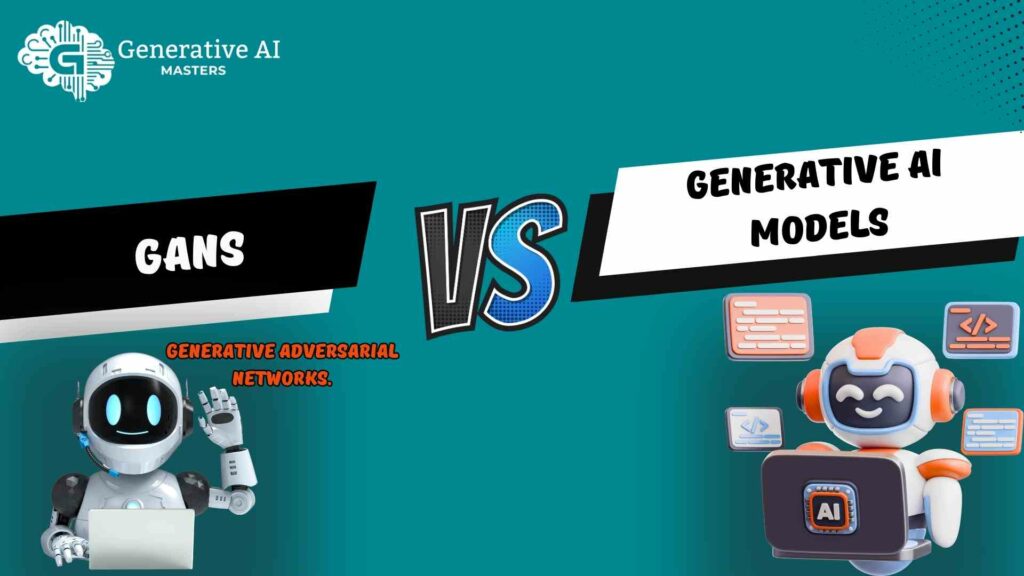
Generative AI has different models that can create images, text, audio, and data. Among them, GANs, VAEs, and Diffusion Models are the most popular. Each model works in a different way and is used for different purposes. Let us understand their differences in a simple and clear manner.
GANs vs VAEs (Variational Autoencoders)
What are VAEs?
Variational Autoencoders (VAEs) are generative models that learn how data is distributed and then create new data similar to it.
Key Differences
- GANs use two networks (Generator and Discriminator) that compete with each other.
- VAEs use an encoder and decoder to compress and recreate data.
Output Quality
- GANs produce very realistic and sharp images
- VAEs produce slightly blurry images
Stability
- GANs are harder to train
- VAEs are easier and more stable
Use Cases
- GANs: image generation, deepfakes, super-resolution
- VAEs: data compression, anomaly detection
Simple idea
GANs focus on realism, VAEs focus on stability.
GANs vs Diffusion Models
What are Diffusion Models?
Diffusion Models generate images by slowly removing noise step by step.
Key Differences
- GANs generate images in one step
- Diffusion models generate images in multiple steps
Image Quality
- GANs create high-quality images quickly
- Diffusion models create very high-quality and detailed images
Training
- GANs are difficult to train
- Diffusion models are more stable but slower
Popular Usage
- GANs: real-time image generation, avatars
- Diffusion models: DALL·E, Stable Diffusion, Midjourney
If you want to learn more about Generative AI Syllabus
Careers & Skills Needed to Learn GANs
Generative Adversarial Networks (GANs) are one of the hottest topics in Artificial Intelligence (AI). Learning GANs can open doors to exciting career opportunities in AI, data science, gaming, healthcare, finance, and more. Even if you are a beginner, GANs are learnable with the right skills and dedication.
Skills Required to Learn GANs
To work with GANs, you need a combination of programming, machine learning, and deep learning skills
1. Python Programming
- Python is the most common language used in AI.
- Libraries like TensorFlow, PyTorch, and Keras are used to build GANs.
- Knowing Python is a must.
2.Machine Learning (ML) Basics
- Understand supervised and unsupervised learning
- Learn about data preprocessing, training, and evaluation
- ML knowledge helps you understand how GANs generate data
3.Deep Learning
- GANs are built on deep neural networks
- You should understand:
- Convolutional Neural Networks (CNNs) for images
- Recurrent Neural Networks (RNNs) for sequences
- Deep learning frameworks like TensorFlow and PyTorch are essential
4. Mathematics Basics
- Linear algebra, probability, and statistics help in understanding GAN algorithms.
- Optional but useful for deeper knowledge.
Who Should Learn GANs?
GANs are suitable for
- Students looking for AI projects
- Data science beginners wanting practical experience
- Professionals aiming to switch to AI roles
- Researchers exploring new AI applications
- Creatives & designers using AI in art, games, or marketing
Even if you are a beginner, you can start with Python and ML basics and gradually move to GANs.
Career Roles with GAN Skills
Learning GANs can lead to several high-demand career roles
1. AI Engineer
- Build AI systems using GANs
- Work on computer vision, audio, and video projects
- Develop AI-powered applications
2. Data Scientist
- Analyze data and generate synthetic datasets
- Use GANs for data augmentation and predictions
- Work in industries like healthcare, finance, and e-commerce
3. Machine Learning Engineer
- Design and train GAN models
- Improve AI model performance
- Deploy AI solutions for real-world problems
Top Applications of Generative Adversarial Networks
1 Image Generation & Image Enhancement
Image Generation and Image Enhancement are one of the most important applications of Generative Adversarial Networks (GANs). GANs are widely used to create new images and to improve the quality of existing images. These technologies are used in many real-world industries such as social media, design, healthcare, entertainment, and marketing.
Creating Realistic Images
GANs are very powerful when it comes to creating realistic images. They can generate images that look almost exactly like real photos, even though those images are completely created by AI.
The Generator in a GAN learns patterns such as:
- Shape
- Color
- Texture
- Lighting
Using this knowledge, it creates new images that look natural and real. The Discriminator checks whether the image looks real or fake and helps improve the quality.
Where it is used
- Human face generation
- Product image creation
- Fashion and design visuals
- Game characters and environments
This is especially useful when real images are expensive or difficult to collect.
Old Photo Restoration
Old photos are often damaged, faded, blurry, or broken. GANs can restore old photographs and make them look clear and new again.
GANs can
- Fix cracks and scratches
- Improve brightness and contrast
- Reconstruct missing parts of images
- Convert black-and-white photos into color images
Real-world use
- Family photo restoration
- Historical photo preservation
- Museum and archive projects
- Media and publishing
With GANs, memories stored in old photos can be revived digitally.
Image Super-Resolution
Image Super-Resolution means increasing the quality and resolution of an image. GANs can convert low-quality images into high-resolution and sharp images.
GANs analyze low-resolution images and predict missing details such as:
- Sharp edges
- Fine textures
- Clear backgrounds
Common applications
- Medical imaging (MRI, CT scans)
- CCTV and security footage
- Satellite images
- Mobile camera enhancement
This helps professionals see more details and make better decisions.
Used by Google, Adobe, and Meta
Many leading technology companies use GANs in their products and services.
- Google uses GANs in image enhancement and AI research
- Adobe uses GANs in tools like Photoshop for image editing and restoration
- Meta (Facebook) uses GANs for face recognition, avatars, and content creation
These companies use GANs to improve user experience and visual quality.
Example: Face Generation & AI Avatars
One popular use of GANs is face generation. GANs can create realistic human faces that do not belong to any real person.
AI Avatars
- Used in social media
- Used in gaming and virtual worlds
- Used in customer support and marketing
These avatars look human-like and help businesses interact with users in a modern way.
Video Generation & Deepfake Technology
Video Generation and Deepfake Technology are important applications of Generative Adversarial Networks (GANs). Using GANs, AI systems can create realistic videos, modify existing videos, and even generate human faces and expressions that look real. This technology is widely used in entertainment, education, marketing, and research.
Healthcare Applications of GANs
Generative Adversarial Networks (GANs) are playing a very important role in the healthcare industry. GANs help doctors, researchers, and hospitals by improving medical images, supporting disease detection, and protecting patient data. These AI systems do not replace doctors, but they assist medical professionals in making better and faster decisions.
Medical Image Enhancement
Medical images such as X-rays, MRI scans, and CT scans are very important for diagnosis. Sometimes these images are blurry or low quality. GANs help improve the quality of these images.
GANs can
- Increase image clarity
- Reduce noise
- Improve contrast and sharpness
This helps doctors see details clearly, which leads to better diagnosis and treatment.
Disease Detection and Diagnosis Support
GANs help AI systems learn from medical data and support early disease detection.
GANs are used in
- Cancer detection
- Brain tumor analysis
- Lung disease identification
- Eye disease detection
By generating additional training data, GANs improve the accuracy of AI diagnostic models. This is very helpful when real medical data is limited.
Data Augmentation for Medical Research
Medical data is often limited and sensitive. GANs can generate synthetic medical data that looks real but does not belong to any real patient.
Benefits
- Protects patient privacy
- Provides more data for research
- Helps train AI models safely
This is widely used in hospitals, research labs, and medical universities.
- Drug Discovery and Research
GANs help researchers in drug discovery by generating new chemical structures and drug molecules.
GANs can
- Suggest new medicine compounds
- Reduce research time
- Lower research cost
This speeds up the development of new treatments and vaccines.
Medical Training and Simulation
GANs are used to create realistic medical simulations.
Examples
- Training medical students using simulated scans
- Virtual surgery practice
- AI-generated case studies
This helps doctors and students learn without risking real patients.
Finance & Fraud Detection Using GANs
Generative Adversarial Networks (GANs) are widely used in the finance and banking industry to detect fraud, improve security, and protect customer money. Financial fraud is increasing day by day, and traditional systems are not always able to catch new fraud patterns. GANs help by learning what is normal and identifying unusual or suspicious activities.
What is Fraud in Finance?
Fraud means illegal or dishonest financial activity.
Examples include
- Credit card fraud
- Fake online transactions
- Identity theft
- Loan and insurance fraud
Banks and financial institutions must detect these activities quickly and accurately to avoid losses.
How GANs Help in Fraud Detection
GANs learn from large amounts of transaction data and understand normal customer behavior.
- The Generator creates fake but realistic transaction data
- The Discriminator tries to detect whether a transaction is real or fake
- Over time, the system learns to identify unusual patterns
If a transaction looks different from normal behavior, it is flagged as suspicious.
Anomaly Detection in Banking
Anomaly detection means finding activities that do not match normal patterns.
GANs help detect:
- Sudden large transactions
- Transactions from unusual locations
- Multiple transactions in a short time
This helps banks stop fraud in real time.
Data Augmentation for Financial Security
Real fraud data is limited because fraud cases are rare. GANs generate synthetic fraud data to train better AI models.
Benefits
- Improves fraud detection accuracy
- No risk to real customer data
- Helps test security systems
Cybersecurity and Payment Protection
GANs are also used in
- Online payment systems
- Digital wallets
- Fintech apps
They help detect:
- Hacking attempts
- Fake accounts
- Suspicious login behavior
Benefits of Using GANs in Finance
- Faster fraud detection
- Reduced financial losses
- Improved customer trust
- Better security systems
Education Applications of GANs
Generative Adversarial Networks (GANs) are becoming very useful in the education sector. GANs help improve teaching methods, create better learning content, and support students and teachers using Artificial Intelligence. These technologies make learning more interactive, personalized, and effective.
Personalized Learning Content
Every student learns at a different speed. GANs help create personalized learning materials based on a student’s level.
GANs can generate
- Practice questions
- Study examples
- Visual explanations
- Learning simulations
This helps students understand topics more easily and clearly.
Creating Educational Images and Videos
GANs are used to generate educational images and videos for subjects like science, biology, physics, and geography.
Examples
- Human anatomy diagrams
- Chemical reactions visuals
- Historical reconstructions
- Virtual lab experiments
These visuals make learning more engaging and easy to remember.
Virtual Classrooms and Simulations
GANs help create virtual classrooms and training simulations.
Used for
- Medical education
- Engineering training
- Science experiments
- Skill-based learning
Students can practice in a safe and controlled virtual environment without real-world risks.
Automatic Question Paper Generation
GANs can help generate
- Question papers
- Practice tests
- Sample exam questions
These questions are created based on:
- Syllabus
- Difficulty level
- Student performance
This reduces teacher workload and improves assessment quality.
Data Augmentation for Educational Research
Educational AI systems need large datasets. GANs generate synthetic student data for research and system training.
Benefits
- Protects student privacy
- Improves AI accuracy
- Supports educational research
Support for Online Learning Platforms
Online learning platforms use GANs to:
- Improve video quality
- Create AI tutors
- Generate interactive content
This improves the overall online learning experience.
E-commerce Applications of GANs
Generative Adversarial Networks (GANs) are widely used in the e-commerce industry to improve customer experience, increase sales, and reduce business costs. Online shopping platforms use GANs to create better product images, personalize user experience, and detect fraud. These AI technologies help e-commerce businesses grow faster and smarter.
Product Image Generation and Enhancement
High-quality product images are very important in online shopping. GANs help generate and improve product images.
GANs can
- Create realistic product images
- Enhance image quality and resolution
- Generate images from different angles
- Improve lighting and background
This helps customers see products clearly and make better purchase decisions.
Virtual Try-On and Fashion Visualization
GANs are widely used in fashion and beauty e-commerce platforms.
Examples
- Virtual clothing try-on
- Makeup and hairstyle preview
- Accessories visualization
Customers can see how a product looks on them before buying, which reduces returns and increases satisfaction.
Personalized Shopping Experience
GANs help create a personalized shopping experience.
They analyze
- Customer preferences
- Browsing history
- Purchase behavior
Based on this, GANs generate:
- Personalized product recommendations
- Customized ads
- Personalized banners and offers
This increases customer engagement and sales.
Synthetic Data for Training AI Models
E-commerce platforms need large datasets to train AI systems. GANs generate synthetic customer and transaction data.
Benefits
- Protects user privacy
- Improves recommendation systems
- Helps test AI models safely
Fraud Detection and Security
GANs help detect
- Fake reviews
- Fake seller accounts
- Payment fraud
By identifying unusual behavior, GANs improve platform security and trust.
Marketing and Advertising Content Creation
GANs are used to create
- Product banners
- Promotional videos
- Ad creatives
This saves time and reduces marketing costs.
Gaming & Virtual Worlds
Generative Adversarial Networks (GANs) play a major role in modern gaming and virtual worlds. Game developers use GANs to create realistic characters, detailed environments, and high-quality game assets. This helps reduce development time and makes games more immersive and visually appealing.
Game Character Creation
Creating game characters usually takes a lot of time and effort. GANs make this process faster and easier by generating realistic and unique game characters.
GANs can create
- Human characters
- Fantasy characters
- Animals and creatures
- NPCs (Non-Player Characters)
These characters can have different
- Faces
- Body shapes
- Clothing styles
- Expressions
This allows developers to create thousands of unique characters automatically, improving game variety and realism.
Background & Environment Design
Game worlds need detailed backgrounds such as cities, forests, mountains, and space environments. GANs help design rich and realistic game environments.
GANs can generate:
- Natural landscapes
- Urban scenes
- Fantasy worlds
- Sci-fi environments
These environments adapt to different lighting, weather, and time settings, making the game world feel alive and dynamic.
AI-Based Game Assets
Game assets include
- Weapons
- Buildings
- Vehicles
- Objects and props
GANs can automatically generate these assets in different styles and designs. This helps developers:
- Save time
- Reduce costs
- Focus more on gameplay and storytelling
AI-generated assets maintain high visual quality and consistency throughout the game.
Used in Modern Game Development
Many modern games and studios use GANs to
- Speed up game production
- Improve visual quality
- Create open-world experiences
- Support VR and AR games
GANs are especially useful in
- Open-world games
- Virtual reality (VR)
- Metaverse platforms
Data Augmentation for Machine Learning
Machine Learning. In simple words, it means creating extra training data so that AI models can learn better and give accurate results. GANs are especially useful when real data is limited, expensive, or difficult to collect.
Creating Fake but Useful Training Data
GANs can create fake data that looks very similar to real data. This fake data is also called synthetic data.
GANs can generate
- Images
- Text
- Audio
- Transaction data
- Medical data
Even though the data is fake, it is very useful for training AI models because it follows real patterns.
Example
If you have only 100 images to train an AI model, GANs can generate 1,000 more similar images. This helps the AI learn better.
Solving Data Shortage Problems
Many industries face data shortage problems.
Examples
- Medical data is limited due to privacy
- Fraud data is rare
- Industrial failure data is hard to collect
GANs solve this problem by generating high-quality synthetic data.
Benefits
- No need to collect real data again
- Saves time and money
- Protects sensitive information
This is very helpful in healthcare, finance, and research fields.
Used in AI Model Training
AI and Machine Learning models perform better when they are trained on large and diverse datasets. GANs help improve:
- Model accuracy
- Prediction performance
- Generalization ability
GAN-generated data helps models learn different patterns and scenarios, reducing overfitting and bias.
Why This Is Very Useful for Data Science Beginners
For beginners in data science
- Real datasets may be small
- Data collection is difficult
- Practice data is limited
GANs help beginners
- Practice model training
- Understand real-world data problems
- Build better ML projects
This makes GANs a powerful learning tool for students and freshers.
Benefits of GANs in Real Life
Generative Adversarial Networks (GANs) provide many practical benefits in real life. They are widely used across industries because they help save time, reduce costs, improve creativity, and solve data-related problems. GANs are an important part of modern Artificial Intelligence and play a key role in driving innovation.
Saves Time and Cost
Traditional methods of creating images, videos, designs, and data take a lot of time and money. GANs help automate these tasks.
GANs can
- Generate images instead of photoshoots
- Create videos without real filming
- Produce design samples automatically
- Generate data without real data collection
This reduces the need for manual work, large teams, and expensive equipment. As a result, businesses and researchers can complete tasks faster and at a lower cost.
Improves Creativity
GANs support human creativity by generating new and unique ideas.
GANs help in
- Creating digital art
- Designing fashion and products
- Generating music and sound effects
- Building game characters and virtual worlds
Instead of replacing humans, GANs act as creative assistants, helping artists, designers, and developers explore new possibilities and ideas.
Solves Data Problems
Many AI projects fail due to lack of quality data. GANs solve this problem by creating synthetic data.
GANs help
- Increase dataset size
- Balance training data
- Protect sensitive information
- Reduce data bias
This is especially useful in healthcare, finance, and research, where real data is limited or private.
Boosts AI Innovation
GANs push the boundaries of what AI can do.
They help
- Build smarter AI models
- Improve machine learning accuracy
- Support advanced AI applications
- Speed up research and development
GANs are used in cutting-edge technologies like Generative AI tools, virtual reality, and the metaverse.
Limitations & Challenges of GANs
Generative Adversarial Networks (GANs) are powerful, but they also come with several limitations and challenges. Understanding these challenges is important for building trust in AI systems and using GANs responsibly in real-world applications.
Training Difficulty
Training GANs is not easy. A GAN has two models—the Generator and the Discriminator—that must learn together.
Common training problems
- One model becomes too strong
- The other model fails to learn
- Training becomes unstable
This can lead to
- Poor-quality results
- Repeated or unrealistic outputs
Because of this, GANs require:
- Skilled AI engineers
- Careful tuning
- More time for experimentation
Ethical Issues
GANs can generate content that looks very real, which raises ethical concerns.
Ethical challenges include
- Creating fake images of people
- Generating misleading content
- Using AI without user consent
If GANs are not used responsibly, they can harm trust in digital content. That is why ethical AI guidelines are very important.
Deep fake Misuse
One of the biggest concerns with GANs is deepfake misuse.
Deepfakes can be used to:
- Spread fake news
- Damage personal reputation
- Create fake political videos
- Commit online scams
Because deepfake videos look real, many people may believe them. This creates serious social and legal risks.
Governments and companies are now working on
- Deepfake detection tools
- AI regulations
- Awareness programs
High Computational Cost
GANs require
- Powerful GPUs
- Large memory
- High electricity usage
This makes them
- Expensive to train
- Difficult for small companies
- Hard for beginners without resources
Cloud platforms help, but cost remains a challenge.
Conclusion
Generative Adversarial Networks (GANs) are one of the most exciting technologies in Artificial Intelligence today. They have the ability to create realistic images, videos, audio, and data, making them extremely valuable across industries like healthcare, finance, gaming, e-commerce, education, and entertainment.
With GANs, businesses and researchers can
- Save time and cost by automating content creation
- Boost creativity by generating unique designs, art, and virtual worlds
- Solve data problems by creating synthetic datasets for AI training
- Drive innovation in AI-powered applications
However, GANs also come with challenges like training difficulty, high computational costs, ethical concerns, and potential misuse in deepfakes. Understanding these limitations is important for responsible and safe use of GANs in real life.
For students, beginners, and professionals, learning GANs opens doors to high-demand AI careers. Roles like AI Engineer, Data Scientist, and Machine Learning Engineer are actively seeking skills in GANs, making it a promising field for anyone interested in technology and innovation.
FAQS
1.What are GANs in simple words?
GANs (Generative Adversarial Networks) are a type of Artificial Intelligence that can create new images, videos, music, and data. They work using two networks
- Generator – creates new content
- Discriminator – checks if the content is real or fake
The two networks compete, which helps GANs produce realistic outputs
2. What is the difference between GANs and other AI models?
- GANs: Generate realistic images and videos quickly
- VAEs: Easier to train but produce slightly blurry results
- Diffusion Models: Very high-quality images but slower generation
GANs are best for realistic visuals and AI content creation
3. What are the main applications of GANs?
GANs are used in
- Image & video generation (faces, avatars, movies)
- Healthcare (medical imaging, disease detection)
- Finance (fraud detection, anomaly detection)
- E-commerce (product images, virtual try-on)
- Gaming & virtual worlds (characters, environments)
- Education (visuals, simulations, personalized learning)
4. Can GANs create realistic videos?
Yes! GANs can generate realistic videos and deepfake content. They can also create animations, virtual influencers, and training videos. However, deepfakes should be used ethically.
5. How do GANs help in healthcare?
- Improve medical images like X-rays and MRIs
- Detect diseases early (cancer, brain, lung, eye)
- Generate synthetic medical data while protecting patient privacy
- Assist in drug discovery and research
6. How are GANs used in finance?
- Detect fraudulent transactions
- Identify unusual patterns (anomaly detection)
- Generate synthetic data for AI model training
- Improve cybersecurity in online banking and fintech
7. Can beginners learn GANs?
Yes! Beginners can start with
- Python programming
- Machine Learning basics
- Deep Learning frameworks like TensorFlow or PyTorch
With practice, anyone can learn to build GAN models and work on AI projects.
8. What are the limitations of GANs?
- Difficult to train and unstable
- Require high computational power
- Can be misused for deepfakes
- Ethical issues when creating realistic fake content
9. Which careers require GAN skills?
- AI Engineer – Build AI systems using GANs
- Data Scientist – Analyze and generate data
- Machine Learning Engineer – Design, train, and deploy GAN models
GANs skills are highly valued in tech, healthcare, finance, and creative industries.
10. Why are GANs important in real life?
- Save time and cost in content creation
- Boost creativity for design, art, and games
- Solve data problems with synthetic data
- Drive AI innovation across industries
GANs are transforming the way AI is used in business, research, and entertainment.