Applications of Artificial Intelligence in Robotics
Artificial Intelligence is transforming robotics by giving machines the ability to see, learn, reason, and act independently. From factory arms that adapt to new tasks, to surgical robots, self-driving cars, warehouse automation, and humanoid assistants, AI enables robots to sense their environment, make decisions, and improve performance over time without constant human control.
Table of Contents
Introduction to Applications of Artificial Intelligence in Robotics
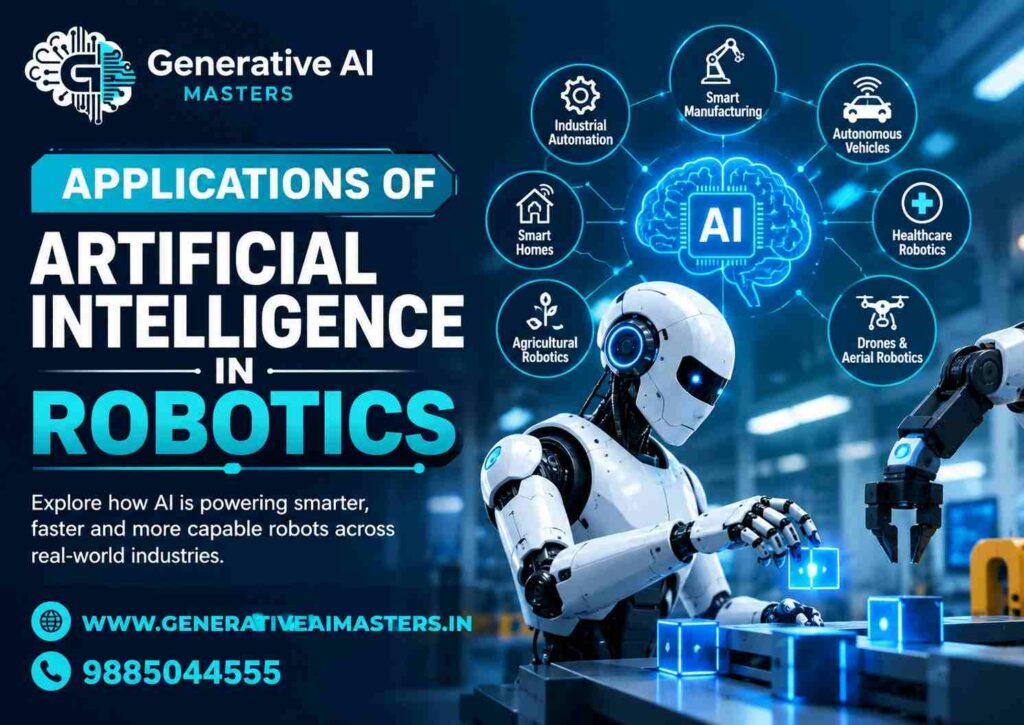
Robots used to follow rigid, pre-programmed instructions. Move here, grip this, repeat. That worked fine on a factory line where nothing ever changed.
Real environments are messier. Warehouses shift layouts. Patients move on operating tables. Roads have unpredictable drivers. Farms have uneven terrain and changing weather.
This is where Artificial Intelligence changes everything. AI gives robots the ability to sense, interpret, and adapt not just execute. A robot with AI can look at an unfamiliar object and decide how to grip it. It can navigate a room it has never seen. It can learn from thousands of past attempts and get better without a human rewriting its code.
This guide breaks down where AI is actually being used in robotics today, how each application works, what technologies power it, and why it matters written for students, engineers, business leaders, and anyone curious about where robotics is heading. If you want to build these skills hands-on, Generative AI Training in Hyderabad is a good place to start.
What is Artificial Intelligence in Robotics?
AI in robotics refers to the use of machine learning, computer vision, natural language processing, and decision-making algorithms to help robots perceive their environment, make choices, and act with a degree of independence.
Traditional robotics relies on fixed programming: a robot arm welding the same joint on the same car model, thousands of times, exactly the same way. AI-powered robotics adds perception and adaptability. The robot can identify a slightly different part, adjust its grip, or reroute around an obstacle it wasn’t explicitly told about.
Why AI Matters in Modern Robotics
Without AI, a robot is only as good as the exact conditions it was programmed for. Change the lighting, move an object a few centimeters, or introduce a new variable, and a purely mechanical robot fails.
AI matters because it closes that gap. It lets robots:
- Interpret visual and sensor data in real time
- Handle variation instead of requiring identical conditions every time
- Learn from past attempts and improve accuracy over time
- Make split-second decisions in dynamic environments
- Work alongside humans safely, understanding context and movement
This shift from rigid automation to adaptive intelligence is why AI robotics is now used far beyond factories, reaching hospitals, farms, highways, and even other planets.
Complete Overview of AI Applications in Robotics
Here’s a snapshot of where AI-driven robotics is making the biggest impact right now.
Application Area | AI Technology Used | Real-World Example | Key Benefit |
Manufacturing | Computer vision, ML | Adaptive robotic arms on assembly lines | Higher precision, less downtime |
Healthcare | Computer vision, ML, sensor fusion | Robotic-assisted surgery (e.g., da Vinci system) | Improved surgical accuracy |
Transportation | Deep learning, sensor fusion | Self-driving cars | Reduced human error |
Logistics | ML, computer vision, path planning | Warehouse picking robots | Faster, 24/7 fulfillment |
Agriculture | Computer vision, ML | Crop-monitoring and harvesting robots | Reduced labor cost, less waste |
Defense | Computer vision, autonomous navigation | Bomb-disposal and surveillance robots | Reduced human risk |
Space Exploration | ML, autonomous navigation | Mars rovers | Operation without real-time human control |
Domestic/Service | NLP, computer vision | Robot vacuum cleaners, delivery robots | Convenience, time savings |
Social/Humanoid | NLP, ML, emotion recognition | Companion and receptionist robots | Improved human-robot interaction |
Manufacturing and Industrial Robotics
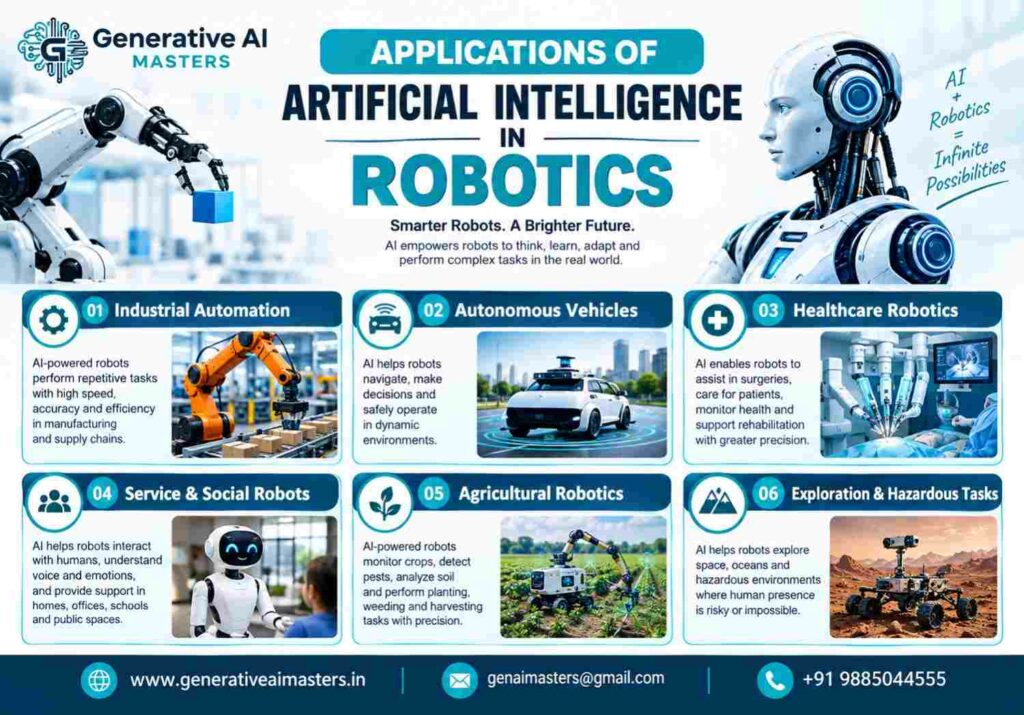
What role does AI play in manufacturing robots? AI allows industrial robots to inspect products visually, detect defects, adjust grip force for delicate parts, and adapt to small variations in components tasks that fixed automation could never handle.
Factories were the first place robots ever worked, and they remain one of the biggest use cases for AI robotics today. Traditional industrial arms repeated the same motion endlessly. AI-enabled arms now use computer vision to inspect parts for defects, machine learning to predict when equipment needs maintenance, and force sensors combined with AI to handle delicate or irregularly shaped items without damaging them.
Companies use this combination often called “smart manufacturing” to reduce waste, cut downtime, and improve consistency across production runs. Platforms like NVIDIA Isaac are built specifically to bring this kind of AI-driven perception and control to industrial robots.
Example: A robotic arm on an electronics assembly line uses a vision model to check solder joints on circuit boards in real time, flagging defects instantly instead of relying on manual inspection.
Healthcare and Medical Robotics
How is AI used in medical robots? AI enhances medical robotics through precision movement control, real-time imaging analysis, and decision support during procedures, helping surgeons operate with greater accuracy and reducing recovery time for patients.
Surgical robots like the da Vinci Surgical System use AI-assisted precision to help surgeons perform minimally invasive procedures with smaller incisions and steadier movements than the human hand alone can achieve.
Beyond surgery, AI-powered robots support:
- Rehabilitation — exoskeletons that adapt resistance based on a patient’s recovery progress
- Hospital logistics — robots that deliver medication and supplies through hallways autonomously
- Diagnostics — robotic systems paired with AI image analysis to detect abnormalities in scans faster
These systems don’t replace doctors. They extend precision and reduce fatigue-related error during long or delicate procedures.
Agricultural Robotics
How does AI improve farming robots? AI enables agricultural robots to identify ripe produce, detect crop disease, estimate yield, and apply pesticides or water precisely where needed, reducing waste and labor while increasing harvest accuracy.
Farming is physically demanding and increasingly short on labor, which makes it a strong fit for AI robotics. Vision-based AI models can distinguish ripe fruit from unripe fruit, spot early signs of plant disease, and guide autonomous tractors across uneven fields without GPS drift causing crop damage.
Example: Autonomous strawberry-picking robots use computer vision to identify ripeness by color and shape before gently harvesting the fruit, a task that used to require careful human judgment.
Space Exploration Robotics
How does NASA use AI in robots like Mars rovers? AI allows rovers such as Perseverance to autonomously navigate Martian terrain, avoid obstacles, and select safe paths in real time, since communication delays with Earth make constant human control impossible.
When a round-trip radio signal to Mars can take over 20 minutes, a rover can’t wait for human instructions to avoid a rock. AI-driven autonomous navigation lets rovers analyze terrain, plan safe routes, and even choose interesting rock samples to study all independently. NASA’s own AI use case inventory documents how deeply this technology is now embedded across its missions.
Humanoid Robots and Social Robotics
What is the purpose of humanoid AI robots? Humanoid robots use natural language processing and machine learning to interact with humans through speech, gestures, and facial expression recognition, supporting roles in customer service, companionship, education, and research into human-robot interaction.
Humanoid and social robots are designed less for raw industrial output and more for interaction. They’re used in customer service kiosks, hotel front desks, elder-care companionship trials, and educational settings relying heavily on natural language processing to hold basic conversations and respond appropriately to tone and context. Companies like Boston Dynamics have been at the forefront of combining mobility engineering with this kind of AI-driven interaction.
Key AI Technologies Powering Robotics
AI Technology | What It Does in Robotics |
Computer Vision | Lets robots identify objects, people, and obstacles |
Machine Learning | Improves robot performance through experience |
Deep Learning | Powers complex pattern recognition (e.g., image, speech) |
Natural Language Processing | Enables robots to understand and respond to human speech |
Reinforcement Learning | Trains robots through trial-and-error reward systems |
SLAM | Helps robots map and navigate unfamiliar environments |
Sensor Fusion | Combines camera, radar, and LiDAR data for accurate perception |
Most of these systems are built on open frameworks like PyTorch and pre-trained models shared through communities like Hugging Face, which let robotics teams avoid training every model completely from scratch.
Benefits of AI in Robotics
- Higher precision — reduced error in surgery, manufacturing, and assembly
- Continuous operation — robots don’t need breaks, enabling 24/7 workflows
- Safety in hazardous environments — bomb disposal, deep-sea, and space tasks stay off human shoulders
- Adaptability — robots handle variation instead of failing outside narrow parameters
- Scalability — warehouse and manufacturing robots coordinate across large fleets efficiently
Challenges and Limitations
AI robotics isn’t without real hurdles:
- High development and maintenance cost — advanced sensors and compute aren’t cheap
- Data dependency — AI models need large, high-quality datasets to perform reliably
- Safety and reliability concerns — errors in perception can have serious real-world consequences
- Ethical and regulatory questions — especially in defense, surveillance, and autonomous vehicles
- Limited generalization — a robot trained for one environment often struggles in a very different one
Future Trends in AI Robotics
- Embodied AI — combining large language models with physical robots for more natural reasoning and interaction
- Humanoid general-purpose robots — companies like Tesla, Boston Dynamics, and Figure are developing robots meant to perform varied tasks rather than one fixed job
- Edge AI in robotics — processing decisions directly on the robot instead of relying on cloud connectivity, improving speed and reliability
- Swarm robotics — multiple robots coordinating collectively, inspired by how ants or bees work together
- Human-robot collaboration (cobots) — robots designed to work directly alongside people rather than in isolated cages
Key Takeaways
- AI transforms robots from rigid, pre-programmed machines into adaptive systems capable of perception and decision-making.
- Major applications span manufacturing, healthcare, transportation, agriculture, defense, space exploration, logistics, and social robotics.
- Core enabling technologies include computer vision, machine learning, deep learning, NLP, reinforcement learning, and SLAM.
- Real-world benefits include higher precision, continuous operation, and improved safety in hazardous environments.
- Challenges remain around cost, data dependency, reliability, and ethical/regulatory concerns.
- The future points toward embodied AI, general-purpose humanoid robots, and closer human-robot collaboration.
Conclusion
AI hasn’t just made robots faster it’s made them capable of handling a world that doesn’t stay the same from one moment to the next. That shift, from fixed automation to adaptive intelligence, is what’s opened the door to robots performing surgery, harvesting crops, navigating Mars, and working safely next to humans on a factory floor.
The applications will keep expanding as perception models get sharper and robots get better at reasoning about the tasks in front of them. Understanding where and how AI is already being used in robotics today is the clearest way to see where the technology is headed next.
This article is contributed by the team at Generative AI Masters, offering hands-on Generative AI Training in Hyderabad for students and working professionals looking to build real-world AI skills.
Frequently Asked Questions
1. What is the main application of AI in robotics
There isn’t a single “main” application AI in robotics spans manufacturing, healthcare, transportation, agriculture, logistics, and more. Its core contribution everywhere is the same: giving robots the ability to perceive their environment and make adaptive decisions instead of following fixed instructions.
2. How is AI different from robotics?
AI is the software layer that enables intelligent decision-making perception, learning, and reasoning. Robotics is the physical engineering discipline that builds machines capable of movement and interaction with the world. AI robotics combines both: intelligent software controlling a physical body.
3. What is the role of AI in industrial robots?
In industrial settings, AI helps robots detect defects visually, adjust grip and movement for varying part shapes, predict maintenance needs before equipment fails, and work safely alongside human employees on the same floor.
4. Can robots learn on their own using AI?
Yes, through reinforcement learning, robots can improve their performance by repeatedly attempting a task and adjusting based on feedback, similar to trial and error. Over many iterations, the robot’s success rate improves without a human manually rewriting its instructions.
5. What is the safest use of AI robots today?
Hazardous-environment robots like bomb disposal units, space rovers, and deep-sea exploration robots are among the safest and most widely accepted uses, since they remove humans from direct physical danger without raising the ethical concerns tied to autonomous decision-making about people.
6. Do AI robots need internet connectivity to function?
Not always. Many robots use “edge AI,” processing data and making decisions locally on the device rather than depending on a live internet connection. This is especially important for robots operating in remote locations, like Mars rovers or underwater vehicles.
7. What industries use AI robotics the most?
Manufacturing, healthcare, logistics, and automotive currently see the heaviest AI robotics adoption, largely because these industries involve repetitive or precision tasks at scale where AI-driven consistency delivers clear, measurable returns.
8. Are humanoid robots powered entirely by AI?
Humanoid robots combine mechanical engineering (joints, balance, movement) with AI systems (vision, language understanding, decision-making). The physical body and the “intelligence” are separate but tightly integrated layers working together.
9. What is SLAM in robotics?
SLAM stands for Simultaneous Localization and Mapping. It’s an AI-driven technique that lets a robot build a map of an unfamiliar space while simultaneously tracking its own position within that map, essential for navigation robots like vacuum cleaners or warehouse bots.
10. Will AI robots replace human workers entirely?
Most current AI robots are designed to handle repetitive, dangerous, or highly precise tasks rather than fully replace human judgment. In practice, many deployments function as collaborative tools (cobots) that work alongside people rather than eliminating roles outright.

Mr. Dinesh Tunguturi Generative AI Trainer
GenAI Masters AI Experts | 60+ Articles Published on Generative AI, Prompt Engineering, LLMs & AI Careers
Mr. Dinesh is a Generative AI Trainer with expertise in Large Language Models (LLMs), Prompt Engineering, Agentic AI, RAG, and AI Automation. He helps students and professionals gain practical, job-ready AI skills through hands-on training, real-world projects, and industry-focused mentorship.