
Generative AI vs Prompt Engineering
Generative AI is the broader technology that creates text, images, code, or audio using models like GPT, Claude, and Gemini. Prompt engineering is a specific skill within that field — the practice of crafting inputs to get accurate, useful outputs from those models. Generative AI is the system; prompt engineering is how you communicate with it effectively.
Table of Contents
Introduction to Generative AI vs Prompt Engineering
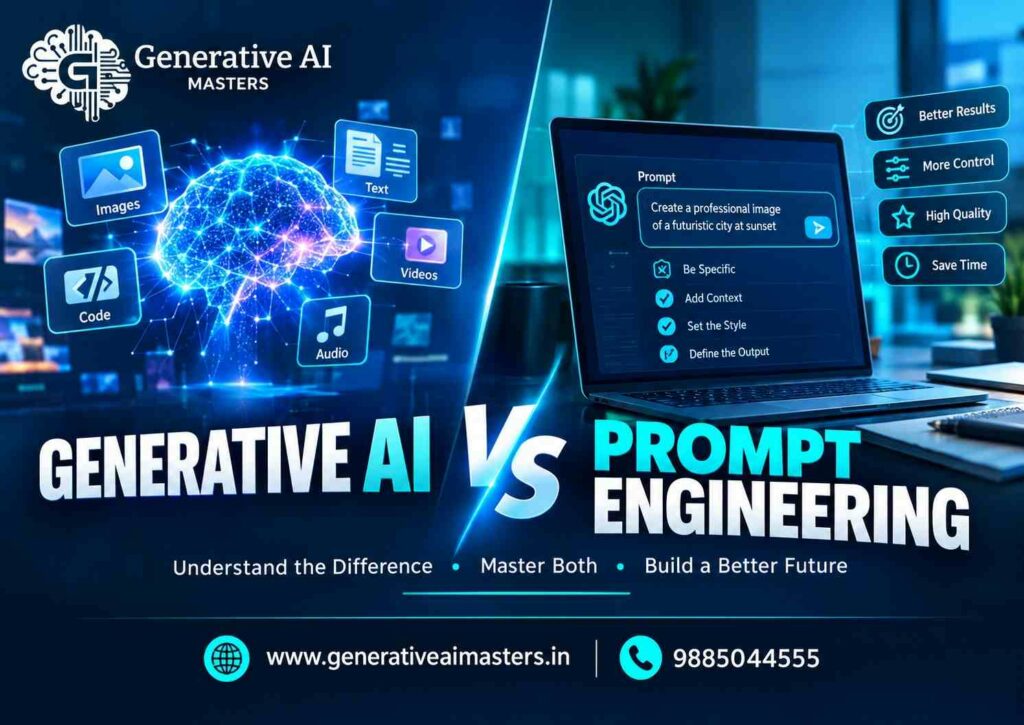
If you’ve started exploring artificial intelligence, you’ve probably run into these two terms everywhere: Generative AI and prompt engineering. They show up in the same articles, the same course listings, and the same job posts — which makes it easy to assume they’re the same thing.
They’re not.
Generative AI is a technology. Prompt engineering is a skill you use to work with that technology. Understanding the difference matters because it changes how you learn, what you build, and where you focus your time first.
This guide breaks down exactly what each term means, how they relate to each other, what skills and tools belong to each, and which one makes sense to learn first depending on your goals — whether you’re a student, a developer, a content creator, or a working professional exploring AI for the first time. If you want the complete step-by-step path once you’ve understood these basics, see this generative AI roadmap.
By the end, you’ll know exactly where generative AI ends and prompt engineering begins, and how the two fit together in a real learning path.
What is Generative AI?
Generative AI refers to artificial intelligence systems that create new content text, images, audio, video, or code rather than simply analyzing or classifying existing data.
Traditional AI models are typically built to predict, sort, or detect patterns. A spam filter, for example, decides whether an email is spam or not. Generative AI works differently. It produces something new based on patterns it learned from massive amounts of training data.
Tools like ChatGPT, Claude, Gemini, and Microsoft Copilot are all generative AI systems. Under the hood, most of them are powered by large language models (LLMs) — neural networks trained on huge volumes of text using an architecture called the transformer, first introduced by Google researchers in their 2017 “Attention Is All You Need” paper. NVIDIA’s own explainer on generative AI is a useful primer if you want the hardware and infrastructure side of the picture too.
Generative AI isn’t limited to text. It also includes:
- Image generation (Midjourney, DALL·E, Stable Diffusion)
- Code generation (GitHub Copilot, Claude Code)
- Audio and voice generation (ElevenLabs, Suno)
- Video generation (Runway, Sora)
At its core, generative AI is the engine. It’s built by organizations like OpenAI, Anthropic, Google DeepMind, and Meta AI, using deep learning, massive datasets, and enormous computing power from hardware providers like NVIDIA.
What is Prompt Engineering?
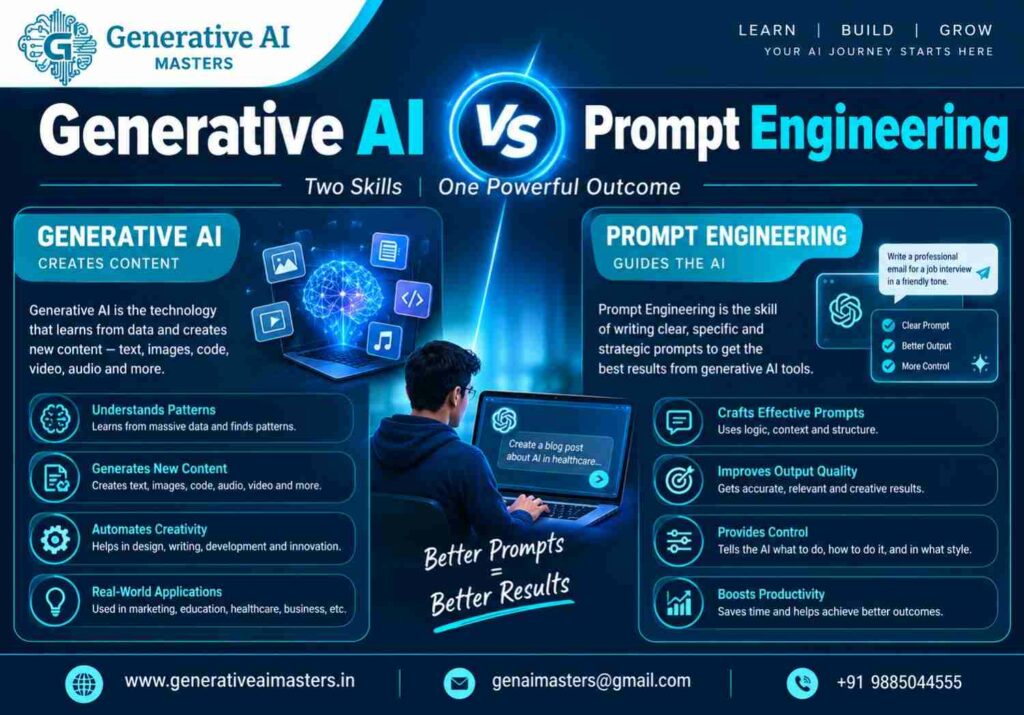
Prompt engineering is the practice of designing inputs called prompts that guide a generative AI model to produce accurate, relevant, and useful output.
Think of a large language model as an extremely capable but very literal assistant. It doesn’t know your intent unless you tell it clearly. Prompt engineering is the discipline of telling it clearly.
A poorly written prompt like “write about marketing” might return something generic and unusable. A well-engineered prompt one that specifies the audience, tone, format, length, and goal will return something far closer to what you actually need. OpenAI’s own prompt engineering guide is a good reference for the core principles, and if you’d rather learn this hands-on with guided projects, this prompt engineering course covers it step by step.
Prompt engineering includes techniques such as:
- Zero-shot prompting — asking the model to complete a task with no examples
- Few-shot prompting — giving the model a few examples to guide its output
- Chain-of-thought prompting — asking the model to reason step-by-step before answering
- Role-based prompting — assigning the model a persona or expertise level
- Function calling / tool calling — structuring prompts so the model can trigger external tools or APIs
Prompt engineering doesn’t require programming knowledge to get started, which is one reason it became popular so quickly. But at an advanced level, it overlaps heavily with software development especially when prompts are embedded inside applications, agents, or automated workflows.
Generative AI vs Prompt Engineering: Key Differences
The easiest way to understand the difference is this: generative AI is the system, prompt engineering is the interface you use to control it.
Aspect | Generative AI | Prompt Engineering |
Definition | A field of AI that generates new content | A skill for communicating effectively with AI models |
Scope | Broad — includes model architecture, training, and deployment | Narrow — focused on crafting effective inputs |
Core Knowledge | Machine learning, deep learning, neural networks, transformers | Language clarity, logic, model behavior, iteration |
Who Uses It | AI engineers, researchers, developers | Anyone — writers, marketers, developers, analysts |
Technical Depth | Can require coding, math, and model training | Requires little to no coding for basic use |
Output | A trained or deployed AI system/application | A well-structured input that improves AI output |
Learning Curve | Steep — months to years for depth | Shallow to start, deep for mastery |
Career Path | AI/ML Engineer, LLM Developer, AI Researcher | Prompt Engineer, AI Content Strategist, AI Product Specialist |
How Generative AI and Prompt Engineering Work Together
These two concepts aren’t competitors they’re layers of the same stack.
Generative AI is the foundation. Companies like OpenAI, Anthropic, and Google DeepMind spend years and enormous resources building and training models. That’s the generative AI layer the model itself.
Prompt engineering sits on top of that foundation. It’s how everyday users, developers, and businesses extract value from these models without needing to train or fine-tune anything. For a deeper look at what happens between your prompt and the model’s response, see how generative AI works.
Here’s a simple analogy: if generative AI is a powerful search engine, prompt engineering is knowing how to search well. Two people can use the same Google search box and get very different results depending on how they phrase their query. The same is true with AI models the model doesn’t change, but the quality of the output changes dramatically based on the prompt.
This is also why prompt engineering becomes even more important as generative AI advances. As models get access to tools, memory, and the ability to take actions (often called agentic AI), prompt engineering evolves too from writing a single instruction to designing multi-step reasoning flows, tool calls, and structured outputs using protocols like MCP (Model Context Protocol).
Core Skills Required for Generative AI
Working seriously with generative AI beyond just using tools typically requires:
- Python programming, since most AI frameworks are Python-based
- Machine learning fundamentals, including supervised and unsupervised learning
- Deep learning and neural networks, including how transformers process language
- Data handling using libraries like NumPy and Pandas
- Framework experience with PyTorch or TensorFlow
- Understanding of LLMs, tokenization, and embeddings
- API integration, using platforms like the OpenAI API, Anthropic API, or Google AI Studio
- Retrieval-Augmented Generation (RAG) and vector databases like Pinecone, Chroma, FAISS, or Weaviate for building knowledge-aware applications
This path leans toward developers, engineers, and technically inclined learners who want to build AI-powered products, not just use existing chat tools. For a fuller breakdown of what employers actually look for, see skills required for an AI engineer.
Core Skills Required for Prompt Engineering
Prompt engineering has a much lower barrier to entry, but real mastery still takes deliberate practice. Core skills include:
- Clear, structured writing — being specific about goals, format, and constraints
- Understanding model behavior — knowing how Claude, ChatGPT, or Gemini interpret instructions differently
- Prompt patterns — zero-shot, few-shot, and chain-of-thought techniques
- Iteration and testing — refining prompts based on output quality
- Context management — structuring long conversations or documents so the model doesn’t lose track
- Basic tool and function calling concepts — for anyone building AI-powered workflows or agents
- Evaluation — being able to judge whether an output is actually correct, not just fluent
Anyone can start learning prompt engineering today with free access to tools like ChatGPT, Claude, or Gemini — no coding background needed to begin. Anthropic’s prompt engineering documentation is a solid reference once you want to go beyond the basics with Claude specifically.
Tools Used in Generative AI
Generative AI development typically involves a broader technical toolkit:
- Model providers: OpenAI, Anthropic, Google DeepMind, Meta AI
- Frameworks: PyTorch, TensorFlow, Hugging Face
- Application frameworks: LangChain, LangGraph, LlamaIndex
- Vector databases: Pinecone, Chroma, FAISS, Weaviate
- Hardware/infrastructure: NVIDIA GPUs for training and inference
- Version control and collaboration: GitHub
For a hands-on reference to these frameworks and models, Hugging Face’s documentation is one of the most widely used resources in the field. If you’d rather see the full toolkit compared side by side, this breakdown of generative AI tools covers each one in more depth.
Tools Used in Prompt Engineering
Prompt engineering, in contrast, mostly requires access to the models themselves and a few supporting tools:
- Chat interfaces: ChatGPT, Claude, Gemini, Microsoft Copilot
- Developer consoles: OpenAI Playground, Google AI Studio, Anthropic Console
- Prompt testing and versioning tools for comparing prompt performance
- Basic API access for anyone building prompts into an application
Which Should You Learn First: Generative AI or Prompt Engineering?
This depends entirely on your goal.
Start with prompt engineering if:
- You want quick, practical results
- You’re a writer, marketer, student, analyst, or business user
- You want to use AI tools more effectively in your current role
- You don’t have (or don’t yet want) a programming background
Start with generative AI fundamentals if:
- You want to build AI applications, not just use them
- You’re a developer or engineer aiming for an AI/ML career
- You want to understand how models actually work
- You eventually want to fine-tune models or build agentic systems
The most practical path for most learners: start with prompt engineering to get comfortable and productive with AI tools immediately, then gradually build generative AI fundamentals (Python, machine learning, LLM architecture) if you want to go deeper into building rather than just using. Once you’re ready to apply both, these generative AI projects for beginners are a good place to start practicing.
Learning Path | Generative AI Focus | Prompt Engineering Focus | Expected Outcome |
Beginner | Learn what AI/ML/LLMs are conceptually | Learn basic prompting techniques | Comfortable using AI tools effectively |
Intermediate | Learn Python, APIs, embeddings | Learn few-shot and chain-of-thought prompting | Able to build simple AI-powered scripts |
Advanced | Learn RAG, vector databases, agents | Learn multi-step prompt chains and tool calling | Able to build AI applications and workflows |
Expert | Fine-tuning, model evaluation, AI safety | Prompt optimization at scale, evaluation frameworks | Able to design and ship production AI systems |
Career and Learning Paths Compared
Generative AI Roadmap | Prompt Engineering Roadmap |
Learn AI/ML fundamentals | Learn how LLMs interpret instructions |
Learn Python and data handling | Practice zero-shot and few-shot prompting |
Study deep learning and transformers | Learn chain-of-thought prompting |
Learn LLM architecture and embeddings | Learn prompt structuring for specific formats |
Build with APIs (OpenAI, Anthropic, Google) | Learn function calling and tool integration |
Learn LangChain, RAG, and vector databases | Learn to design multi-step agent prompts |
Explore fine-tuning (LoRA, QLoRA) | Learn prompt evaluation and A/B testing |
Build and deploy AI applications | Build reusable prompt libraries and templates |
Common Misconceptions
“Prompt engineering is just typing questions into ChatGPT.” Basic usage isn’t the same as engineering. Real prompt engineering involves structure, testing, and consistency — especially when prompts are used inside applications or automated workflows.
“You need to know generative AI deeply to be a good prompt engineer.” Not true for most use cases. You need to understand how the specific model behaves, not how it was trained internally.
“Generative AI and prompt engineering are separate careers with no overlap.” In practice, most AI-related roles today require at least basic prompt engineering skills, even if the job title is “AI Engineer” or “ML Developer.”
“Prompt engineering will become obsolete as models improve.” As models get smarter, prompting shifts rather than disappears — from single instructions toward structuring context, tools, and multi-step reasoning for AI agents.
Latest Trends in Generative AI and Prompt Engineering
Generative AI and prompt engineering are both evolving quickly, and the two fields are converging in several ways:
- Agentic AI is growing fast models that don’t just respond, but take multi-step actions using tools, memory, and planning.
- MCP (Model Context Protocol) is emerging as a standard way for AI models to connect with external tools and data sources, changing how prompts and system instructions are structured.
- Multimodal generative AI models that handle text, images, audio, and video together is becoming the norm rather than the exception.
- Prompt engineering is shifting toward “context engineering” designing not just a single instruction, but the entire information environment (documents, memory, tools) a model has access to.
- Evaluation and guardrails are becoming core skills, as both fields mature from experimentation toward production-grade, safety-conscious deployment.
Key Takeaways
- Generative AI is the broader technology that creates content; prompt engineering is the skill used to guide it effectively.
- Generative AI requires deeper technical knowledge Python, machine learning, and model architecture.
- Prompt engineering has a low barrier to entry and can be learned by anyone, regardless of technical background.
- The two skills complement each other understanding generative AI makes prompt engineering more effective, and vice versa.
- Beginners should generally start with prompt engineering for quick, practical wins, then build generative AI fundamentals if they want to develop applications.
- Both fields are evolving together, especially with the rise of agentic AI, context engineering, and tool-using models.
Conclusion
Generative AI and prompt engineering aren’t rival skills they’re two layers of the same evolving field. Generative AI is the engine that makes AI-generated content possible. Prompt engineering is the steering wheel that determines how well you can direct that engine toward useful, accurate results.
If you’re just starting out, learn to prompt well first it’s fast, practical, and immediately useful in almost any role. As you grow more comfortable, start layering in generative AI fundamentals: Python, machine learning basics, and how large language models actually work. That combination knowing both how the system works and how to communicate with it is what separates casual AI users from people who can genuinely build, optimize, and lead with generative AI.
The best way to learn either skill is the same: practice consistently, test your assumptions, and keep building with real tools and real projects.
Frequently Asked Questions
1. Is prompt engineering part of generative AI?
Yes. Prompt engineering is a subset skill within the broader generative AI field. Generative AI covers how models are built and how they generate content, while prompt engineering focuses specifically on how to communicate with those models effectively to get better results.
2. Do I need to learn coding for prompt engineering?
No, not for basic prompt engineering. You can start writing effective prompts using tools like ChatGPT or Claude with zero programming knowledge. However, coding becomes useful once you want to integrate prompts into applications, automate workflows, or use APIs directly.
3. Is prompt engineering a real career?
Yes, though the role is evolving. Many companies now expect prompt engineering skills as part of broader roles like AI product specialist, AI content strategist, or AI-integrated developer, rather than as a completely standalone job title.
4. Which pays more, generative AI or prompt engineering roles?
Generative AI and machine learning engineering roles generally require deeper technical skills, including Python, model training, and system design, which typically leads to higher compensation than prompt-engineering-only roles. Combining both skill sets tends to be the most valuable overall.
5. Can I learn prompt engineering without learning generative AI first?
Yes. Prompt engineering can be learned independently by practicing directly with AI tools. However, understanding basic generative AI concepts — like how LLMs process context — helps you write significantly more effective prompts.
6. What is the difference between prompt engineering and context engineering?
Prompt engineering focuses on crafting a single, well-structured instruction. Context engineering is a broader practice that involves managing everything the model sees — documents, memory, prior conversation, and tool access — to produce reliable results, especially in AI agents.
7. Do generative AI models like ChatGPT and Claude respond differently to the same prompt?
Yes. Different models are trained differently and have different strengths, so identical prompts can produce noticeably different outputs across ChatGPT, Claude, Gemini, and Copilot. Effective prompt engineers adjust their approach per model.
8. Is prompt engineering still relevant with more advanced AI models?
Yes. As models improve, prompting becomes more sophisticated rather than unnecessary — shifting toward structuring context, chaining reasoning steps, and coordinating tools within AI agents.
9.What’s a simple way to start learning prompt engineering today?
Start by writing specific, detailed prompts for real tasks you already do — emails, summaries, code, research — and compare results against vague prompts. Study techniques like few-shot and chain-of-thought prompting, and practice consistently with one model before comparing across others.
10. Should beginners learn generative AI or prompt engineering first?
Most beginners benefit from starting with prompt engineering because it requires no technical background and delivers immediate, practical results. Generative AI fundamentals can be layered afterward for those who want to build applications rather than just use existing tools.

Mr. Dinesh Tunguturi Generative AI Trainer
GenAI Masters AI Experts | 60+ Articles Published on Generative AI, Prompt Engineering, LLMs & AI Careers
Mr. Dinesh is a Generative AI Trainer with expertise in Large Language Models (LLMs), Prompt Engineering, Agentic AI, RAG, and AI Automation. He helps students and professionals gain practical, job-ready AI skills through hands-on training, real-world projects, and industry-focused mentorship.