
How Generative AI Works
Generative AI works by learning patterns from massive datasets using advanced AI models like Large Language Models (LLMs). When you enter a prompt, it understands the context, predicts the most relevant output, and generates new content such as text, images, code, audio, or videos instead of simply retrieving existing information.
Table of Contents
How Generative AI Works
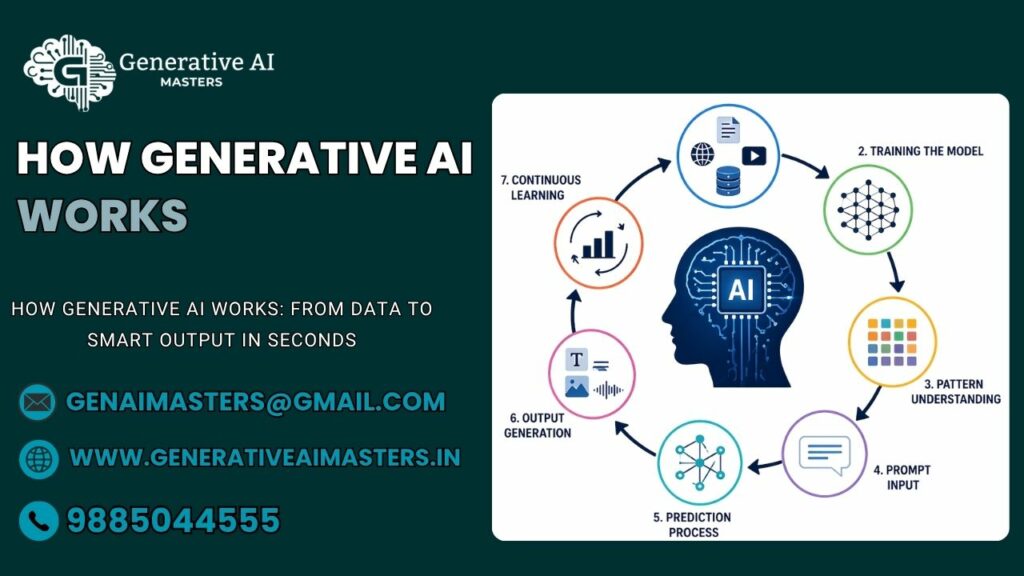
How Generative AI Works — In this blog, you will understand step-by-step how Generative AI works in a simple way. Generative AI learns from large amounts of data like text, images, and code, identifies patterns, and then creates new content based on the prompt you give. It works like a smart assistant that has studied many examples and predicts the best possible answer for your question. It does not think like a human but uses probability to decide what comes next—whether it is writing a sentence, generating an image, or creating audio. In 2026, this technology is widely used in content creation, coding, design, and automation, helping people save time and work faster. So, whenever you type something into an AI tool, it analyzes your input and generates a relevant, human-like response based on learned patterns.
What is Generative AI?
Before understanding how Generative AI Works, you need a clear idea of What is Generative AI . In simple terms, it is a type of AI system that creates new content like text, images, audio, and video using learned data patterns. It does not think like a human but studies examples and predicts the best possible output, working like a smart creator.
How Generative AI Works
Before understanding deeply, let’s break down How Generative AI Works into simple steps so you can easily follow. Think of this like someone explaining the process in a clear, practical way.
Step | What Happens | Simple Explanation | Example |
|---|---|---|---|
1. Data Collection | AI collects large data | Imagine a student reading lakhs of books, websites, and images to learn everything | AI learns from blogs, YouTube captions, code, etc. |
2. Training the Model | AI learns patterns | It doesn’t memorize, it understands how words, sentences, and visuals are connected | Like learning grammar instead of memorizing answers |
3. Pattern Understanding | AI finds relationships | It observes “if this comes, what usually comes next” | Example: “How are…” → “you” |
4. Prompt Input | User gives input | You ask something (this is called a prompt) | “Write a blog intro about AI” |
5. Prediction Process | AI predicts best output | It calculates the most probable next words based on training | Like auto-suggestion but much smarter |
6. Output Generation | AI gives answer | It generates human-like content instantly | Blog, image, code, voice |
7. Continuous Learning | AI improves over time | With updates and feedback, it becomes more accurate | New versions of AI tools |
So, in simple words, Generative AI works like a smart assistant that learns, predicts, and creates. Once you understand this flow, using AI tools becomes much easier and more effective
Generative AI Training in Hyderabad
Learn LLMs, RAG, fine-tuning and AI agents with live classes, 15+ projects and placement support.
Next batch: 5 Oct 2026 · morning 10 AM & evening 7 PM IST
How Generative AI Works – Step-by-Step Explanation
When you first hear about AI, it may feel complicated. But if you look closely, it works in a simple flow—just like how a human learns, understands, and answers..
Step 1: Data Collection – AI Learns by Reading Everything
AI starts from zero. It doesn’t have knowledge like humans. So first, it collects a huge amount of data.
This data includes:
- Blog articles
- Books
- Websites
- Images and videos
- Code and technical content
Think of it like a student who wants to become an expert. That student reads lakhs of books, watches videos, and explores different topics.
AI does the same—but at a very large scale and much faster.
It learns from sources like websites, YouTube captions, and online datasets.
But one key thing matters here: data quality.
If AI learns from:
- Good, clear, and correct data → Output will be accurate
- Poor or confusing data → Output quality reduces
Simple idea: AI becomes as good as what it learns from
Step 2: Training the Model – AI Learns the System
After collecting data, AI goes into training.
Here, it starts understanding how language and content actually work.
Important point:
AI does NOT memorize like students before exams.
Instead, it learns:
- How sentences are structured
- How words connect with each other
- How meaning changes based on context
This is similar to learning grammar in school.
You didn’t remember every sentence—you learned rules, so you can create new sentences anytime.
AI also learns patterns in:
- Writing styles
- Tone (formal, casual, technical)
- Different types of content (blogs, code, conversations)
So AI is not copying—it is learning how to create
Step 3: Pattern Understanding – AI Connects the Dots
Now AI becomes smarter.
It starts identifying patterns and relationships in data.
It observes:
- What words usually come together
- What comes next in a sentence
- How people respond to certain questions
For example:
If the sentence starts with “How are…”, AI already predicts “you”.
But this is not just basic prediction. It understands:
- Story flow
- Logical sequences
- Problem-solving patterns
- Writing tone
It’s like your brain auto-completing sentences because you’ve heard them many times.
AI builds strong connections between words, ideas, and context
Step 4: Prompt Input – You Guide the AI
Now AI is ready to respond—but it needs direction.
That’s where you come in.
When you type something like:
“Write a blog intro about AI”
That input is called a prompt.
Think of it like asking a question to an expert.
- If your question is clear → Answer will be clear
- If your question is confusing → Output may also be general
For example:
- “Write about AI” → Very broad
- “Write a beginner-friendly AI blog intro” → Much better
So, your input controls the quality of output
Step 5: Prediction Process – The Core Working
This is the main engine of AI.
AI does not “think” or “understand” like humans.
It works by predicting the next best word.
Based on training, it calculates:
“What word is most likely to come next in this sentence?”
Example:
“AI is transforming the…”
Possible outputs: world / industry / future
It picks the most suitable one based on context.
This prediction happens:
- Word by word
- Very fast
- Until a full answer is formed
It’s like auto-suggestion on your phone—but much more advanced and accurate.
AI builds responses step by step using probability
Step 6: Output Generation – Final Answer
Large Language Models are the heart of modern Generative AI, and this module is often where learners get genuinely excited.
An LLM is a deep learning model trained on enormous amounts of text so it can predict and generate human-like language. The syllabus explains exactly how that works without drowning you in maths.
Key topics:
- Tokenization — how text is broken into pieces a model can process.
- Embeddings — turning words and meaning into numbers.
- The attention mechanism and how transformers use it.
- Context windows — how much text a model can “see” at once.
- Model families: the GPT series behind ChatGPT, Anthropic’s Claude, Google’s Gemini, and open models like Llama, Mistral, and Qwen.
- Capabilities and limits: reasoning, hallucination, and why prompts matter so much.
You’ll also explore multimodal models, which now handle text, images, audio, and video together — a baseline expectation in 2026 rather than a premium feature. The outcome: you can explain how an LLM generates a response and what influences its quality.
Step 7: Continuous Learning – AI Improves Over Time
AI is not fixed. It keeps improving.
With:
- New data
- Better training
- User feedback
New versions become:
- More accurate
- Better at understanding prompts
- More natural in responses
For example, newer AI models:
- Follow instructions better
- Make fewer mistakes
- Understand context more clearly
This is similar to how a human improves with practice and feedback.
AI evolves step by step over time
Examples of How Generative AI Works
1. Chatbots Generating Human-Like Answers
Tools like ChatGPT or Google Gemini can understand your questions and reply in a natural way.
They do not think like humans, but they generate responses based on patterns learned during training.
Example:
You ask: “Explain AI in simple words”
AI gives a clear and easy explanation
This feels like having a conversation with a real person.
AI Writing Blog Posts or Emails
AI tools such as Jasper AI and Copy.ai help create
AI generates structured content with proper flow and readability.
This helps save time and makes content creation easier.
Image Generators Creating Artwork from Text
Tools like DALL·E and Midjourney can create images from text descriptions.
Example:
“A futuristic city at night with neon lights”
AI generates a completely new image based on this input.
This allows users to turn ideas into visuals without design skills.
Code Generation Tools Assisting Developers
Tools such as GitHub Copilot support developers by generating code.
You can type a simple instruction, and the AI suggests:
- Code snippets
- Functions
- Fixes
Example:
“Create a login page in HTML”
AI generates the required code.
This speeds up development and helps beginners learn faster.
Voice AI Generating Speech from Text
Tools like Amazon Polly and Google Text-to-Speech convert written text into spoken audio.
Example:
Input: “Welcome to our website”
Output: A natural-sounding human voice
This is widely used in videos, apps, and virtual assistants
Module 12: Real-World Generative AI Projects
Theory fades; projects stick. The final module of any strong Generative AI training syllabus is where you build things that prove your skills.
Projects pull together everything from the earlier modules. Typical builds include:
- A custom chatbot for a specific business or topic.
- A RAG-based document assistant that answers questions from uploaded PDFs.
- An AI agent that performs multi-step tasks using tools.
- A content generation tool for marketing, summaries, or reports.
- A multimodal application that handles text and images together.
These projects do double duty. They cement your understanding, and they become a portfolio you can show during interviews or to clients. The outcome of this module — and the syllabus as a whole — is a set of working applications that demonstrate real, job-ready Generative AI ability.
Conclusion
Generative AI follows a simple flow. It collects large data, learns patterns during training, understands how words and ideas connect, and then predicts the best possible response when you give a prompt. Finally, it generates output and keeps improving over time with updates.Today, Generative AI is a key part of modern technology. It is used in writing, coding, design, automation, and many industries. It helps save time, increase productivity, and make complex work easier.At the same time, it is not perfect. AI can make mistakes and does not truly understand like humans. That is why human review is important. The best results come when humans guide AI properly.If you want to grow in this field, focus on learning and using AI in real situations. Practice regularly and understand how to use tools effectively. Follow Generative AI Masters to learn practical skills, real use cases, and step-by-step guidance to build your expertise in Generative AI.
FAQ’s Skills Required for an AI Engineer (2026)
Generative AI is a type of AI that creates new content like text, images, code, or audio based on learned data. It generates new output instead of copying.
It learns patterns from large data and predicts the next best word or element based on your input, building content step by step.
It is trained on books, websites, articles, images, videos, and code. Better data leads to better results.
A prompt is the instruction you give to AI.
Example: “Write a blog intro about AI”
AI models learn patterns in language, like how words connect. They do not truly understand meaning but recognize patterns.
Neural networks help AI process data and learn patterns, similar to how the human brain works.
Transformer architecture helps AI understand full context instead of one word at a time, improving response quality.
Large language models are advanced AI systems trained on massive text data to generate human-like responses.
No. AI does not think or have awareness. It only predicts based on patterns.
It can be accurate but may also give incorrect answers sometimes. Human review is important.
Examples include ChatGPT, DALL·E, Midjourney, and GitHub Copilot.
AI learns from images and descriptions, then creates new visuals based on text prompts.
Yes, if used responsibly. But users should be careful about misuse and false information.
It may give wrong answers, depends on data quality, lacks true understanding, and raises ethical concerns.
It will become more accurate, more useful, and more widely used across industries.

Mr. Dinesh Tunguturi Generative AI Trainer
GenAI Masters AI Experts | 60+ Articles Published on Generative AI, Prompt Engineering, LLMs & AI Careers
Mr. Dinesh is a Generative AI Trainer with expertise in Large Language Models (LLMs), Prompt Engineering, Agentic AI, RAG, and AI Automation. He helps students and professionals gain practical, job-ready AI skills through hands-on training, real-world projects, and industry-focused mentorship.
Turn this knowledge into a career: Generative AI Training in Hyderabad
Learn LLMs, RAG, fine-tuning and AI agents with live classes, 15+ projects and placement support.
₹35,000 online · ₹40,000 classroom · 60+ live hours · 3 months · ★ 4.9 from 51 Google reviews